







Question: c. (6 marks) Consider an arbitrary weighted directed graph G = (V, E) with weights er : E ? R {that is, the weights are
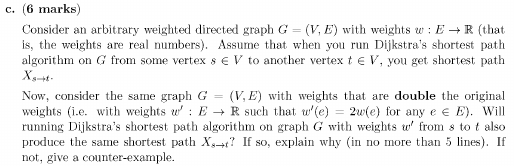
c. (6 marks) Consider an arbitrary weighted directed graph G = (V, E) with weights er : E ? R {that is, the weights are real numbers). Assume that when you run Dijkstra's shortest path algorithm on G from some vertex s EV to another vertex t e V, you get shortest path Now, consider the same graph G (VE with weights that are double the original weights (i.e. with weights ER such that (e 2(e) for any e e E. Will running Dijkstra's shortest path algorithm on graph G with weights from s to t also produce the same shortest path Xs-r? If so, explain why (in no more than 5 lines). If not, give a counter-example
Step by Step Solution
There are 3 Steps involved in it
1 Expert Approved Answer
Step: 1 Unlock

Question Has Been Solved by an Expert!
Get step-by-step solutions from verified subject matter experts
Step: 2 Unlock
Step: 3 Unlock
 Study Help