







Question: C A R E S Peer Review Feedback C Congratulate What does the writer do well in this assignment? (List one or more aspects.) Also,
C A R E S Peer Review Feedback
C
Congratulate
What does the writer do well in this assignment? (List one or more aspects.) Also, please write the writer's main
claim or focus (thesis) according to what you have read. (It may not be the last sentence of the first paragraph -
the traditional place for the thesis.)
A
Ask clarifying questions
What part(s) of the essay were a bit confusing? Why?
What specific suggestions (3 or fewer) do you have for revising the unclear parts of this writing?
R
Request more
What would you like to know more about the topic that can enhance the essay and that supports the thesis?
E
Evaluate its value
What specific detail(s) do not work with the essay (e.g. doesn't support the thesis) or can be moved within the essay?
S
Summarize
Overall, what new information have you learned or how are you thinking differently after this reading?
Better Transit, Cleaner Lungs: A Transportation Focus on Improving Air Quality
"A breath of fresh air" is a common expression, and while these words can be used figuratively and literally, not everyone can get it. According to WHO estimates in 2019, approximately 6.7 million premature deaths can be attributed to poor air quality, with an astonishing 4.2 million of these deaths caused by ambient (outside) air pollution (WHO, 2022). This statistic is often overlooked in regions such as North America and Europe, where air quality is overall decent and only periodically bad, however short-term exposure to air pollution can have an impact on one's health. These health effects only get worse and lead to more chronic conditions as prolonged exposure occurs. DALY, a measurement of lifespan in the number of years lived with a disability combined with the years lost due to premature death, places South Asian and Sub-Saharan countries at the highest affected rates of air pollution-related DALY, with South Asia contributing the most quantitatively. Unfortunately, the most impacted regions are those "in developing countries, which accounted for 91% of the global premature deaths attributable to ambient air pollution." (Ouyang et al., 2022). Air pollution is not a singular substance, with specifics such as carbon monoxide (CO), nitrogen oxides (NOx, x referring to the number of oxygen atoms in the molecule), sulfur dioxide (SO2), and surface ozone (O3, ozone which is present in the air we breathe) commonly recorded. Besides these specific gases, inhalable particulate matter is also recorded, commonly grouped into matter with a diameter of 10 microns or less (PM10) or 2.5 microns or less (PM2.5). With multiple components, and multiple sources contributing to poor air quality, there is no one-fits-all solution to solving this issue. Because of this, engineers, bureaucrats, and health professionals tackling this issue must take into consideration the financial burden of the solutions proposed.
While many global issues cannot gain useful data until attempting a solution, the COVID-19 pandemic provided valuable insight into the magnitude of impact that a person's everyday actions have on their local environment. During periods of lockdown where transport was significantly reduced, reductions in many forms of pollutants were found. In a study on COVID-19's impact on air quality in India, it was found that across 22 Indian cities, there were "around 32, 31, 10 and 18% decreases in PM2.5, PM10, CO, and NO2" (Sharma et al.) during periods of lockdown, which has a direct correlation to the reduced traffic done during this period. This is not a unique statistic to India however, with many cities globally experiencing similar results. In Singapore for example, it was found that a decrease of 23, 19, 54, 29, and 6% for PM2.5, PM10, CO, NO2, and SO2, respectively, in the April-May 2020 lockdown period in relation to the same months in recent years prior.
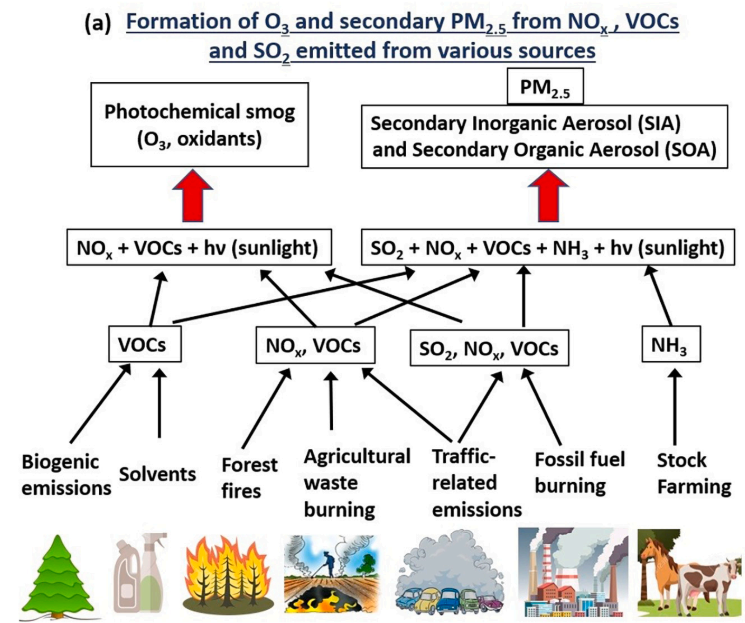
When looking at increases in COVID-era statistics, an increase in O3(ozone) was found "which could be due to the decrease in PM in addition to decrease in NOx." (Sharma et al., 2020) Sharma et al. (2020) also conclude that while the reduction in other pollutants trumps the increase in ozone, an increase signifies that additional attention is needed to what may cause an increase in ozone. Contributing processes towards the formation of ozone (as well as secondary particulate matter) can be visualized in Figure 1.
Step by Step Solution
There are 3 Steps involved in it

Get step-by-step solutions from verified subject matter experts
 Study Help