







Question: C. Anti-reflection coatings So far you have explored constructive interference from multi-layer thin films. It is also possible for interference to be destructive, a phenomenon
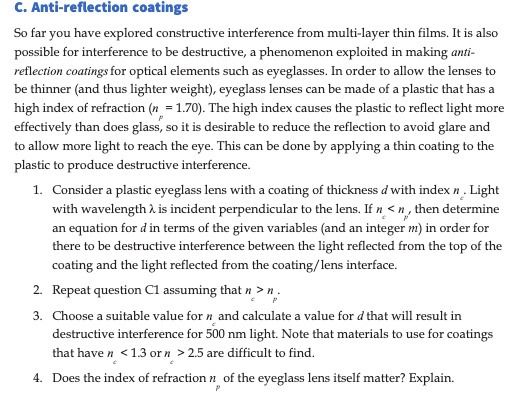
C. Anti-reflection coatings So far you have explored constructive interference from multi-layer thin films. It is also possible for interference to be destructive, a phenomenon exploited in making anti- reflection coatings for optical elements such as eyeglasses. In order to allow the lenses to be thinner (and thus lighter weight), eyeglass lenses can be made of a plastic that has a high index of refraction ( = 1.70). The high index causes the plastic to reflect light more effectively than does glass, so it is desirable to reduce the reflection to avoid glare and to allow more light to reach the eye. This can be done by applying a thin coating to the plastic to produce destructive interference. 1. Consider a plastic eyeglass lens with a coating of thickness d with index n . Light with wavelength ) is incident perpendicular to the lens. If n n . 3. Choose a suitable value for a and calculate a value for d that will result in destructive interference for 500 nm light. Note that materials to use for coatings that have n 2.5 are difficult to find. 4. Does the index of refraction n of the eyeglass lens itself matter? Explain
Step by Step Solution
There are 3 Steps involved in it

Get step-by-step solutions from verified subject matter experts
 Study Help