







Question: C++ Balanced Binary Search Tree. Please fix my code!! Hello there, I made a program for binary search tree register machine in C++. When I
C++ Balanced Binary Search Tree. Please fix my code!!
Hello there, I made a program for binary search tree register machine in C++.
When I run my program, my commands (create,insert,remove,merge, etc..) do not work. It actually gives me segmentation fault whenever I type commands.
My instructor told me that my tree implementation doesn't do any of the rebalancing/rotations needed after an insert or delete to preserve the AVL height-balance property.
So I guess that is the only thing wrong with my program.
I'm attaching the original prompt for the program so you can understand what I was actually trying to do.
I am pretty sure that I have completed part 1 so far.
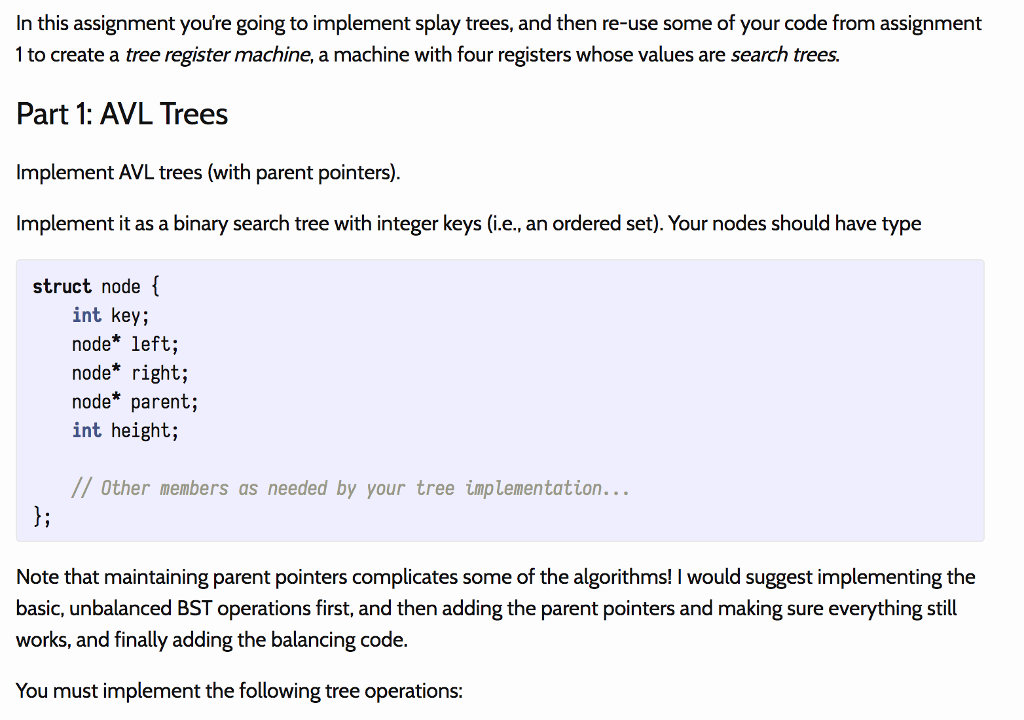
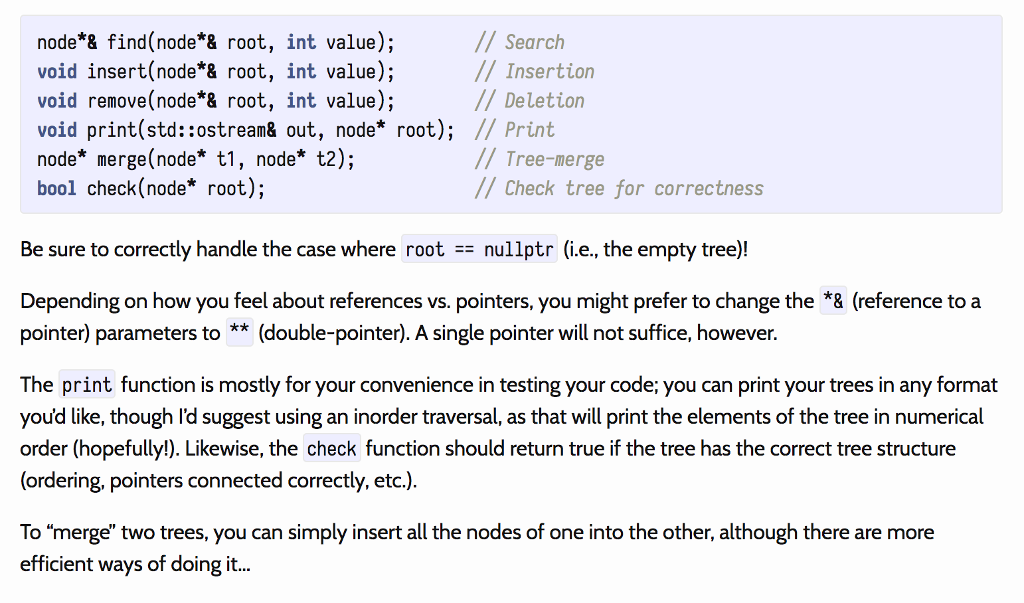
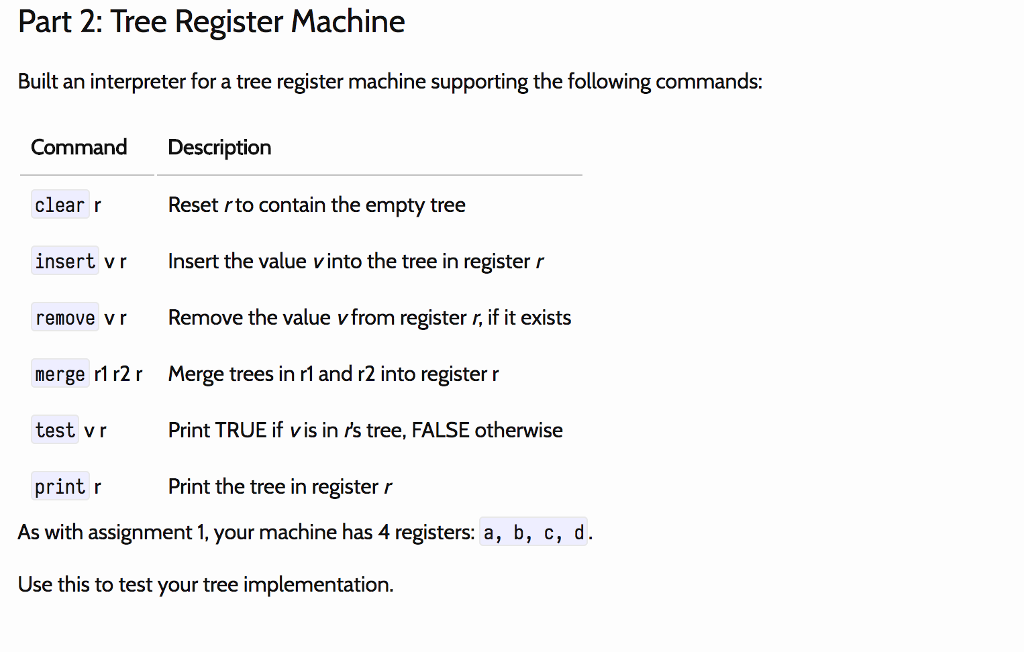
And below is my code:
#include
#include
#include
#include
#include
#include
#include
#include
using std::string;
struct node {
int key;
node* right;
node* left;
node* parent;
int height;
};
node*& find(node*& root, int key){
if(root == nullptr)
return root;
else if(root->key == key)
return root;
else if(key > root->key)
return find(root->right, key);
else
return find(root->left, key);
}
void insert(node*& root, int key){
node* n = find(root, key);
if(n == nullptr)
n = new node {key, nullptr, nullptr, nullptr, 1};
}
node*& largest(node*& root){
if(!root)
return root;
else if(!root->right)
return root;
else
return largest(root->right);
}
node*& pred(node*& target, int key){
if(target->left)
return largest(target -> left);
else
return largest(target -> right);
}
void remove(node*& root, int key){
node* n = find(root, key);
if(n){
if(!n -> left && !n -> right){
delete n;
n = nullptr;
}
if(!n -> right){
node* t = n -> left;
delete n;
n = t;
}
else if(!n -> left){
node* t = n -> right;
delete n;
n = t;
}
else{
node* k = pred(root, key);
std::swap(n -> key, k -> key);
remove(k, key);
}
}
}
//Instead of using void print function, I chose to use this one below.
void inorder(node* root, std::function
if(!root)
return;
if(root->left)
inorder(root->left, visit);
visit(root);
if(root->right)
inorder(root->right, visit);
}
void spine(node* p, node*& prev, node*& head){
if(!p)
return;
spine(p->left, prev, head);
if(prev) prev->right = p;
else head = p;
prev = p;
p -> left = 0;
spine(p->right, prev, head);
}
void advance(node*& last, node*& n){
last->right = n;
last = n;
n = n-> right;
}
node* mergespines(node* n1, node* n2){
node head;
node* last = &head;
while(n1 || n2){
if(!n1)
advance(last, n2);
else if(!n2)
advance(last, n1);
else if(n1->right right)
advance(last, n1);
else if(n1->right > n2->right)
advance(last, n2);
else{
advance(last, n1);
n2 = n2 ->right;
}
}
return head.right;
}
node* balance2(node*& list, int start, int end){
if(start > end)
return nullptr;
int mid = start + (end - start) / 2;
node *leftchild = balance2(list, start, mid-1);
node *parent = list;
parent-> left = leftchild;
list = list->right;
parent->right = balance2(list, mid+1, end);
return parent;
}
node* balance(node *head){
int size = 0;
for(node* n = head; n; n = n ->right)
size++;
return balance2(head, 0, size-1);
}
node* merge(node* t1, node* t2){
node *prev, *head1, *head2;
prev = head1 = 0;
spine(t1, prev, head1);
prev = head2 = 0;
spine(t2, prev, head2);
return balance(mergespines(head1, head2));
}
bool check(node* root){
if(root == nullptr)
return false;
node* n = root;
if(n->right
return false;
else if(n->left > root)
return false;
else if(n->left > n->right)
return false;
return true;
int main() {
using std::cout;
using std::cin;
using std::stringstream;
string input, c;
string command;
string y, z;
string reg[1];
int values[1];
string mergetrees[2];
cout
while(true){
cout ";
std::getline(cin, input);
std::istringstream split_string(input);
split_string >> command;
node* r;
if(command.compare("clear") == 0){
split_string >> reg[0];
delete[] reg;
}
else if(command.compare("insert") == 0){
split_string >> values[0] >> reg[0];
c = reg[0];
node* c;
insert(c, values[0]);
}
else if(command.compare("remove") == 0){
split_string >> values[0] >> reg[0];
c = reg[0];
node* c;
remove(c, values[0]);
}
else if(command.compare("merge") == 0){
split_string >> mergetrees[0] >>mergetrees[1];
y = mergetrees[0];
z = mergetrees[1];
node* y;
node* z;
merge(y,z);
}
else if(command.compare("test") == 0){
split_string >> values[0] >> reg[0];
int testvalue = values[0];
c = reg[0];
node* c;
if(find(c, testvalue))
cout
else
cout
}
else if(command.compare("print") == 0){
split_string >> reg[0];
c = reg[0];
node* c;
//inorder print
inorder(c, [](node*& n) { cout key
}
else
cout
}
}
------------------------------------------------
I've been getting trolled in the Q&A section for more than five times.
If you don't think you can fix this code to actually run properly, please skip my question.
I'm really desparate on expert-level help on this.
Thank you in advance!!
In this assignment you're going to implement splay trees, and then re-use some of your code from assignment 1 to create a tree register machine, a machine with four registers whose values are search trees. Part 1: AVL Trees Implement AVL trees (with parent pointers) Implement it as a binary search tree with integer keys (i.e., an ordered set). Your nodes should have type struct node int key; node* left. node right node parent; int height; Other members as needed by your tree implementation. Note that maintaining parent pointers complicates some of the algorithms I would suggest implementing the basic, unbalanced BST operations first, and then adding the parent pointers and making sure everything still works, and finally adding the balancing code You must implement the following tree operations
Step by Step Solution
There are 3 Steps involved in it

Get step-by-step solutions from verified subject matter experts
 Study Help