







Question: (c) Based on what we know about Observation B, if the cutoff value is lowered to 0.2, what happens to the values of sensitivity and
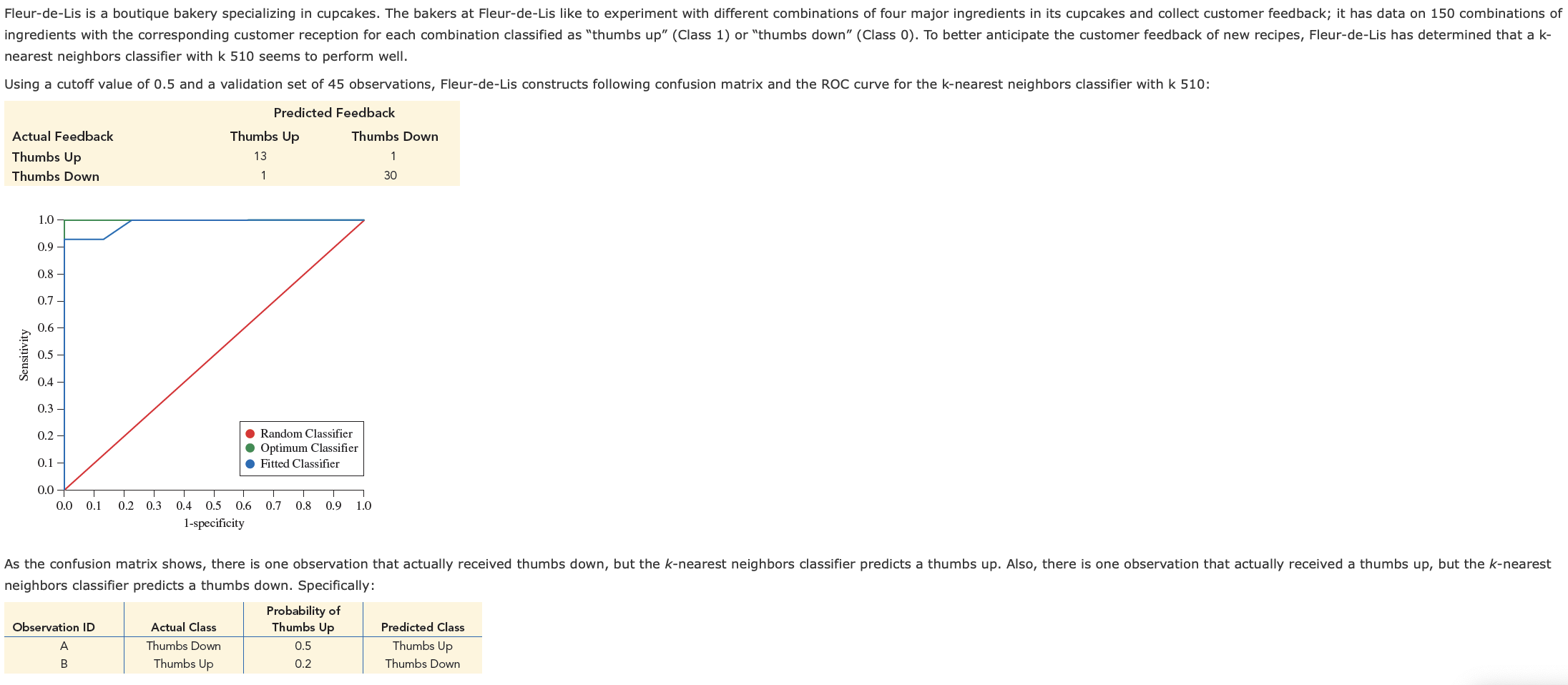

(c) Based on what we know about Observation B, if the cutoff value is lowered to 0.2, what happens to the values of sensitivity and specificity? Explain. Use the ROC curve to estimate the values of sensitivity and specificity for a cutoff value of 0.2. If required, round your answers to three decimal places. Do not round intermediate calculations.
Answer Part C, there are no other parts here. I have the sensitivity already and is equal to 1. What is the specificity?? I have uploaded this multiple times and Chegg "experts" have given me the wrong answer every time. If you are not 100% sure you are right, do not attempt this it is frustrating. The cutoff value has changed from 0.5 to 0.2. The sensitivity is 1 which is correct. I need help with the specificity. Sensitivity does not equal 1/14 and specificity does not equal 1/31 so don't answer that and do not answer any other parts just answer part C.
Fleur-de-Lis is a boutique bakery specializing in cupcakes. The bakers at Fleur-de-Lis like to experiment with different combinations of four major ingredients in its cupcakes and collect customer feedback; it has data on 150 combinations of ingredients with the corresponding customer reception for each combination classified as "thumbs up" (Class 1) or "thumbs down" (Class 0). To better anticipate the customer feedback of new recipes, Fleur-de-Lis has determined that a k- nearest neighbors classifier with k 510 seems to perform well. Using a cutoff value of 0.5 and a validation set of 45 observations, Fleur-de-Lis constructs following confusion matrix and the ROC curve for the k-nearest neighbors classifier with k 510: Predicted Feedback Actual Feedback Thumbs Up Thumbs Down 13 1 Thumbs Up Thumbs Down 1 30 1.0 0.9 0.8 0.7 0.6 Sensitivity 0.5 0.4 0.3 0.2 Random Classifier Optimum Classifier Fitted Classifier 0.1 0.0 0.0 0.1 0.2 0.3 0.4 0.5 T 0.8 0.6 0.7 1 0.9 1.0 1-specificity As the confusion matrix shows, there is one observation that actually received thumbs down, but the k-nearest neighbors classifier predicts a thumbs up. Also, there is one observation that actually received a thumbs up, but the k-nearest neighbors classifier predicts a thumbs down. Specifically: Probability of Observation ID Actual Class Thumbs Up Predicted Class . Thumbs Down 0.5 Thumbs Up B Thumbs Up 0.2 Thumbs Down (c) Based on what we know about Observation B, if the cutoff value is lowered to 0.2, what happens to the values of sensitivity and specificity? Explain. Use the ROC curve to estimate the values of sensitivity and specificity for a cutoff value of 0.2. If required, round your answers to three decimal places. Do not round intermediate calculations. Sensitivity = 1 Specificity = 0.032 Fleur-de-Lis is a boutique bakery specializing in cupcakes. The bakers at Fleur-de-Lis like to experiment with different combinations of four major ingredients in its cupcakes and collect customer feedback; it has data on 150 combinations of ingredients with the corresponding customer reception for each combination classified as "thumbs up" (Class 1) or "thumbs down" (Class 0). To better anticipate the customer feedback of new recipes, Fleur-de-Lis has determined that a k- nearest neighbors classifier with k 510 seems to perform well. Using a cutoff value of 0.5 and a validation set of 45 observations, Fleur-de-Lis constructs following confusion matrix and the ROC curve for the k-nearest neighbors classifier with k 510: Predicted Feedback Actual Feedback Thumbs Up Thumbs Down 13 1 Thumbs Up Thumbs Down 1 30 1.0 0.9 0.8 0.7 0.6 Sensitivity 0.5 0.4 0.3 0.2 Random Classifier Optimum Classifier Fitted Classifier 0.1 0.0 0.0 0.1 0.2 0.3 0.4 0.5 T 0.8 0.6 0.7 1 0.9 1.0 1-specificity As the confusion matrix shows, there is one observation that actually received thumbs down, but the k-nearest neighbors classifier predicts a thumbs up. Also, there is one observation that actually received a thumbs up, but the k-nearest neighbors classifier predicts a thumbs down. Specifically: Probability of Observation ID Actual Class Thumbs Up Predicted Class . Thumbs Down 0.5 Thumbs Up B Thumbs Up 0.2 Thumbs Down (c) Based on what we know about Observation B, if the cutoff value is lowered to 0.2, what happens to the values of sensitivity and specificity? Explain. Use the ROC curve to estimate the values of sensitivity and specificity for a cutoff value of 0.2. If required, round your answers to three decimal places. Do not round intermediate calculations. Sensitivity = 1 Specificity = 0.032
Step by Step Solution
There are 3 Steps involved in it

Get step-by-step solutions from verified subject matter experts
 Study Help