



Question: c Bosonic creation and destruction operators The creation operator at (f) is defined by at (8)|41,42, ..., N) = 14,41,42, ..., 9N) and at (0)|0))
c
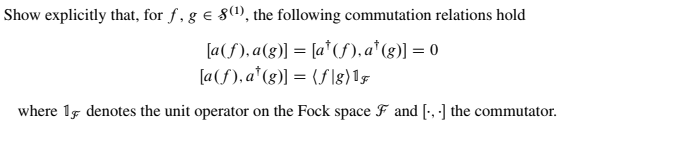
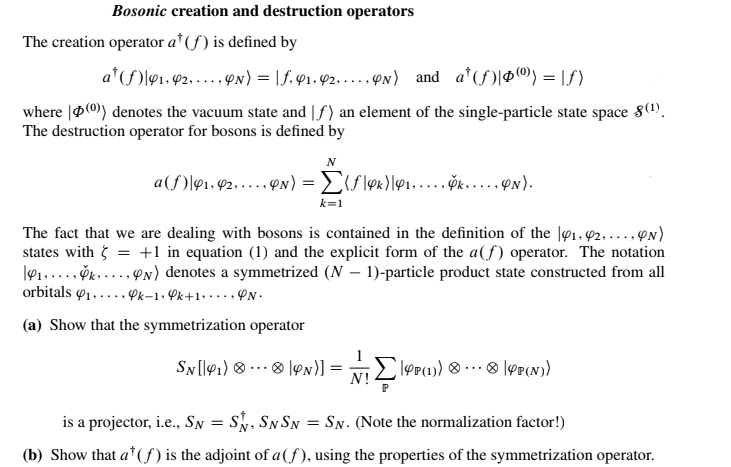
Bosonic creation and destruction operators The creation operator at (f) is defined by at (8)|41,42, ..., N) = 14,41,42, ..., 9N) and at (0)|0)) = 18) where (0) denotes the vacuum state and (f) an element of the single-particle state space f(1). The destruction operator for bosons is defined by N alf)|41,42, ..., 9N) = (fok)|$1,..., k, ...,n). k=1 The fact that we are dealing with bosons is contained in the definition of the 191,92, ...,ON) states with +1 in equation (1) and the explicit form of the af) operator. The notation 191, ..., k, ..., 9N) denotes a symmetrized (N 1)-particle product state constructed from all orbitals 41 4k-1,4k+1,...,UN. (a) Show that the symmetrization operator SxLlei) 8...8 \)] = v90) 8...8 |Pecx)) is a projector, i.e., Sy = ST, Sn Sy = Sy. (Note the normalization factor!) (b) Show that at(f) is the adjoint of a(f), using the properties of the symmetrization operator. Show explicitly that, for f, g $(1), the following commutation relations hold [a(f),a(g)] = [at(f), at()] = 0 [a(f), at(g)] = {f|g)15 where 1x denotes the unit operator on the Fock space F and (-) the commutator. Bosonic creation and destruction operators The creation operator at (f) is defined by at (8)|41,42, ..., N) = 14,41,42, ..., 9N) and at (0)|0)) = 18) where (0) denotes the vacuum state and (f) an element of the single-particle state space f(1). The destruction operator for bosons is defined by N alf)|41,42, ..., 9N) = (fok)|$1,..., k, ...,n). k=1 The fact that we are dealing with bosons is contained in the definition of the 191,92, ...,ON) states with +1 in equation (1) and the explicit form of the af) operator. The notation 191, ..., k, ..., 9N) denotes a symmetrized (N 1)-particle product state constructed from all orbitals 41 4k-1,4k+1,...,UN. (a) Show that the symmetrization operator SxLlei) 8...8 \)] = v90) 8...8 |Pecx)) is a projector, i.e., Sy = ST, Sn Sy = Sy. (Note the normalization factor!) (b) Show that at(f) is the adjoint of a(f), using the properties of the symmetrization operator. Show explicitly that, for f, g $(1), the following commutation relations hold [a(f),a(g)] = [at(f), at()] = 0 [a(f), at(g)] = {f|g)15 where 1x denotes the unit operator on the Fock space F and (-) the commutator
Step by Step Solution
There are 3 Steps involved in it

Get step-by-step solutions from verified subject matter experts