







Question: c = c + c(Y-T). (16 points) Consider the impact of an increase in thriftiness in the Keynesian cross model. Suppose the consumption function is
c = c + c(Y-T).
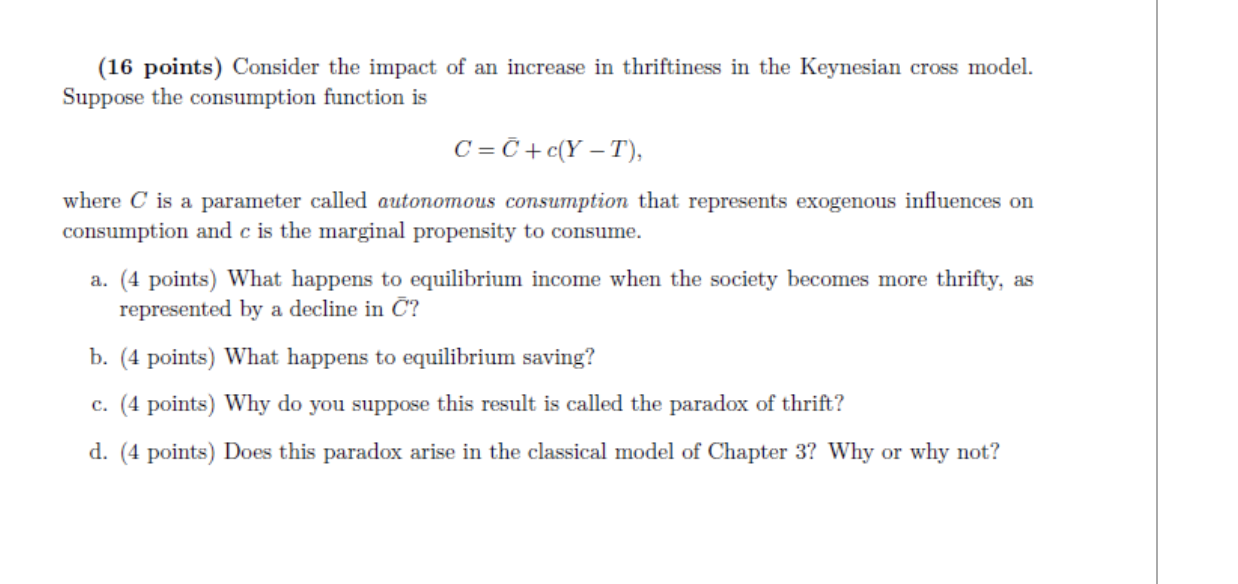
(16 points) Consider the impact of an increase in thriftiness in the Keynesian cross model. Suppose the consumption function is C = C+c(Y - T), where C is a parameter called autonomous consumption that represents exogenous influences on consumption and c is the marginal propensity to consume. a. (4 points) What happens to equilibrium income when the society becomes more thrifty, as represented by a decline in C? b. (4 points) What happens to equilibrium saving? c. (4 points) Why do you suppose this result is called the paradox of thrift? d. (4 points) Does this paradox arise in the classical model of Chapter 3? Why or why not
Step by Step Solution
There are 3 Steps involved in it

Get step-by-step solutions from verified subject matter experts
 Study Help