







Question: C++ class may have multiple constructors only if which of the following conditions is true? A) the constructors have different return types B) each constructor
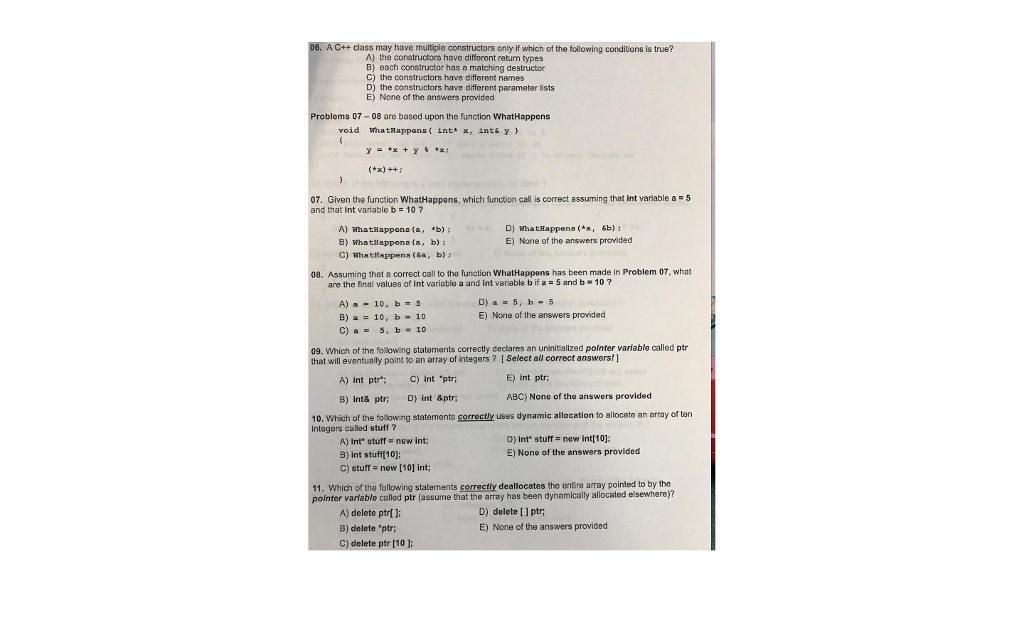
C++ class may have multiple constructors only if which of the following conditions is true? A) the constructors have different return types B) each constructor has a matching destructor C) the constructors have different names D) the constructors have different parameter lists E) None of the answers provided lems 07-08 are based upon the function WhatHappens void WhatHapponsintt x, int& y 07. Given the function WhatHappens, which furnction call is correct assuming that int variable a 5 and that int variable b = 10 ? A) WhatHappons (a, *b) B) WhatHappene (a, b) E) None of the answers provided 08. Assuming that a correct call to the funclion WhatHappens has been made in Problem 07, what are the final values of int variable a and int variable b if a = 5 and b-10 ? A)8.10, b = 5 B) a = 10, b-10 C)a= 5, b-10 D a = 5, b-5 E) None of the answers provided 09. Which of the following statements correctly declares an uninitialized pointer variable called ptr that will eventually point to an array of integers? I Select ail correct answers!] A) int ptr*: C) int 'ptr B) int& ptr; D) int &ptr; E) int ptr; ABC) None of the answers provided 10. Which of the following statements correctly uses dynamic allocation to allocate an array of ten called stuff ? A) int. stuff = new int; 8) int stuff 10] C) stuff = new [10] int; D) int. stutt = new int[10]; E) None of the answers provided 11. Which of the following statements correctiy deallocates the entire array pointed to by the r varable called ptr (assume that the array has been dynemically allocated elsewhere)? A) delete ptr l B) delete 'ptr; C) delete ptr [10 ]; D) delete [1 ptr E) None of the answers providecd
Step by Step Solution
There are 3 Steps involved in it

Get step-by-step solutions from verified subject matter experts
 Study Help