







Question: C++ code - Byte order programming The C++ language Bit-Wise operations give you the ability to work with endian. ****************************************************************** Turn in code, screen prints
C++ code - Byte order programming
The C++ language Bit-Wise operations give you the ability to work with endian.
******************************************************************
Turn in code, screen prints of successful execution
and write up the uses of Byte programming.
/* $begin show-bytes */
#include
/* $end show-bytes */
#include
#include
/* $begin show-bytes */
typedef unsigned char *byte_pointer;
void show_bytes(byte_pointer start, int len) {
int i;
for (i = 0; i
printf(" %.2x", start[i]); //line:data:show_bytes_printf
printf(" ");
}
void show_int(int x) {
show_bytes((byte_pointer) &x, sizeof(int)); //line:data:show_bytes_amp1
}
void show_float(float x) {
show_bytes((byte_pointer) &x, sizeof(float)); //line:data:show_bytes_amp2
}
void show_pointer(void *x) {
show_bytes((byte_pointer) &x, sizeof(void *)); //line:data:show_bytes_amp3
}
/* $end show-bytes */
/* $begin test-show-bytes */
void test_show_bytes(int val) {
int ival = val;
float fval = (float) ival;
int *pval = &ival;
show_int(ival);
show_float(fval);
show_pointer(pval);
}
/* $end test-show-bytes */
void simple_show_a() {
/* $begin simple-show-a */
int val = 0x87654321;
byte_pointer valp = (byte_pointer) &val;
show_bytes(valp, 1); /* A. */
show_bytes(valp, 2); /* B. */
show_bytes(valp, 3); /* C. */
/* $end simple-show-a */
}
void simple_show_b() {
/* $begin simple-show-b */
int val = 0x12345678;
byte_pointer valp = (byte_pointer) &val;
show_bytes(valp, 1); /* A. */
show_bytes(valp, 2); /* B. */
show_bytes(valp, 3); /* C. */
/* $end simple-show-b */
}
void float_eg() {
int x = 3490593;
float f = (float) x;
printf(" For x = %d ", x);
show_int(x);
show_float(f);
x = 3510593;
f = (float) x;
printf(" For x = %d ", x);
show_int(x);
show_float(f);
}
void string_ueg() {
/* $begin show-ustring */
const char *s = "ABCDEF";
show_bytes((byte_pointer) s, strlen(s));
/* $end show-ustring */
}
void string_leg() {
/* $begin show-lstring */
const char *s = "abcdef";
show_bytes((byte_pointer) s, strlen(s));
/* $end show-lstring */
}
void show_twocomp()
{
/* $begin show-twocomp */
short x = 12345;
short mx = -x;
show_bytes((byte_pointer) &x, sizeof(short));
show_bytes((byte_pointer) &mx, sizeof(short));
/* $end show-twocomp */
}
int main(int argc, char *argv[])
{
int val = 12345;
if (argc > 1) {
if (argc > 1) {
val = strtol(argv[1], NULL, 0);
}
printf(" calling test_show_bytes ");
test_show_bytes(val);
}
else
{
printf(" calling show two comp function ");
show_twocomp();
printf(" Calling simple show a function ");
simple_show_a();
printf(" Calling simple show b function ");
simple_show_b();
printf(" Calling float eg function ");
float_eg();
printf(" Calling string ueg function ");
string_ueg();
printf(" Calling string leg function ");
string_leg();
}
system("pause"); // For PC Visual Studios Only
return 0;
}
***************************************************************
Error shown on my computer:
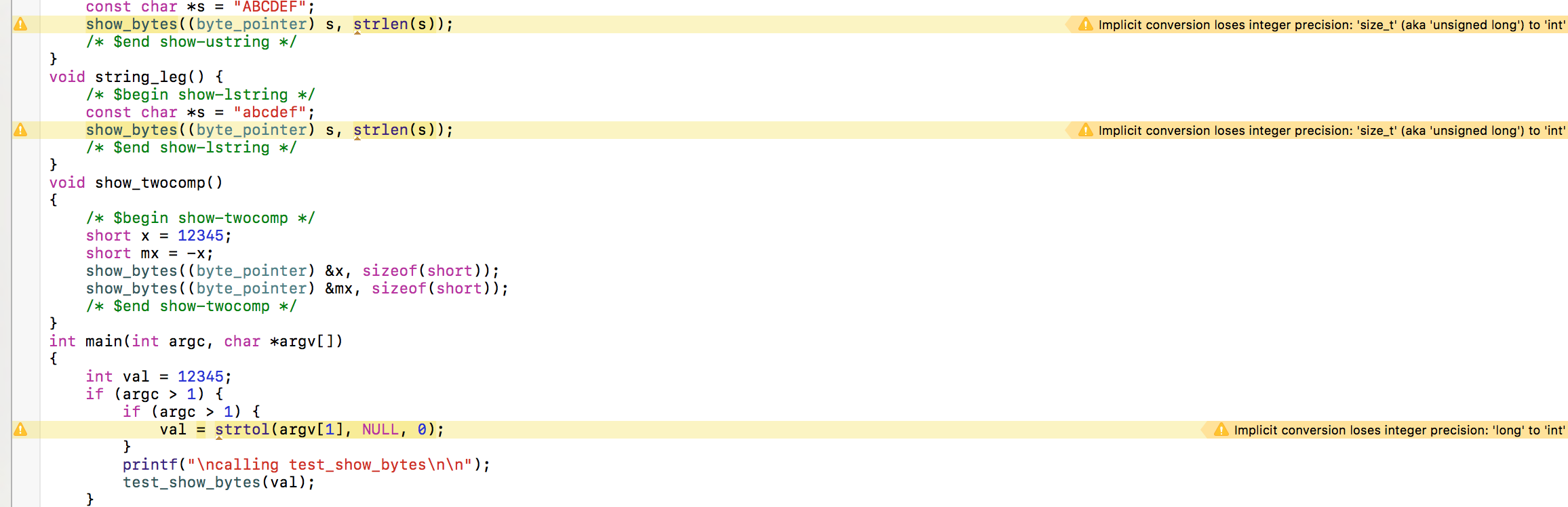
const char s"ABCDEF" show_bytes ( (byte_pointer) s, strlen (s)) /* Send show-ustring Implicit conversion loses integer precision: 'size t' (aka 'unsigned long') to 'int' void string leg() f /* $begin show-lstring/ const char *s "abcdef"; show_bytes ((byte_pointer) s, strlen(s)); /* Send show-lstring / Implicit conversion loses integer precision: 'size_t' (aka 'unsigned long') to 'int' void show_twocomp() /* $begin show-twocomp/ short x = 12345; short mx = -x; show_bytes ( (byte_pointer) &x, sizeof (short)); show_bytes( (byte_pointer) &mx, sizeof (short)); /* $end show-twocomp / int main(int argc, char *argv[]) int val = 12345; if (argc > 1) f if (argc > 1) f val strtol(argv [1], NULL, 0); Implicit conversion loses integer precision: 'long' to 'int' = printf("ncalling test_show_bytes ") test_show_bytes (val)
Step by Step Solution
There are 3 Steps involved in it

Get step-by-step solutions from verified subject matter experts
 Study Help