







Question: C coding on: Figure 2.1, 2.2 and 2.3 show program segments which contain user-defined function. Analyze all the program segments and trace the process in
C coding on:
Figure 2.1, 2.2 and 2.3 show program segments which contain user-defined function. Analyze all the program segments and trace the process in each function. Your analysis must include the followings:
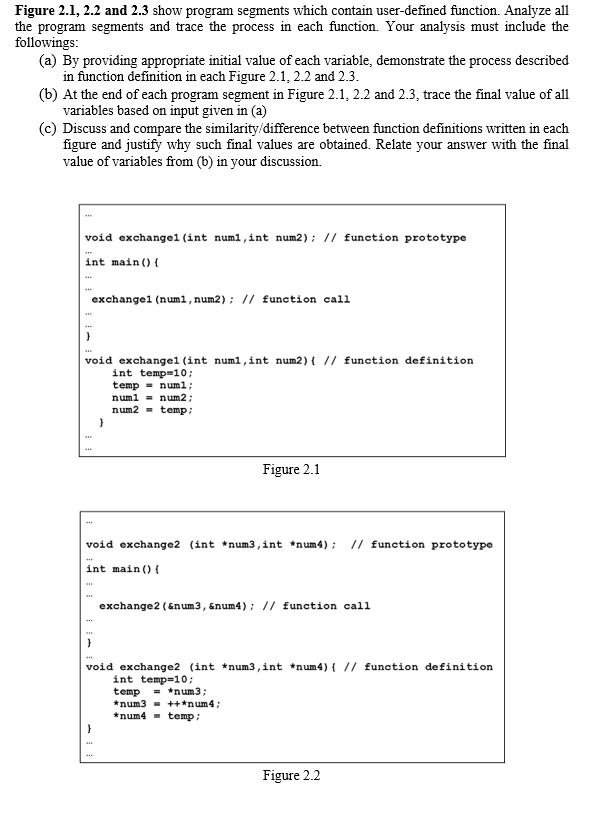
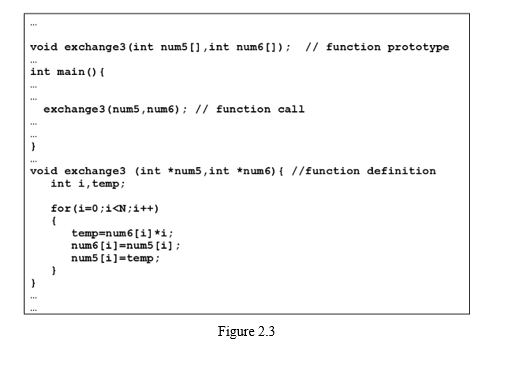
Figure 2.1, 2.2 and 2.3 show program segments which contain user-defined function. Analyze all the program segments and trace the process in each function. Your analysis must include the followings: (a) By providing appropriate initial value of each variable, demonstrate the process described in function definition in each Figure 2.1.2.2 and 2.3. (b) At the end of each program segment in Figure 2.1, 2.2 and 2.3, trace the final value of all variables based on input given in (a) (c) Discuss and compare the similarity/difference between function definitions written in each figure and justify why such final values are obtained. Relate your answer with the final value of variables from (b) in your discussion. void exchangel (int num], int num2); // function prototype int main() { exchangel (num1, num2); // function call } void exchangel (int numi, int num2) { // function definition int temp=10; temp - numi; numi - num2; num2 - temp; Figure 2.1 // function prototype void exchange2 (int *num3, int *num4); int main() { exchange 2 (&num3, &num4); // function call } void exchange2 (int *num3, int *num 4) { // function definition int temp=10; temp*num 3; *num3 ++*num 4: *num 4 - temp: } Figure 2.2 void exchange3 (int num5[], int num6 []); // function prototype int main() { exchange 3 (num5, num6); // function call } void exchange (int *numb, int *num 6) { //function definition int i, temp; for(i=0;i
Step by Step Solution
There are 3 Steps involved in it

Get step-by-step solutions from verified subject matter experts
 Study Help