





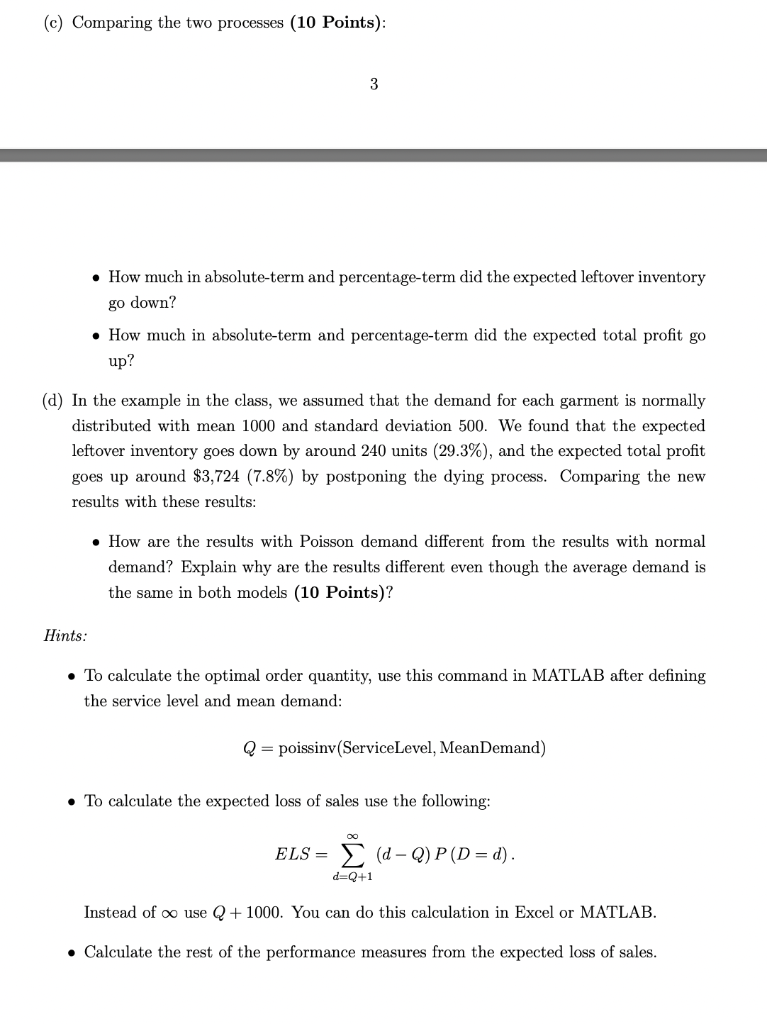
Question: (c) Comparing the two processes (10 Points): 3 How much in absolute-term and percentage-term did the expected leftover inventory go down? How much in absolute-term
(c) Comparing the two processes (10 Points): 3(c) Comparing the two processes (10 Points): 3

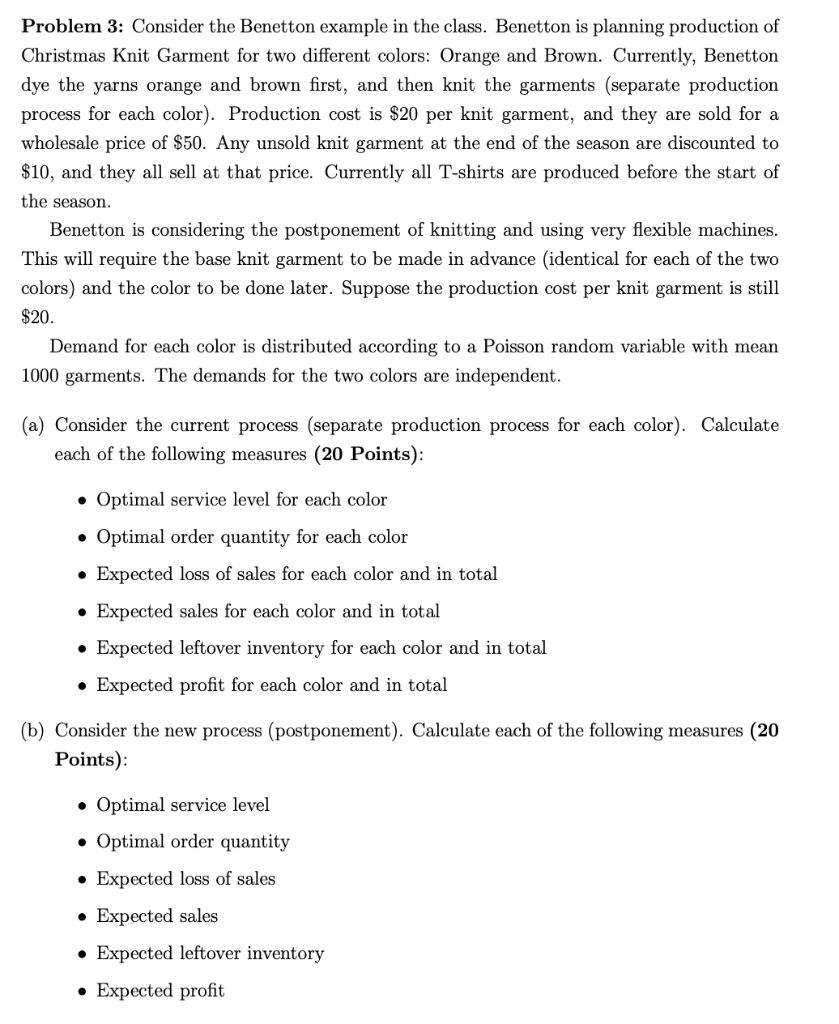
(c) Comparing the two processes (10 Points): 3 How much in absolute-term and percentage-term did the expected leftover inventory go down? How much in absolute-term and percentage-term did the expected total profit go up? (d) In the example in the class, we assumed that the demand for each garment is normally distributed with mean 1000 and standard deviation 500. We found that the expected leftover inventory goes down by around 240 units (29.3%), and the expected total profit goes up around $3,724 (7.8%) by postponing the dying process. Comparing the new results with these results: How are the results with Poisson demand different from the results with normal demand? Explain why are the results different even though the average demand is the same in both models (10 Points)? Hints: To calculate the optimal order quantity, use this command in MATLAB after defining the service level and mean demand: Q = poissinv (Service Level, MeanDemand) To calculate the expected loss of sales use the following: ELS = (d-Q)P (D=d). d=Q+1 Instead of use Q + 1000. You can do this calculation in Excel or MATLAB. Calculate the rest of the performance measures from the expected loss of sales. Problem 3: Consider the Benetton example in the class. Benetton is planning production of Christmas Knit Garment for two different colors: Orange and Brown. Currently, Benetton dye the yarns orange and brown first, and then knit the garments (separate production process for each color). Production cost is $20 per knit garment, and they are sold for a wholesale price of $50. Any unsold knit garment at the end of the season are discounted to $10, and they all sell at that price. Currently all T-shirts are produced before the start of the season. Benetton is considering the postponement of knitting and using very flexible machines. This will require the base knit garment to be made in advance (identical for each of the two colors) and the color to be done later. Suppose the production cost per knit garment is still $20. Demand for each color is distributed according to a Poisson random variable with mean 1000 garments. The demands for the two colors are independent. (a) Consider the current process (separate production process for each color). Calculate each of the following measures (20 Points): Optimal service level for each color Optimal order quantity for each color . Expected loss of sales for each color and in total . Expected sales for each color and in total Expected leftover inventory for each color and in total Expected profit for each color and in total (b) Consider the new process (postponement). Calculate each of the following measures (20 Points) Optimal service level o Optimal order quantity Expected loss of sales Expected sales . Expected leftover inventory Expected profit (c) Comparing the two processes (10 Points): 3 How much in absolute-term and percentage-term did the expected leftover inventory go down? How much in absolute-term and percentage-term did the expected total profit go up? (d) In the example in the class, we assumed that the demand for each garment is normally distributed with mean 1000 and standard deviation 500. We found that the expected leftover inventory goes down by around 240 units (29.3%), and the expected total profit goes up around $3,724 (7.8%) by postponing the dying process. Comparing the new results with these results: How are the results with Poisson demand different from the results with normal demand? Explain why are the results different even though the average demand is the same in both models (10 Points)? Hints: To calculate the optimal order quantity, use this command in MATLAB after defining the service level and mean demand: Q = poissinv (Service Level, MeanDemand) To calculate the expected loss of sales use the following: ELS = (d-Q)P (D=d). d=Q+1 Instead of use Q + 1000. You can do this calculation in Excel or MATLAB. Calculate the rest of the performance measures from the expected loss of sales. Problem 3: Consider the Benetton example in the class. Benetton is planning production of Christmas Knit Garment for two different colors: Orange and Brown. Currently, Benetton dye the yarns orange and brown first, and then knit the garments (separate production process for each color). Production cost is $20 per knit garment, and they are sold for a wholesale price of $50. Any unsold knit garment at the end of the season are discounted to $10, and they all sell at that price. Currently all T-shirts are produced before the start of the season. Benetton is considering the postponement of knitting and using very flexible machines. This will require the base knit garment to be made in advance (identical for each of the two colors) and the color to be done later. Suppose the production cost per knit garment is still $20. Demand for each color is distributed according to a Poisson random variable with mean 1000 garments. The demands for the two colors are independent. (a) Consider the current process (separate production process for each color). Calculate each of the following measures (20 Points): Optimal service level for each color Optimal order quantity for each color . Expected loss of sales for each color and in total . Expected sales for each color and in total Expected leftover inventory for each color and in total Expected profit for each color and in total (b) Consider the new process (postponement). Calculate each of the following measures (20 Points) Optimal service level o Optimal order quantity Expected loss of sales Expected sales . Expected leftover inventory Expected profit

Step by Step Solution

There are 3 Steps involved in it

1 Expert Approved Answer
Step: 1 Unlock blur-text-image

Question Has Been Solved by an Expert!

Get step-by-step solutions from verified subject matter experts

Step: 2 Unlock
Step: 3 Unlock

Students Have Also Explored These Related General Management Questions!