







Question: c d = 6 . 4 * 1 0 - 3 - 1 . 2 * 1 0 - 3 c l + 3 .
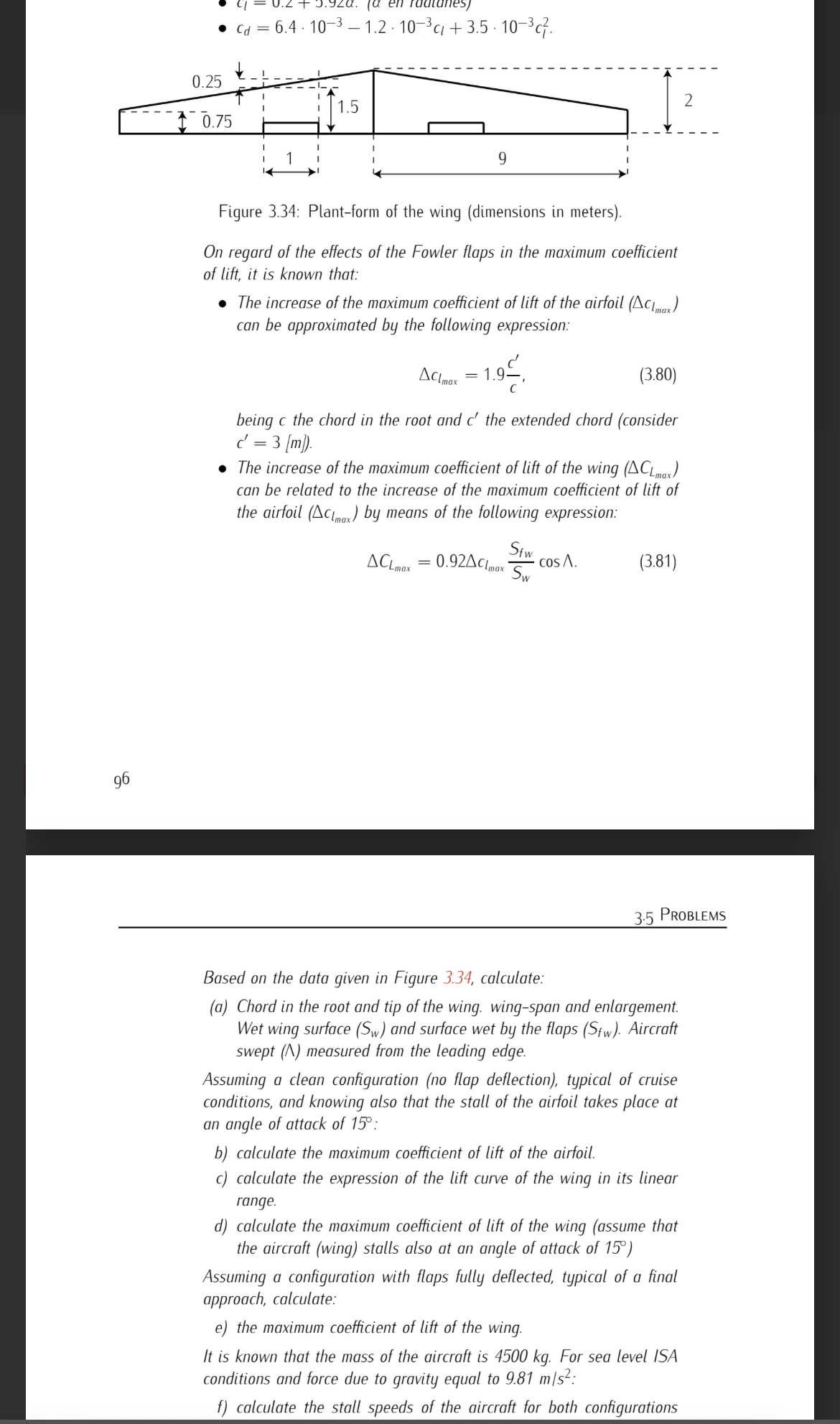
Figure : Plantform of the wing dimensions in meters
On regard of the effects of the Fowler flaps in the maximum coefficient of lift, it is known that:
The increase of the maximum coefficient of lift of the airfoil can be approximated by the following expression:
being the chord in the root and the extended chord consider
The increase of the maximum coefficient of lift of the wing can be related to the increase of the maximum coefficient of lift of the airfoil by means of the following expression:
Problems
Based on the data given in Figure calculate:
a Chord in the root and tip of the wing. wingspan and enlargement. Wet wing surface and surface wet by the flaps Aircraft swept measured from the leading edge.
Assuming a clean configuration no flap deflection typical of cruise conditions, and knowing also that the stall of the airfoil takes place at an angle of attack of :
b calculate the maximum coefficient of lift of the airfoil.
c calculate the expression of the lift curve of the wing in its linear range.
d calculate the maximum coefficient of lift of the wing assume that the aircraft wing stalls also at an angle of attack of
Assuming a configuration with flaps fully deflected, typical of a final approach, calculate:
e the maximum coefficient of lift of the wing.
It is known that the mass of the aircraft is kg For sea level ISA conditions and force due to gravity equal to :
f calculate the stall speeds of the aircraft for both configurations
Step by Step Solution
There are 3 Steps involved in it
1 Expert Approved Answer
Step: 1 Unlock

Question Has Been Solved by an Expert!
Get step-by-step solutions from verified subject matter experts
Step: 2 Unlock
Step: 3 Unlock
 Study Help