





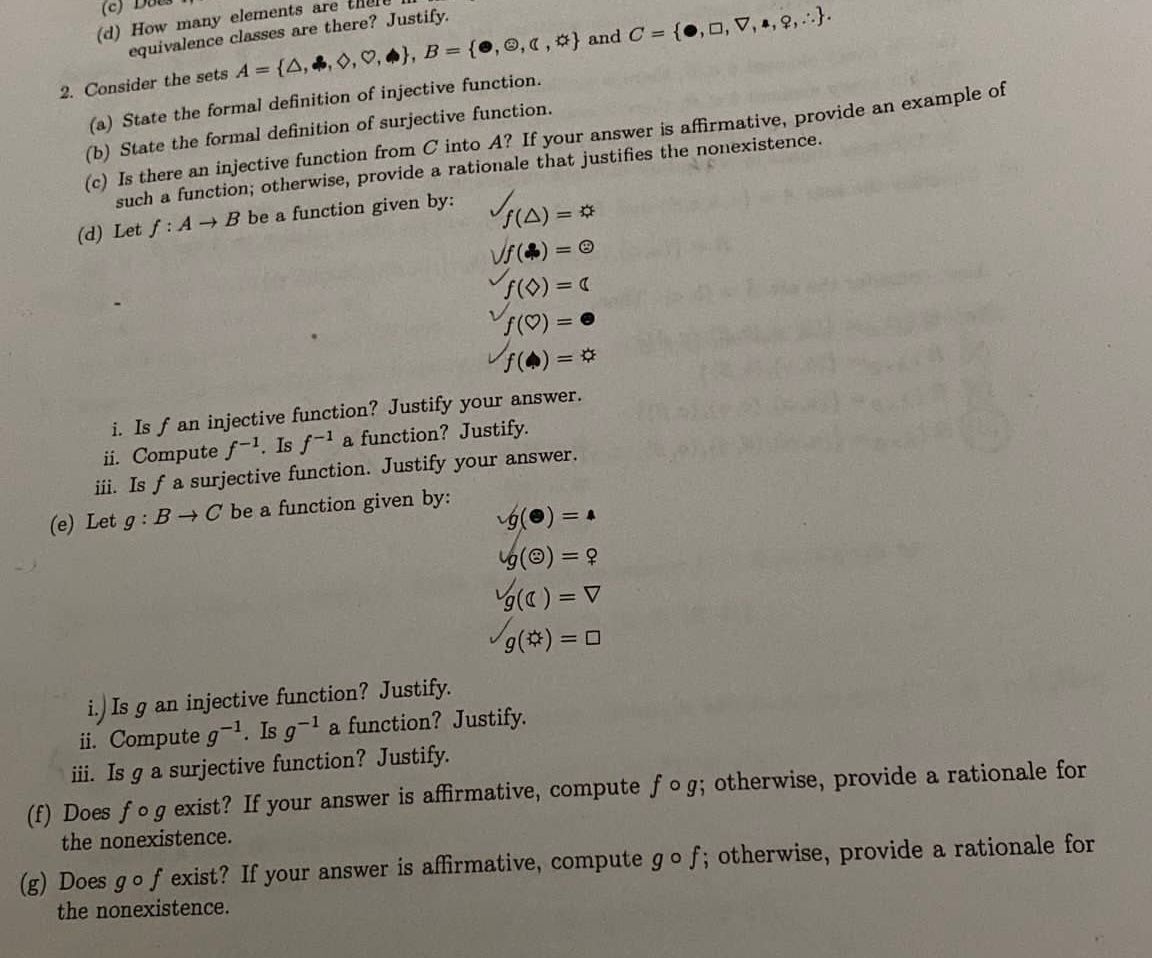
Question: (c) (d) How many elements are th equivalence classes are there? Justify. 2. Consider the sets A = {A, &, 0, 0, }, B =
(c) (d) How many elements are th equivalence
(c) (d) How many elements are th equivalence classes are there? Justify. 2. Consider the sets A = {A, &, 0, 0, }, B = {e, , (, # } and C = (o, 0, V, ., 8,.}. (a) State the formal definition of injective function. (b) State the formal definition of surjective function. (c) Is there an injective function from C into A? If your answer is affirmative, provide an example of such a function; otherwise, provide a rationale that justifies the nonexistence. (d) Let f : A - B be a function given by: 1(A ) = * Vf ( $ ) = 0 f ( 0 ) = 1 f ( 0 ) = 0 f ( 0 ) = # i. Is f an injective function? Justify your answer. ii. Compute f-1. Is f-1 a function? Justify. iii. Is f a surjective function. Justify your answer. (e) Let 9 : B - C be a function given by: g(0 ) =4 g ( @ ) = 9 g ( ( ) = V g ( # ) = 0 i. Is g an injective function? Justify. ii. Compute 9-1. Is 9-1 a function? Justify. iii. Is g a surjective function? Justify. (f) Does fog exist? If your answer is affirmative, compute fog; otherwise, provide a rationale for the nonexistence. (g) Does go f exist? If your answer is affirmative, compute go f; otherwise, provide a rationale for the nonexistence

Step by Step Solution

There are 3 Steps involved in it

1 Expert Approved Answer
Step: 1 Unlock blur-text-image

Question Has Been Solved by an Expert!

Get step-by-step solutions from verified subject matter experts

Step: 2 Unlock
Step: 3 Unlock

Students Have Also Explored These Related Mathematics Questions!