







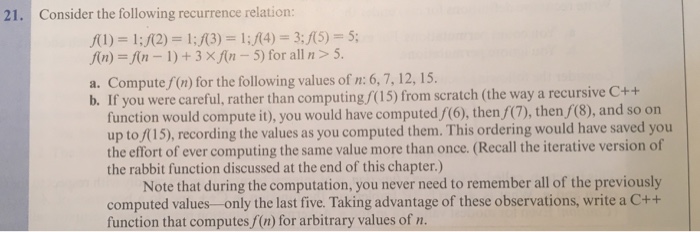
Question: C++ Data Structures question Consider the following recurrence relation: f(1) = 1; f(2) = 1; f(3) = 1; f(4) = 3; f(5) = 5; f(n)
 C++ Data Structures question
 Consider the following recurrence relation: f(1) = 1; f(2) = 1; f(3) = 1; f(4) = 3; f(5) = 5; f(n) = f(n - 1) + 3 times f(n - 5) for all n > 5. a. Compute f(n) for the following values of n: 6, 7, 12, 15. b. If you were careful, rather than computing f(15) from scratch (the way a recursive C++ function would compute it), you would have computed f(6), then f(7), then f(8), and so on up to f(15), recording the values as you computed them. This ordering would have saved you the effort of ever computing the same value more than once. (Recall the iterative version of the rabbit function discussed at the end of this chapter.)
Step by Step Solution
There are 3 Steps involved in it
1 Expert Approved Answer
Step: 1 Unlock

Question Has Been Solved by an Expert!
Get step-by-step solutions from verified subject matter experts
Step: 2 Unlock
Step: 3 Unlock
 Study Help