



Question: C @ @ https://blackboard.towson.edu/webapps/assessment/take/take jsp?course_assessment_id=_260792_1&course_id=_231340_1&content_id=_7. to @ |@ Remaining Time: 1 hour, 48 minutes, 58 seconds. Question Completion Status: Question 2 2 points Save Answer
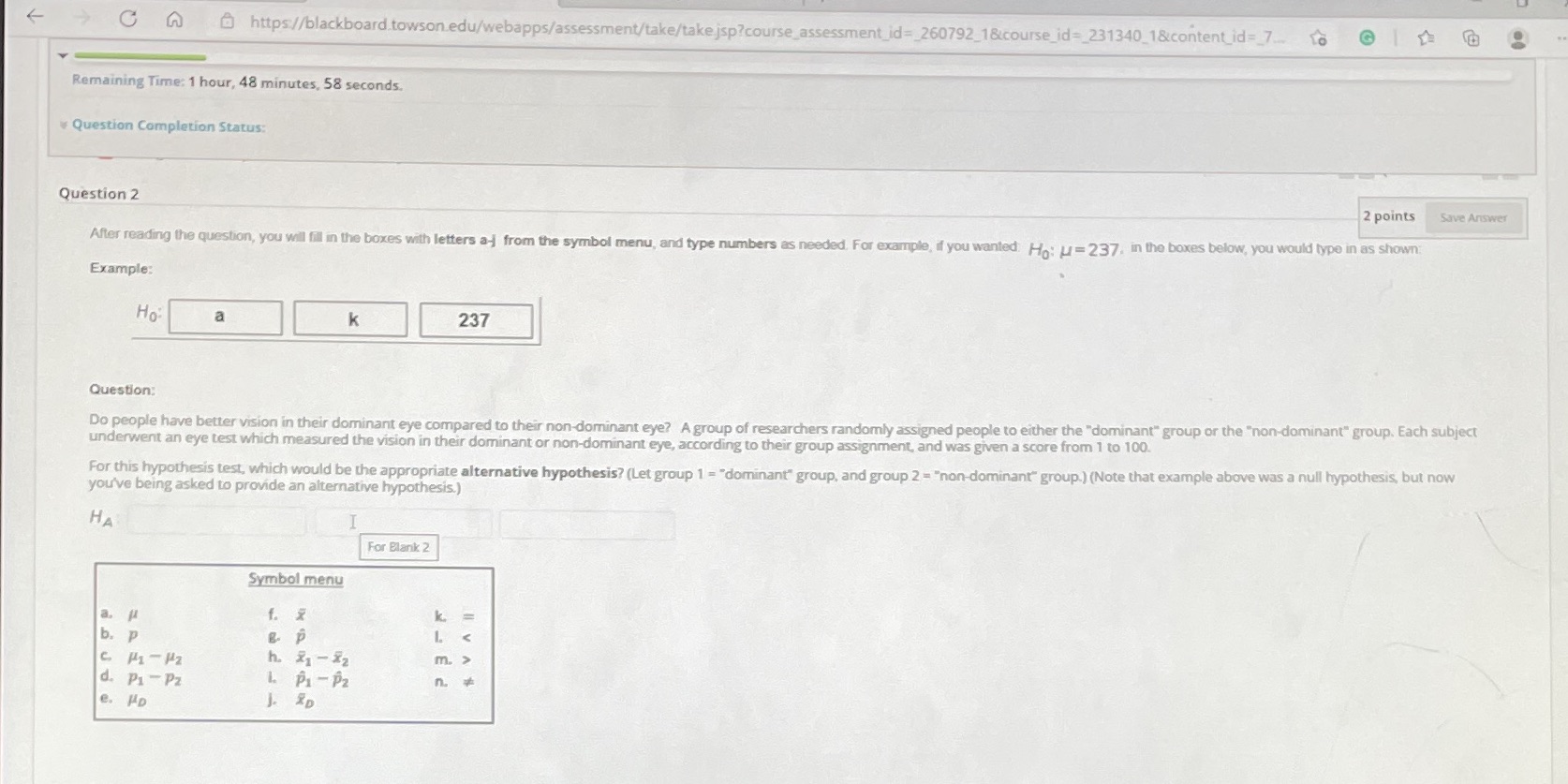
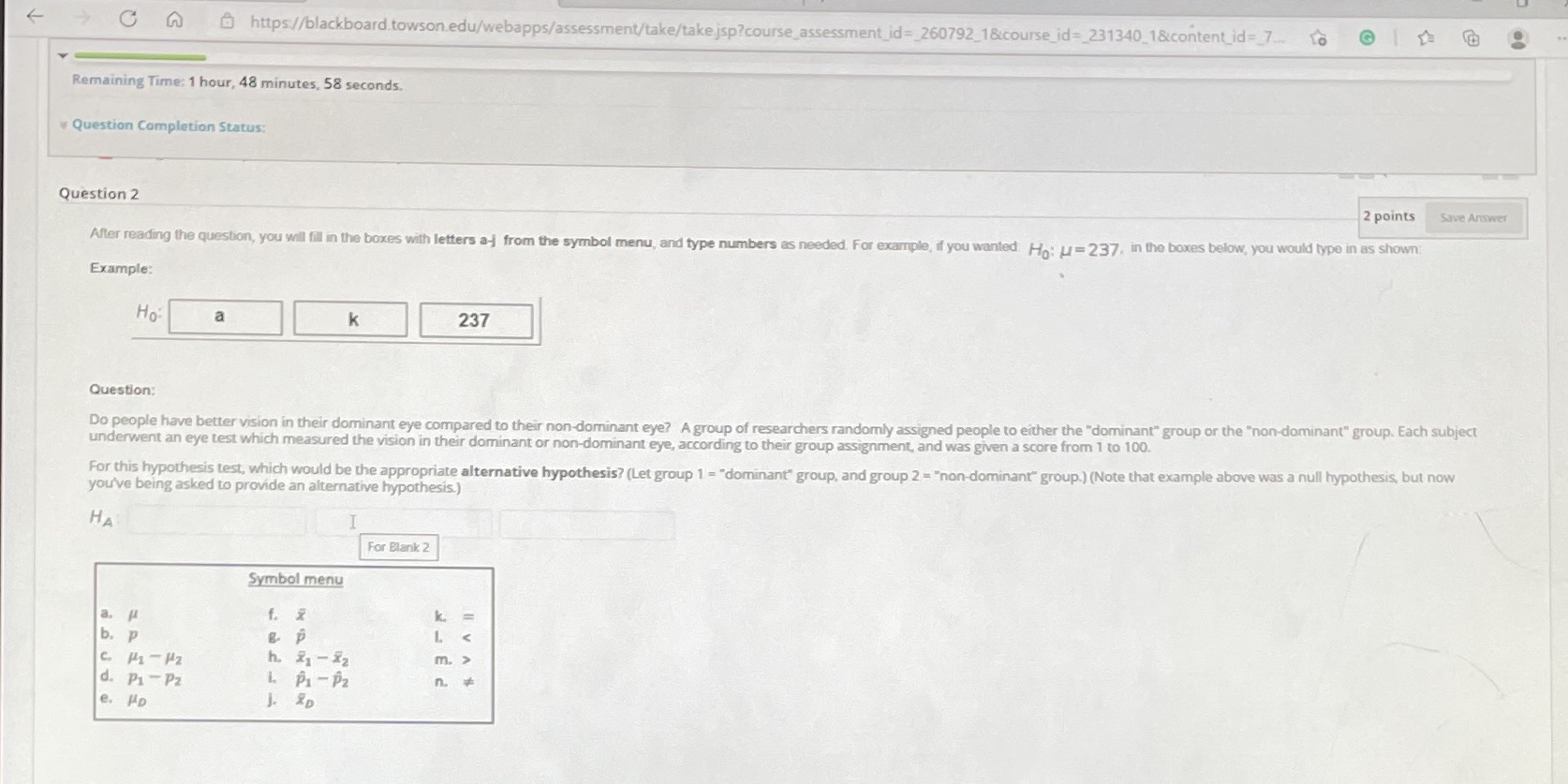
C @ @ https://blackboard.towson.edu/webapps/assessment/take/take jsp?course_assessment_id=_260792_1&course_id=_231340_1&content_id=_7. to @ |@ Remaining Time: 1 hour, 48 minutes, 58 seconds. Question Completion Status: Question 2 2 points Save Answer After reading the question, you will fill in the boxes with letters a-j from the symbol menu, and type numbers as needed. For example, if you wanted. Ho: u = 237. in the boxes below, you would type in as shown: Example: Ho K 237 Question: Do people have better vision in their dominant eye compared to their non-dominant eye? A group of researchers randomly assigned people to either the "dominant" group or the "non-dominant" group. Each subject underwent an eye test which measured the vision in their dominant or non-dominant eye, according to their group assignment, and was given a score from 1 to 100. For this hypothesis test, which would be the appropriate alternative hypothesis? (Let group 1 = "dominant" group, and group 2 = "non-dominant" group.) (Note that example above was a null hypothesis, but now you've being asked to provide an alternative hypothesis.) HA For Blank 2 Symbol menu a. f. K b. p 1. d. P1 - Pz L. P1 - P2 n. e. Hp J. ID
Step by Step Solution
There are 3 Steps involved in it

Get step-by-step solutions from verified subject matter experts