







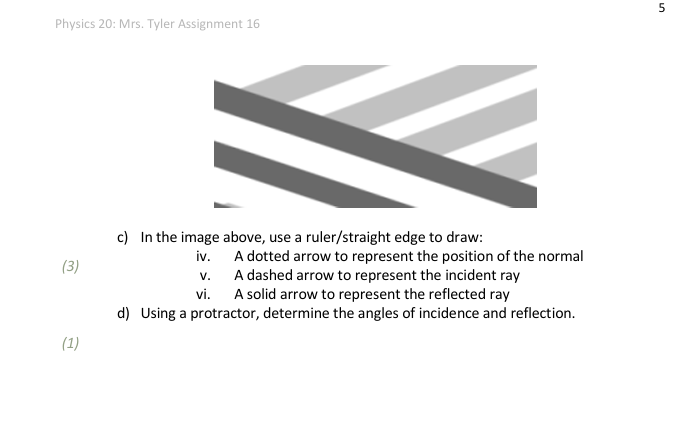
Question: c ) In the image above, use a ruler / straight edge to draw: ( 3 ) iv . A dotted arrow to represent the
c In the image above, use a rulerstraight edge to draw:
iv A dotted arrow to represent the position of the normal
v A dashed arrow to represent the incident ray
vi A solid arrow to represent the reflected ray
d Using a protractor, determine the angles of incidence and reflection.
Use the information below to answer parts ad
In the images below, the reflected wave is darker in the foreground and the incident wave is lighter in the background The reflecting surface is the bottom of the image. Remember: the ray is perpendicular to the wave.
a In the image above, use a rulerstraight edge to draw:
i A dotted line to represent the position of the normal
ii A dashed arrow to represent the incident ray
iii. A solid arrow to represent the reflected ray
b Using a protractor, determine the angles of incidence and reflection.
Step by Step Solution
There are 3 Steps involved in it
1 Expert Approved Answer
Step: 1 Unlock

Question Has Been Solved by an Expert!
Get step-by-step solutions from verified subject matter experts
Step: 2 Unlock
Step: 3 Unlock
 Study Help