







Question: c) In this context, what would a Type II error be? A. A Type ll error is failing to decide that new design signs are
c) In this context, what would a Type II error be? A. A Type ll error is failing to decide that new design signs are more visible when they are not.O B. A Type Il error is deciding that new design signs are more visible when they are not.O C. A Type Il error is Sailing to decide that new design signs are more visible when, in fact, they ar O D. A Type Il error is deciding that new design signs are not more visible when, in fact, they are nO E. There is no Type Il error in this context.d) In this context, what is meant by the power of the test?? A. The power of this test is the probability of correctly determining the sign is less visible.? B. The power of this test is the probability of incorrectly determining the sign is less visible.O C. The power of thik test is the probability of incorrectly detecting that a less visible sign works.O D. The power of this test is the probability of detecting that a more visible sign works.O E. There is no power of the test in this context.e) If the hypothesis is tested at the 1% level of significance instead of 10%, how will this affect the power of the test? A. The power of the test will decrease because the level of significance decreased.O B. The power of the test will decrease because the level of significance increasedO C. The power of the test will increase because the level of significance increased? D. The power of the test will increase because the level of significance decreased.f) The engineers hoped to base their decision on the reactions of 99 drivers, but time and budget c the test? Explain.O A. The power of the test decreases because the standard deviation increases.? B. The power of the test increases because the standard deviation increases.? C. The power of the test increases because the standard deviation decreases.O D. The power of the test decreases because the standard deviation decreases.O E. The power of the test is the samp regardless of the change in sample size.
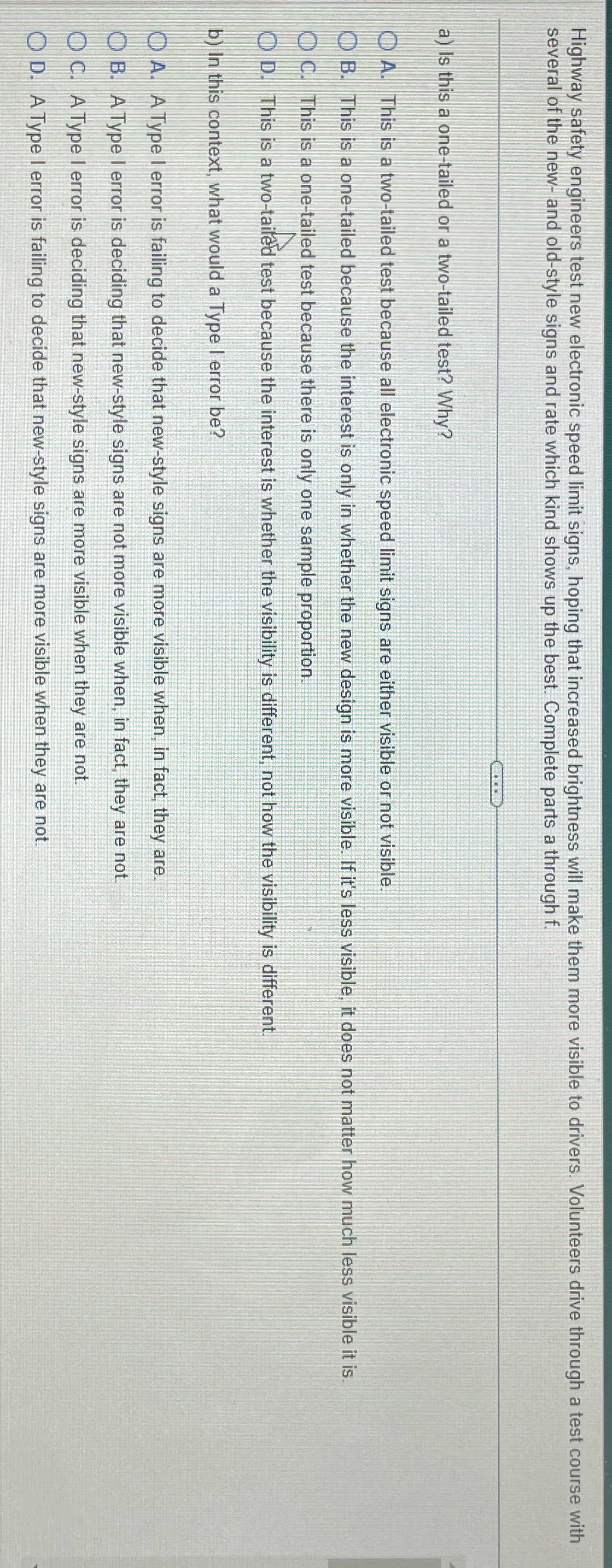
Highway safety engineers test new electronic speed limit signs, hoping that increased brightness will make them more visible to drivers. Volunteers drive through a test course with several of the new- and old-style signs and rate which kind shows up the best. Complete parts a through f. a) Is this a one-tailed or a two-tailed test? Why? A. This is a two-tailed test because all electronic speed limit signs are either visible or not visible. B. This is a one-tailed because the interest is only in whether the new design is more visible. If it's less visible, it does not matter how much less visible it is C. This is a one-tailed test because there is only one sample proportion. D. This is a two-tailed test because the interest is whether the visibility is different, not how the visibility is different. b) In this context, what would a Type I error be? A. A Type I error is failing to decide that new-style signs are more visible when, in fact, they are. B. A Type I error is deciding that new-style signs are not more visible when, in fact, they are not. C. A Type I error is deciding that new-style signs are more visible when they are not. OD. A Type I error is failing to decide that new-style signs are more visible when they are not
Step by Step Solution
There are 3 Steps involved in it

Get step-by-step solutions from verified subject matter experts
 Study Help