







Question: C++ language only please!!! Let's consider the following function: void do It (int& a, int b) {a = a + 5; b = b +
 C++ language only please!!!
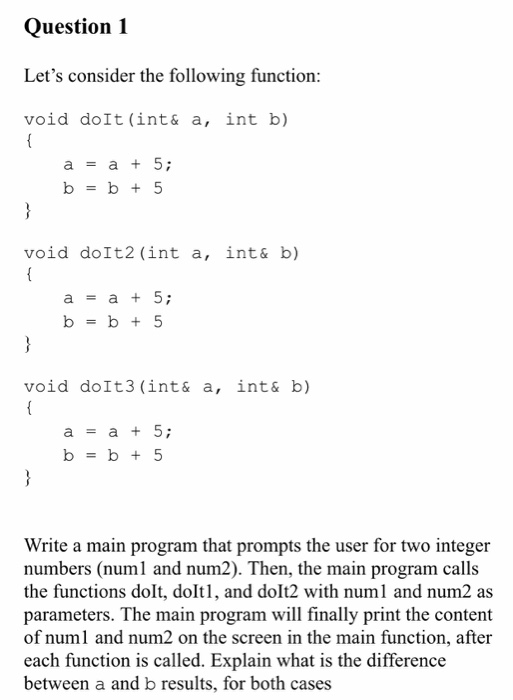
 Let's consider the following function: void do It (int& a, int b) {a = a + 5; b = b + 5} void doIt2(int a, int& b) {a = a + 5; b = b + 5} void doIt3(int& a, int& b) {a = a + 5; b = b + 5} Write a main program that prompts the user for two integer numbers (numl and num2). Then, the main program calls the functions dolt, dolt l, and dolt2 with num l and num2 as parameters. The main program will finally print the content of num 1 and num2 on the screen in the main function, after each function is called. Explain what is the difference between a and b results, for both cases
Step by Step Solution
There are 3 Steps involved in it
1 Expert Approved Answer
Step: 1 Unlock

Question Has Been Solved by an Expert!
Get step-by-step solutions from verified subject matter experts
Step: 2 Unlock
Step: 3 Unlock
 Study Help