







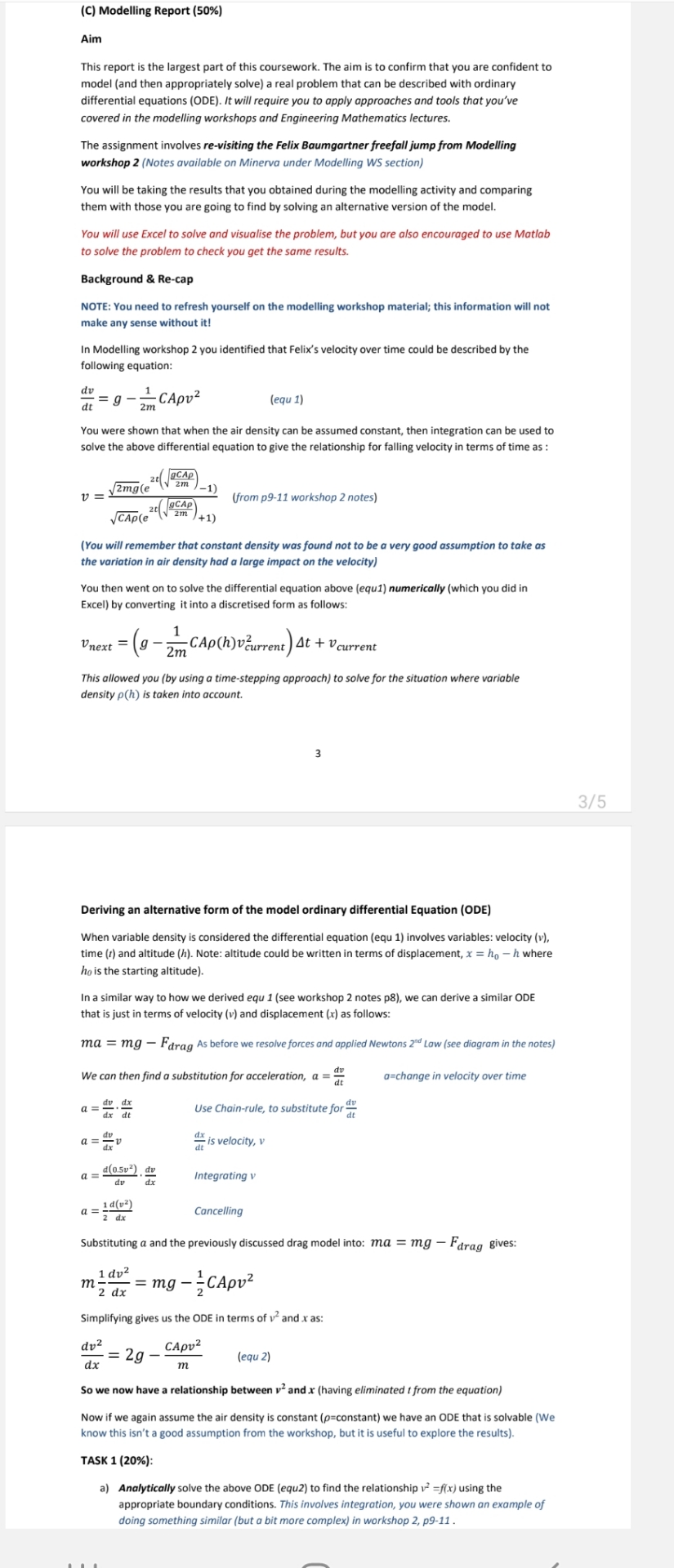
Question: ( C ) Modelling Report ( 5 0 % ) Aim This report is the largest part of this coursework. The aim is to confirm
C Modelling Report
Aim
This report is the largest part of this coursework. The aim is to confirm that you are confident to model and then appropriately solve a real problem that can be described with ordinary differential equations ODE It will require you to apply approaches and tools that you've covered in the modelling workshops and Engineering Mathematics lectures.
The assignment involves revisiting the Felix Baumgartner freefall jump from Modelling workshop Notes available on Minerva under Modelling WS section
You will be taking the results that you obtained during the modelling activity and comparing them with those you are going to find by solving an alternative version of the model.
You will use Excel to solve and visualise the problem, but you are also encouraged to use Matlab to solve the problem to check you get the same results.
Background & Recap
NOTE: You need to refresh yourself on the modelling workshop material; this information will not make any sense without it
In Modelling workshop you identified that Felix's velocity over time could be described by the following equation:
equ
You were shown that when the air density can be assumed constant, then integration can be used to solve the above differential equation to give the relationship for falling velocity in terms of time as :
from p workshop notes
You will remember that constant density was found not to be a very good assumption to take as the variation in air density had a large impact on the velocity
You then went on to solve the differential equation above equ numerically which you did in Excel by converting it into a discretised form as follows:
This allowed you by using a timestepping approach to solve for the situation where variable density is taken into account.
Deriving an alternative form of the model ordinary differential Equation ODE
When variable density is considered the differential equation equ involves variables: velocity time and altitude Note: altitude could be written in terms of displacement, where is the starting altitude
In a similar way to how we derived equ see workshop notes p we can derive a similar ODE that is just in terms of velocity and displacement as follows:
As before we resolve forces and applied Newtons Law see diagram in the notes
We can then find a substitution for acceleration, change in velocity over time
Use Chainrule, to substitute for
is velocity,
Integrating
Cancelling
Substituting a and the previously discussed drag model into: gives:
Simplifying gives us the ODE in terms of and as:
So we now have a relationship between and having eliminated from the equation
Now if we again assume the air density is constant constant we have an ODE that is solvable We know this isn't a good assumption from the workshop, but it is useful to explore the results
TASK :
a Analytically solve the above ODE equ to find the relationship using the appropriate boundary conditions. This involves integration, you were shown an example of doing something similar but a bit more complex in workshop p
Step by Step Solution
There are 3 Steps involved in it
1 Expert Approved Answer
Step: 1 Unlock

Question Has Been Solved by an Expert!
Get step-by-step solutions from verified subject matter experts
Step: 2 Unlock
Step: 3 Unlock
 Study Help