







Question: c++ please CSE 2383 - Data Structures Program 1 - Linked Lists Objectives: - Practice utilization of dynamic memory and objects - Practice altering and
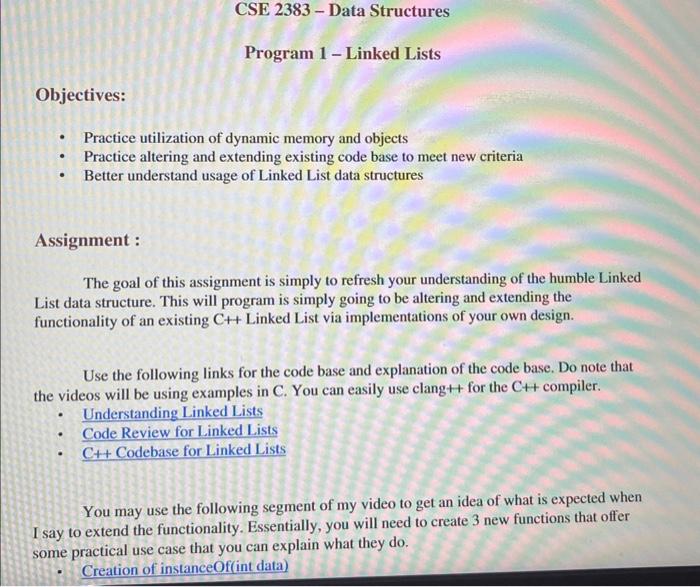
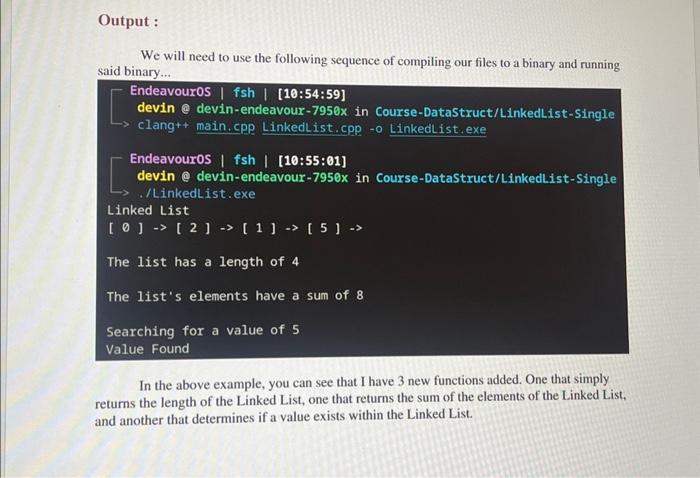
CSE 2383 - Data Structures Program 1 - Linked Lists Objectives: - Practice utilization of dynamic memory and objects - Practice altering and extending existing code base to meet new criteria - Better understand usage of Linked List data structures Assignment : The goal of this assignment is simply to refresh your understanding of the humble Linked List data structure. This will program is simply going to be altering and extending the functionality of an existing C++ Linked List via implementations of your own design. Use the following links for the code base and explanation of the code base. Do note that the videos will be using examples in C. You can easily use clang ++ for the C++ compiler. - Understanding Linked Lists - Code Review for Linked Lists - C++ Codebase for Linked Lists You may use the following segment of my video to get an idea of what is expected when I say to extend the functionality. Essentially, you will need to create 3 new functions that offer some practical use case that you can explain what they do. - Creation of instanceOf(int data) You may use the following segment of my video to get an idea of what is expected when I say to extend the functionality. Essentially, you will need to create 3 new functions that offer some practical use case that vou can exnlain what they do. As with the previous assignment, I do still expect the same compiler to be used and the commands used will be a portion of the submission. We will need to use the following sequence of compiling our files to a binary and running said binary... Endeavouros | fsh | [10:54:59] devin @ devin-endeavour-7950x in Course-DataStruct/LinkedList-Single clang++ main.cpp LinkedList. Cpp -0 LinkedList, exe Endeavouros | fsh | [10:55:01] devin e devin-endeavour-7950x in Course-DataStruct/LinkedList-Single / LinkedList.exe Linked List [0][2][1][5] The list has a length of 4 The list's elements have a sum of 8 Searching for a value of 5 value Found In the above example, you can see that I have 3 new functions added. One that simply returns the length of the Linked List, one that returns the sum of the elements of the Linked List, and another that determines if a value exists within the Linked List
Step by Step Solution
There are 3 Steps involved in it

Get step-by-step solutions from verified subject matter experts
 Study Help