







Question: c++ please dont give me any answer from chegg , not simillar please i want only the answer to copy it , thx #include using
c++
please dont give me any answer from chegg , not simillar please i want only the answer to copy it , thx
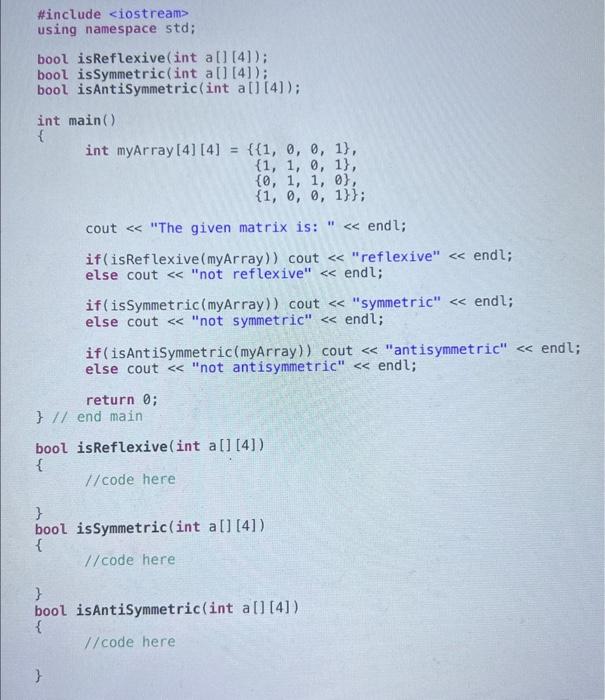
#include
using namespace std;
bool isReflexive(int a[][4]);
bool isSymmetric(int a[][4]);
bool isAntiSymmetric(int a[][4]);
int main()
{
int myArray[4][4] = {{1, 0, 0, 1},
{1, 1, 0, 1},
{0, 1, 1, 0},
{1, 0, 0, 1}};
cout
if(isReflexive(myArray)) cout
else cout
if(isSymmetric(myArray)) cout
else cout
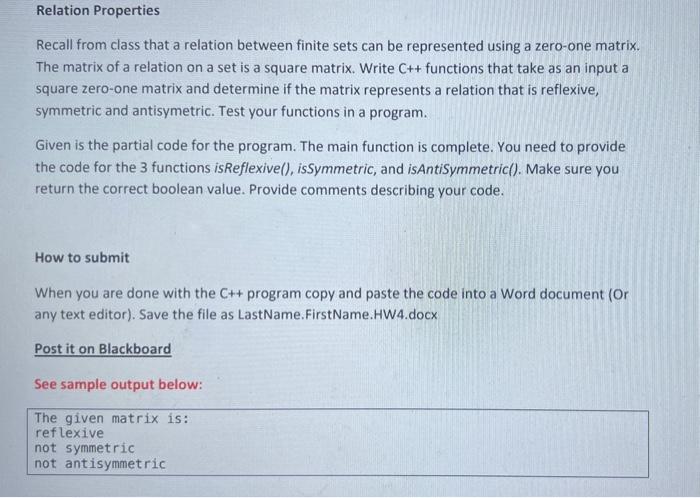
Recall from class that a relation between finite sets can be represented using a zero-one matrix. The matrix of a relation on a set is a square matrix. Write C++ functions that take as an input a square zero-one matrix and determine if the matrix represents a relation that is reflexive, symmetric and antisymetric. Test your functions in a program. Given is the partial code for the program. The main function is complete. You need to provide the code for the 3 functions isReflexive(), isSymmetric, and isAntiSymmetric(). Make sure you return the correct boolean value. Provide comments describing your code. How to submit When you are done with the C++ program copy and paste the code into a Word document (Or any text editor). Save the file as LastName.FirstName.HW4.docx Post it on Blackboard See sample output below: The given matrix is: ref lexive not symmetricif(isAntiSymmetric(myArray)) cout
else cout
return 0;
} // end main
bool isReflexive(int a[][4])
{
//code here
}
bool isSymmetric(int a[][4])
{
//code here
}
bool isAntiSymmetric(int a[][4])
{
//code here
}
Step by Step Solution
There are 3 Steps involved in it
1 Expert Approved Answer
Step: 1 Unlock

Question Has Been Solved by an Expert!
Get step-by-step solutions from verified subject matter experts
Step: 2 Unlock
Step: 3 Unlock
 Study Help