







Question: C++, please help me. This is code I had so far(above the picture). How to code the Partition Funtion from description above, can someone code
C++, please help me. 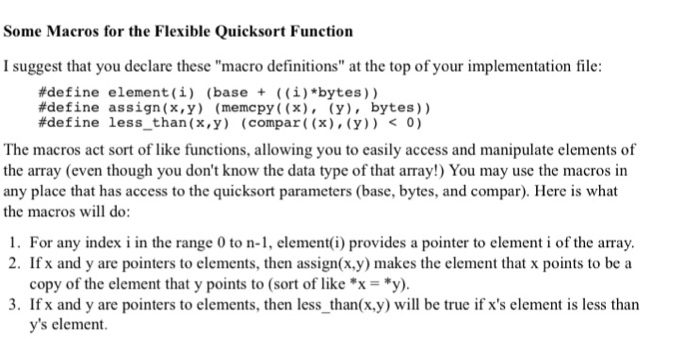
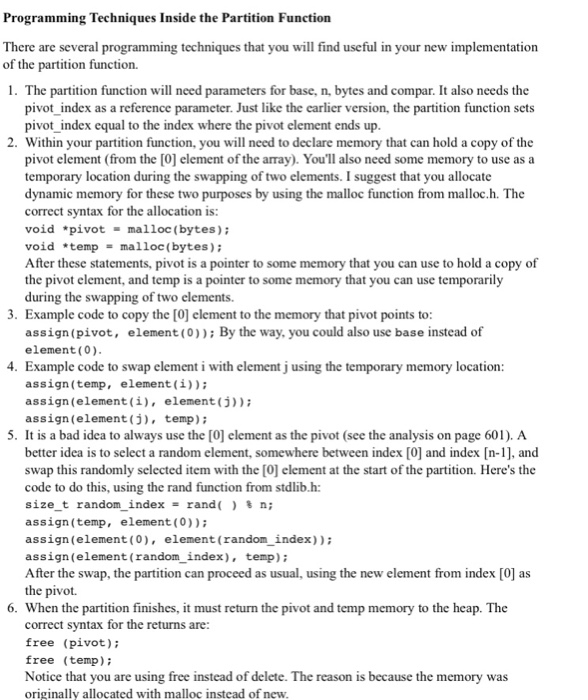
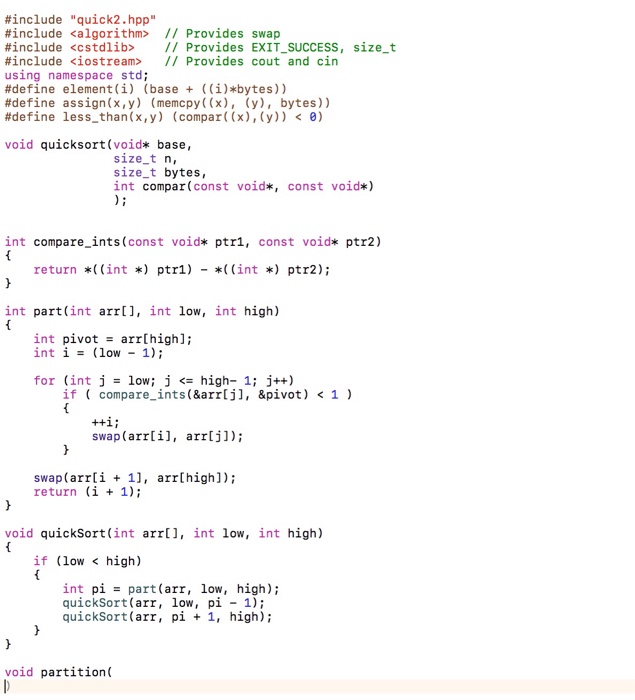
This is code I had so far(above the picture). How to code the Partition Funtion from description above, can someone code it for me?
Some Macros for the Flexible Quicksort Function I suggest that you declare these "macro definitions" at the top ofyour implementation file: #define elements (i) (base ((i) bytes) #define assign (x,y) (memcpy (x), (y), bytes)) define less than (x, y) (compar ((x), (y)) 0) The macros act sort of like functions, allowing you to easily access and manipulate elements of the array (even though you don't know the data type of that array!) You may use the macros in any place that has access to the quicksort parameters (base, bytes, and compar). Here is what the macros will do: l. For any index i in the range 0 to n-1, element(i) provides a pointer to element i of the array. 2. If x and y are pointers to elements, then assign(x,y) makes the element that x points to be a copy of the element that y points to (sort of like "xa y). 3. Ifx and y are pointers to elements, then less than(x,y) will be true if x's element is less than y's element. Some Macros for the Flexible Quicksort Function I suggest that you declare these "macro definitions" at the top ofyour implementation file: #define elements (i) (base ((i) bytes) #define assign (x,y) (memcpy (x), (y), bytes)) define less than (x, y) (compar ((x), (y)) 0) The macros act sort of like functions, allowing you to easily access and manipulate elements of the array (even though you don't know the data type of that array!) You may use the macros in any place that has access to the quicksort parameters (base, bytes, and compar). Here is what the macros will do: l. For any index i in the range 0 to n-1, element(i) provides a pointer to element i of the array. 2. If x and y are pointers to elements, then assign(x,y) makes the element that x points to be a copy of the element that y points to (sort of like "xa y). 3. Ifx and y are pointers to elements, then less than(x,y) will be true if x's element is less than y's element
Step by Step Solution
There are 3 Steps involved in it

Get step-by-step solutions from verified subject matter experts
 Study Help