







Question: C++ please Write a program that prompts the user to enter a set of N double precision floating point numbers, scans them into a 1-D
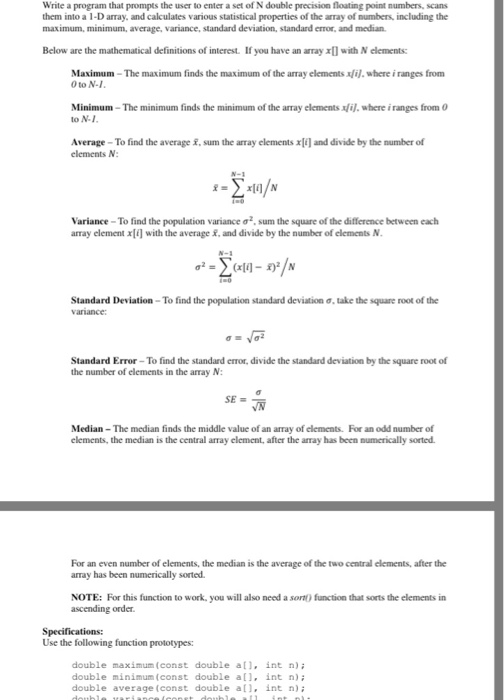
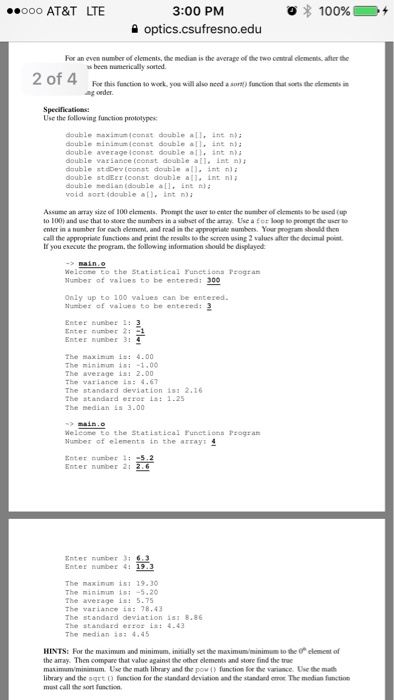
Write a program that prompts the user to enter a set of N double precision floating point numbers, scans them into a 1-D array, and calculates various statistical properties of the array of numbers, including the maximum, minimum, average, variance, standard deviation, standard error, and median. Below are the mathematical definitions of interest. If you have an array x with N elements: Maximum-The maximum finds the maximum of the array elements 0 to N-I . where i ranges from Minimum-The minimum finds the minimum of the array elements to N-1 , where i ranges from 0 Average To find the average , sum the array elements x[] and divide by the number of elements N Variance-To find the population vanance , sum the square of the difference between each array element x[] with the average R, and divide by the number of elements N Standard Deviation-To find the population standard deviation , take the square root of the variance: Standard Error-To find the standard error, divide the standard deviation by the square root of the number of elements in the array N Median The median finds the middle value of an array elements, the median is the central array clement, after the array has been numerically sorted. of elements. For an odd number of For an even number of elements, the median is the average of the two central elements, after the array has been numerically sorted function that sorts the elements in NOTE: For this function to work, you will also need a sor ascending order. Use the following function prototypes: double maximum(const double al. int n)i double minimum(const double a. int n) double average (const double a. int n)
Step by Step Solution
There are 3 Steps involved in it

Get step-by-step solutions from verified subject matter experts
 Study Help