







Question: C++ Program: // Example 1 // Time class. #include #include using namespace std; class Time { public: Time(); void setTime(int, int, int); void printUniversal(); void
C++ Program:
// Example 1
// Time class.
#include
#include
using namespace std;
class Time {
public:
Time();
void setTime(int, int, int);
void printUniversal();
void printStandard();
private:
int hour;
int minute;
int second;
};
Time::Time()
{
hour = 0;
minute = 0;
second = 0;
}
void Time::setTime(int h, int m, int s)
{
hour = (h >= 0 && h
minute = (m >= 0 && m
second = (s >= 0 && s
}
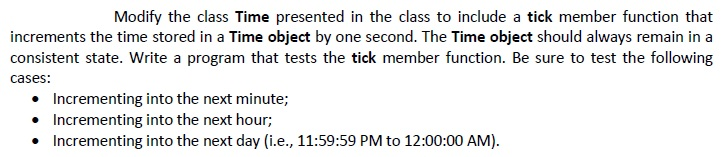
Modify the class Time presented in the class to include a tick member function that increments the time stored in a Time object by one second. The Time object should always remain in a consistent state. Write a program that tests the tick member function. Be sure to test the following cases: incrementing into the next minute; . Incrementing into the next hour; Incrementing into the next day (i.e, 11:59:59 PM to 12:00:00 AM)
Step by Step Solution
There are 3 Steps involved in it

Get step-by-step solutions from verified subject matter experts
 Study Help