







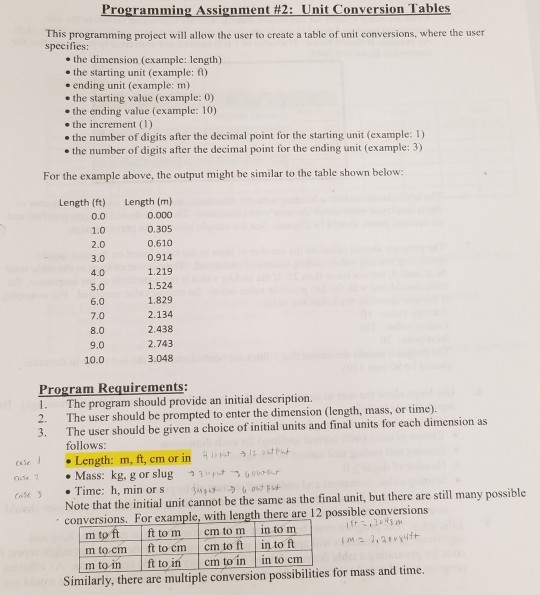
Question: C++ Programming Assignment #2: Unit Conversion Tables This programming project will allow the user to create a table of unit conversions, where the user specifies:
C++
Programming Assignment #2: Unit Conversion Tables This programming project will allow the user to create a table of unit conversions, where the user specifies: e the dimension (example: length) e the starting unit (example: f) - ending unit (example: m) the starting value (example: 0) the ending value (example: 10) the increment (1) the number of digits after the decimal point for the starting unit (example: 1) the number of digits after the decimal point for the ending unit (example: 3) For the example above, the output might be similar to the table shown below: Length (ft) 0.0 Length (m) 0.000 0.305 0.610 0.914 1.219 1.524 1.829 2.134 2.438 2.743 3.048 2.0 3.0 5.0 6.0 7.0 8.0 10.0 Program Requirements: 1. The program should provide an initial description. 2. The user should be prompted to enter the dimension (length, mass, or time). 3. The user should be given a choice of initial units and final units for each dimension as follows: . Length: m, ft, cm or in i)9 . Mass: kg, g or slug 31' r, uou.tr C&Se l .. Note that the initial unit cannot be the same as the final unit, but there are still many possible conversions. For example, with length there are 12 possible conversions mtoft ftto m lem tom lin to m m to cm ft to cm tof in to ft mtoin | ft to in crn to inlin to cm Similarly, there are multiple conversion possibilities for mass and time. Programming Assignment #2: Unit Conversion Tables This programming project will allow the user to create a table of unit conversions, where the user specifies: e the dimension (example: length) e the starting unit (example: f) - ending unit (example: m) the starting value (example: 0) the ending value (example: 10) the increment (1) the number of digits after the decimal point for the starting unit (example: 1) the number of digits after the decimal point for the ending unit (example: 3) For the example above, the output might be similar to the table shown below: Length (ft) 0.0 Length (m) 0.000 0.305 0.610 0.914 1.219 1.524 1.829 2.134 2.438 2.743 3.048 2.0 3.0 5.0 6.0 7.0 8.0 10.0 Program Requirements: 1. The program should provide an initial description. 2. The user should be prompted to enter the dimension (length, mass, or time). 3. The user should be given a choice of initial units and final units for each dimension as follows: . Length: m, ft, cm or in i)9 . Mass: kg, g or slug 31' r, uou.tr C&Se l .. Note that the initial unit cannot be the same as the final unit, but there are still many possible conversions. For example, with length there are 12 possible conversions mtoft ftto m lem tom lin to m m to cm ft to cm tof in to ft mtoin | ft to in crn to inlin to cm Similarly, there are multiple conversion possibilities for mass and time
Step by Step Solution
There are 3 Steps involved in it

Get step-by-step solutions from verified subject matter experts
 Study Help