







Question: C Programming Fill in the missing code in the four areas that say Student provides missing code... All source files Problem5.c, Random.h, Random.c located in
C Programming
Fill in the missing code in the four areas that say "Student provides missing code..."
All source files Problem5.c, Random.h, Random.c located in the chegg link I provided
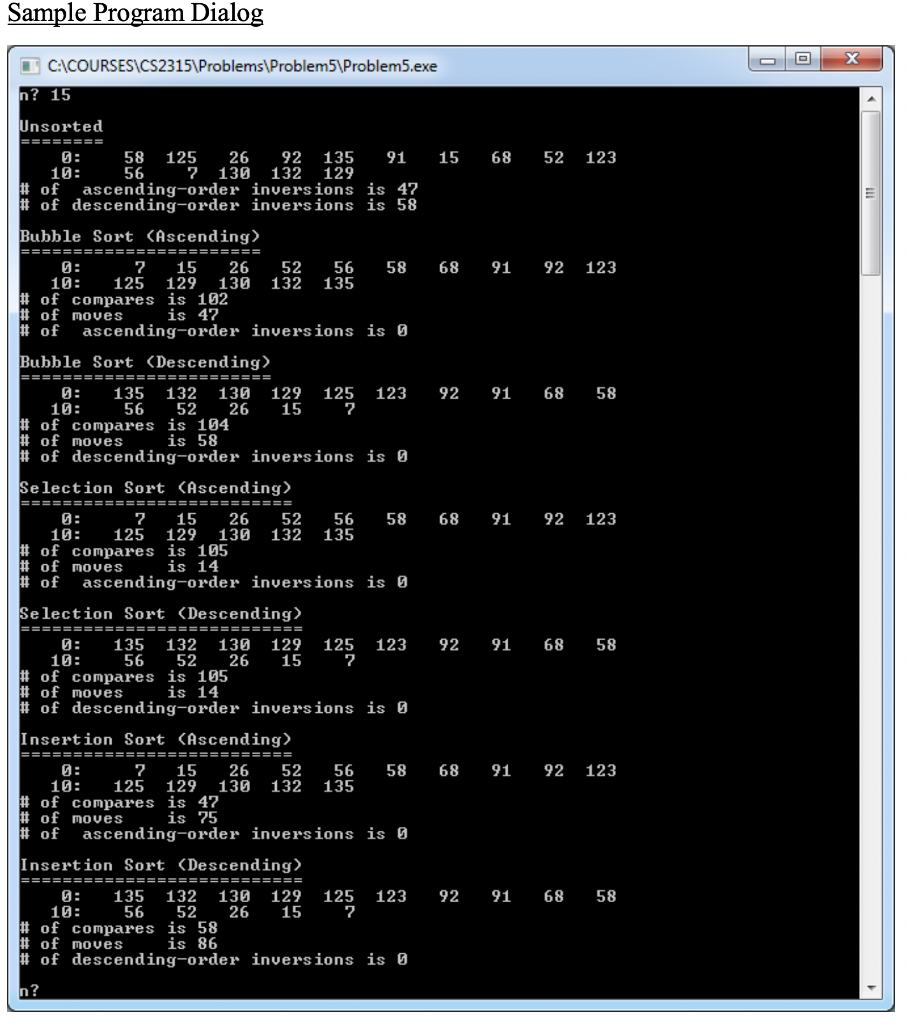
Please make sure to provide all completed source code and screenshot of compiled output.
-will rate positively.
I have source codes Problem5.c, Random.h, and Random.C in my other question. Couldn't put here because it said question is too long
https://www.chegg.com/homework-help/questions-and-answers/c-programming-take-screenshot-compiled-output-complete-look-similar-sample-one-provided--f-q31891843
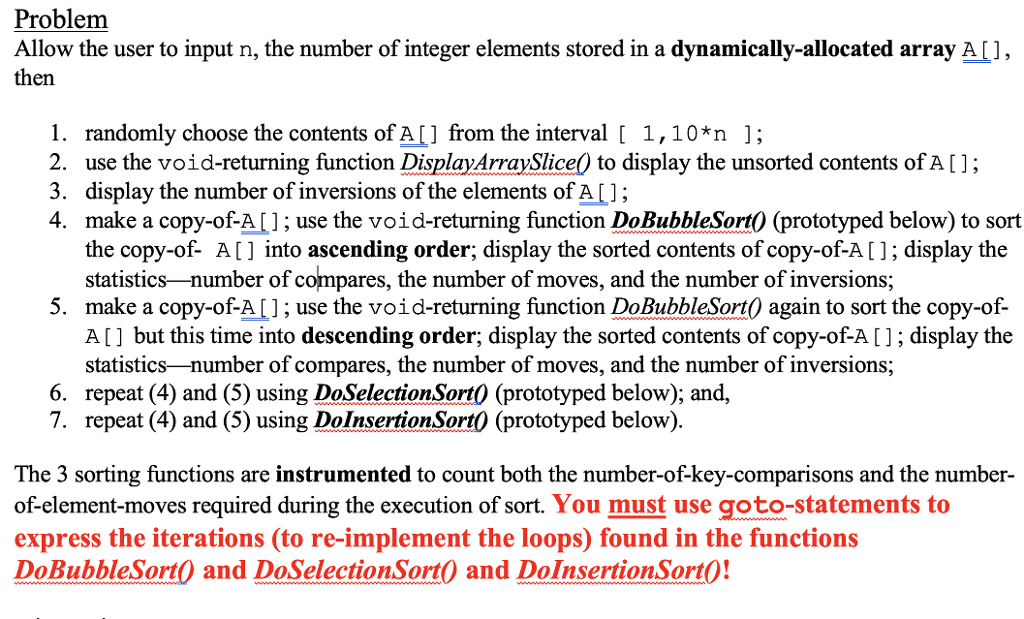
Problemm Allow the user to input n, the number of integer elements stored in a dynamically-allocated array en 1. randomly choose the contents of A] from the interval [ 1,10*n ]; 2. use the void-returning function DisplayArraySlice) to display the unsorted contents of A[]; 3. display the number of inversions of the elements of A[]; 4. make a copy-of-A[]; use the void-returning function DoBubbleSort0 (prototyped below) to sort the copy-of- A[] into ascending order; display the sorted contents of copy-of-A[]; display the statistics-number of compares, the number of moves, and the number of inversions; 5. make a copy-of-A[]; use the void-returning function DoBubbleSort0 again to sort the copy-of- A [] but this time into descending order; display the sorted contents of copy-of-A [1; display the statistics-number of compares, the number of moves, and the number of inversions; 6. repeat (4) and (5) using DoSelectionSort0 (prototyped below); and, 7. repeat (4) and (5) using DoInsertionSort) (prototyped below) The 3 sorting functions are instrumented to count both the number-of-key-comparisons and the number- of-element-moves required during the execution of sort. You must use goto-statements to express the iterations (to re-implement the loops) found in the functions DoBubbleSort) and DoSelectionSort) and DoInsertionSort)! Problemm Allow the user to input n, the number of integer elements stored in a dynamically-allocated array en 1. randomly choose the contents of A] from the interval [ 1,10*n ]; 2. use the void-returning function DisplayArraySlice) to display the unsorted contents of A[]; 3. display the number of inversions of the elements of A[]; 4. make a copy-of-A[]; use the void-returning function DoBubbleSort0 (prototyped below) to sort the copy-of- A[] into ascending order; display the sorted contents of copy-of-A[]; display the statistics-number of compares, the number of moves, and the number of inversions; 5. make a copy-of-A[]; use the void-returning function DoBubbleSort0 again to sort the copy-of- A [] but this time into descending order; display the sorted contents of copy-of-A [1; display the statistics-number of compares, the number of moves, and the number of inversions; 6. repeat (4) and (5) using DoSelectionSort0 (prototyped below); and, 7. repeat (4) and (5) using DoInsertionSort) (prototyped below) The 3 sorting functions are instrumented to count both the number-of-key-comparisons and the number- of-element-moves required during the execution of sort. You must use goto-statements to express the iterations (to re-implement the loops) found in the functions DoBubbleSort) and DoSelectionSort) and DoInsertionSort)
Step by Step Solution
There are 3 Steps involved in it

Get step-by-step solutions from verified subject matter experts
 Study Help