







Question: C programming. Please don't use any previous chegg solutions, if you do I will be forced to down vote the solution so please provide an
C programming. Please don't use any previous chegg solutions, if you do I will be forced to down vote the solution so please provide an original answer. Please provide the code for the program file (.c), and provide screenshots of sample runs of the program. Please include commenting with your code.
Assume that a finite number of resources of a single resource type must be managed. Processes may ask for a number of these resources and will return them once finished. As an example, many commercial software packages provide a given number of licenses, indicating the number of applications that may run concurrently. When the application is started, the license count is decremented. When the application is terminated, the license count is incremented. If all licenses are in use, requests to start the application are denied. Such a request will be granted only when an existing license holder terminates the application and a license is returned. The following program segment is used to manage a finite number of instances of an available resource. The maximum number of resources and the number of available resources are declared as follows:
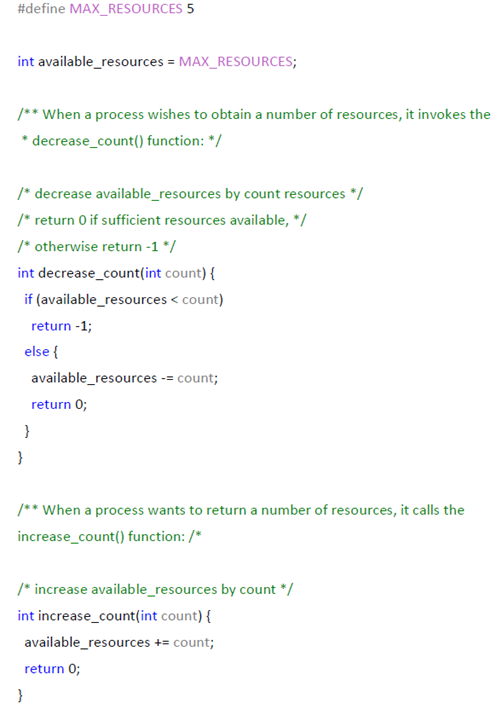
The preceding program segment produces a race condition. Do the following: a. Identify the data involved in the race condition. b. Identify the location (or locations) in the code where the race condition occurs. c. Using a semaphore or mutex lock, fix the race condition. It is permissible to modify the decrease_count() function so that the calling process is blocked until sufficient resources are available.
The code for this solution must read a set of integers from the command line. The first integer is MAX_RESOURCES. Subsequent integers will be negative to decrease resources, and positive to increase resources. As indicated decrease_count() can be modified, but must return -1 if the requested resources > MAX_RESOURCES. Output should be the results from each call. For example, a MAX_RESOURCES of 5 with 3 calls would result in the following: ./a.out 5 -4 -2 2 0, -1, 0
#define MAX_RESOURCES 5 int available_resources = MAX_RESOURCES; /** When a process wishes to obtain a number of resources, it invokes the * decrease_count() function: */ /* decrease available_resources by count resources */ /* return 0 if sufficient resources available, */ /* otherwise return -1 */ int decrease_count(int count) { if (available_resources
Step by Step Solution
There are 3 Steps involved in it

Get step-by-step solutions from verified subject matter experts
 Study Help