







Question: C Programming Question (please respond with the code necessary to answer question in yellow box! Commandline arguments An example that uses commandline arguments . Consider
C Programming Question (please respond with the code necessary to answer question in yellow box!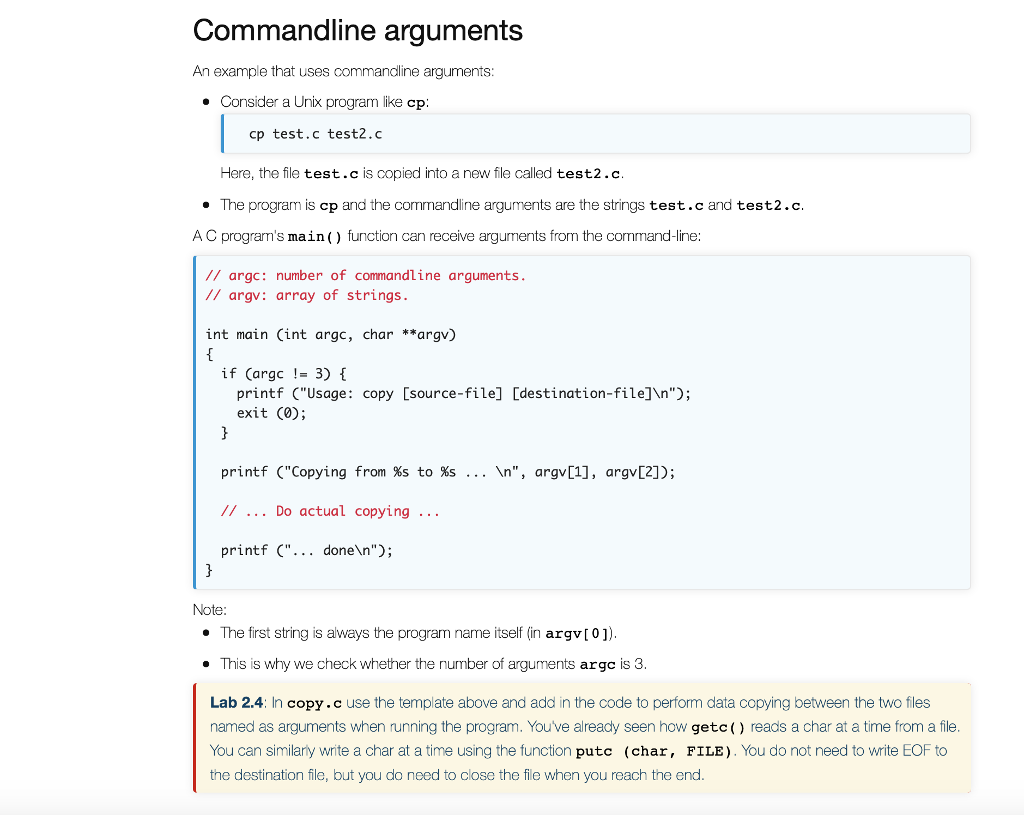
Commandline arguments An example that uses commandline arguments . Consider a Unix program like cp: cp test.c test2.c Here, the file test.cis copied into a new fle called test2.c The program is cp and the commandline arguments are the strings test.c and test2.c AC program's main)function can receive arguments from the command-ine: 1 argc: number of commandline arguments. 7argv: array of strings int main Cint argc, char "argv) if (argc !-3) { printf C"Usage: copy [source-file] [destination-file] "); exit 0) printf C"Copying from s to s .. In", argv[1], argv[2]) II. Do actual copying. printf C"... done ) Note: The first string is always the program name itself (in argv[o]. This is why we check whether the number of arguments argc is 3. Lab 2.4: In copy.c use the template above and add in the code to perform data copying between the two fles named as arguments when running the program. You've already seen how getc() reads a char at a time from a file. You can similary write a char at a time using the function putc (char, FILE).You do not need to write EOF to the destination file, but you do need to close the file when you reach the end
Step by Step Solution
There are 3 Steps involved in it

Get step-by-step solutions from verified subject matter experts
 Study Help