





Question: C++ Recursive *Quick Sort* 1. Please modify the PARTITION function below so that the array gets sorted from least to greatest. 2. pass the quickSort

C++ Recursive *Quick Sort* 1. Please modify the PARTITION function below so that the array gets sorted from least to greatest. 2. pass the quickSort function an array with the following values: 5, 2, 6, 1, 3, 4 ... run the program and show a screenshot showing that it works.

double arr[] = {5, 2, 6, 1, 3, 4};

quickSort(arr, 0, 6);

for (int i = 0; i

Thank YOU!!!

PS: do not change the pivot. Our pivot must be the first element of the array. (what I mean by this is, that there different ways to choose a pivot. You can select a random pivot, make the middle number your pivot, or the last number of the array your pivot... etc... for this assigment, we are required to choose the first number in the array as our pivot)
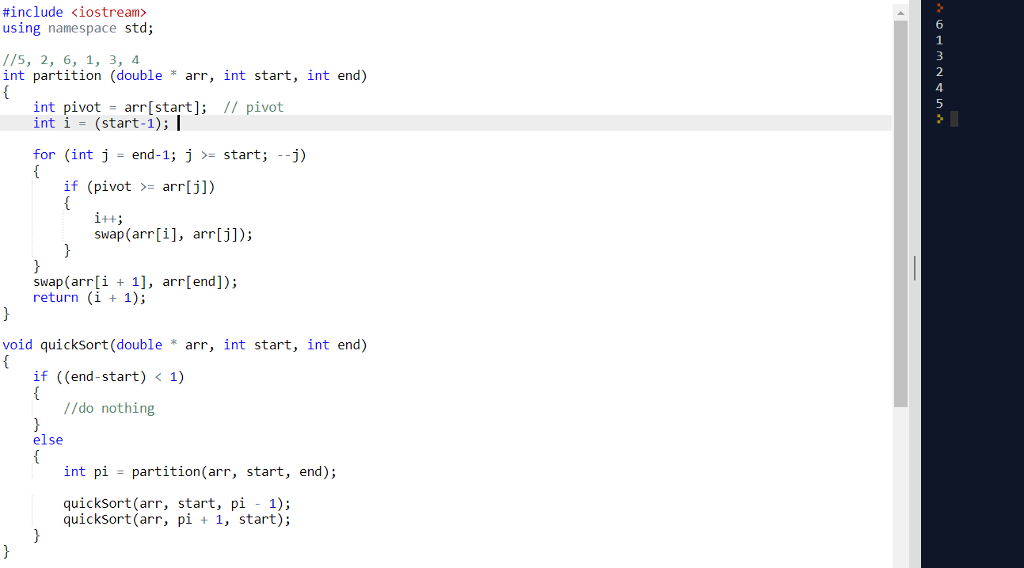
C++ Recursive *Quick Sort* 1. Please modify the PARTITION function below so

#include using namespace std; 6 /15, 2, 6, 1, 3, 4 int partition (double arr, int start, int end) 2 4 5 int pivot - arr[start]; // pivot int i = (start-1); I for (int j - end-1; j >- start; --j) if (pivot >= arr[j]) swap(arr[i], arr[j]); swap (arr[i 1], arr[end]); return (i + 1); void quicksort(double arr, int start, int end) if ((end-start) 1) //do nothing else int pi partition(arr, start, end); quickSort(arr, start, pi - 1); quickSort(arr, pi 1, start); #include using namespace std; 6 /15, 2, 6, 1, 3, 4 int partition (double arr, int start, int end) 2 4 5 int pivot - arr[start]; // pivot int i = (start-1); I for (int j - end-1; j >- start; --j) if (pivot >= arr[j]) swap(arr[i], arr[j]); swap (arr[i 1], arr[end]); return (i + 1); void quicksort(double arr, int start, int end) if ((end-start) 1) //do nothing else int pi partition(arr, start, end); quickSort(arr, start, pi - 1); quickSort(arr, pi 1, start)

Step by Step Solution

There are 3 Steps involved in it

1 Expert Approved Answer
Step: 1 Unlock blur-text-image
Question Has Been Solved by an Expert!

Get step-by-step solutions from verified subject matter experts

Step: 2 Unlock
Step: 3 Unlock

Students Have Also Explored These Related Databases Questions!