







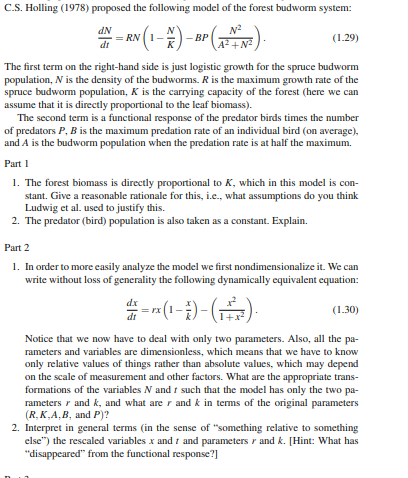
Question: C . S . Holling ( 1 9 7 8 ) proposed the following model of the forest budworm system: d N d t =
CS Holling proposed the following model of the forest budworm system:
The first term on the righthand side is just logistic growth for the spruce budworm population, is the density of the budworms. is the maximum growth rate of the
spruce budworm population, is the carrying capacity of the forest here we can assume that it is directly proportional to the leaf biomass
The second term is a functional response of the predator birds times the number of predators is the maximum predation rate of an individual bird on average and is the budworm population when the predation rate is at half the maximum.
Part
The forest biomass is directly proportional to which in this model is constant. Give a reasonable rationale for this, ie what assumptions do you think Ludwig et al used to justify this.
The predator bird population is also taken as a constant. Explain.
Part
In order to more easily analyze the model we first nondimensionalize it We can write without loss of generality the following dynamically equivalent equation:
Notice that we now have to deal with only two parameters. Also, all the parameters and variables are dimensionless, which means that we have to knowonly relative values of things rather than absolute values, which may depend on the scale of measurement and other factors. What are the appropriate transformations of the variables and such that the model has only the two parameters and and what are and in terms of the original parameters, and
Interpret in general terms in the sense of "something relative to somethingelse" the rescaled variables and and parameters and Hint: What has"disappeared" from the functional response?
Step by Step Solution
There are 3 Steps involved in it
1 Expert Approved Answer
Step: 1 Unlock

Question Has Been Solved by an Expert!
Get step-by-step solutions from verified subject matter experts
Step: 2 Unlock
Step: 3 Unlock
 Study Help