







Question: c. Using the critical values table, calculate the p-value for this test. d. Interpret the p-value as it relates to these data. Explain the
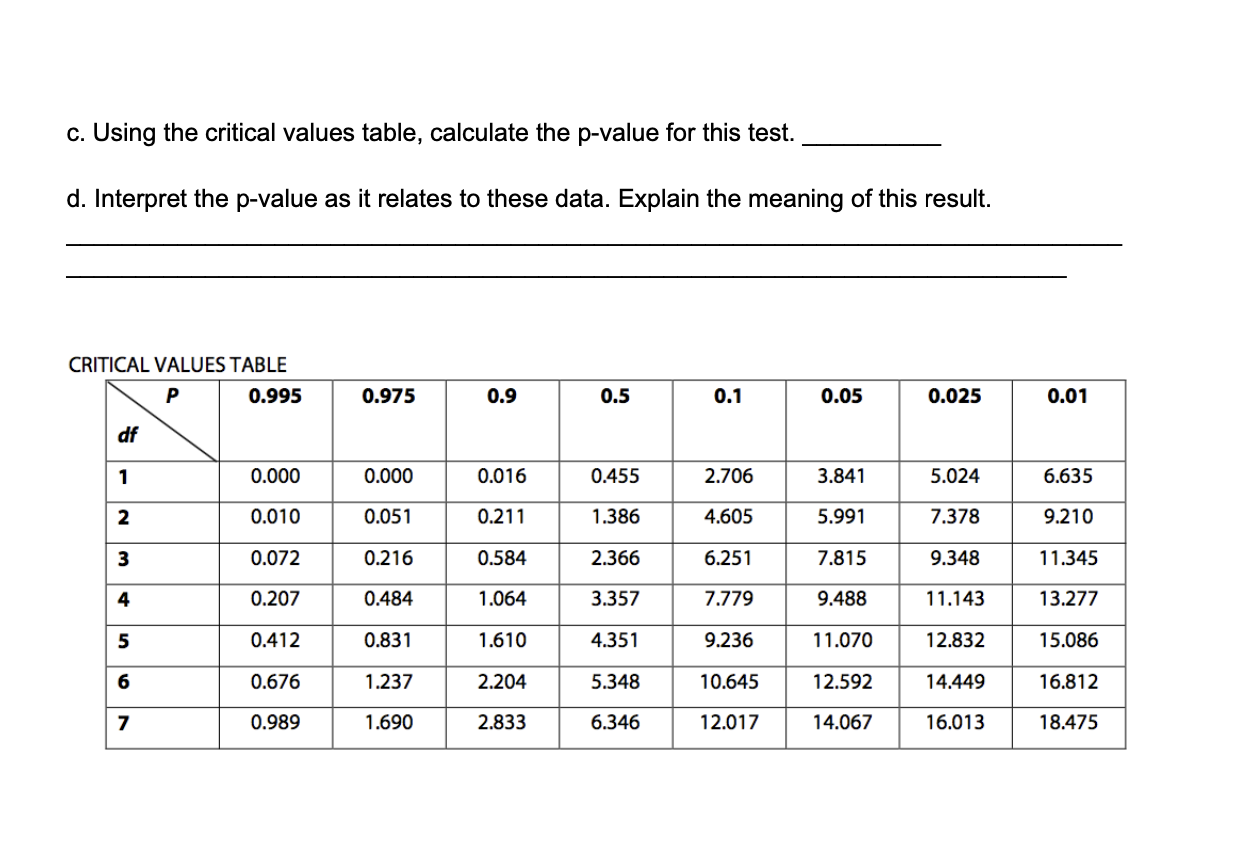
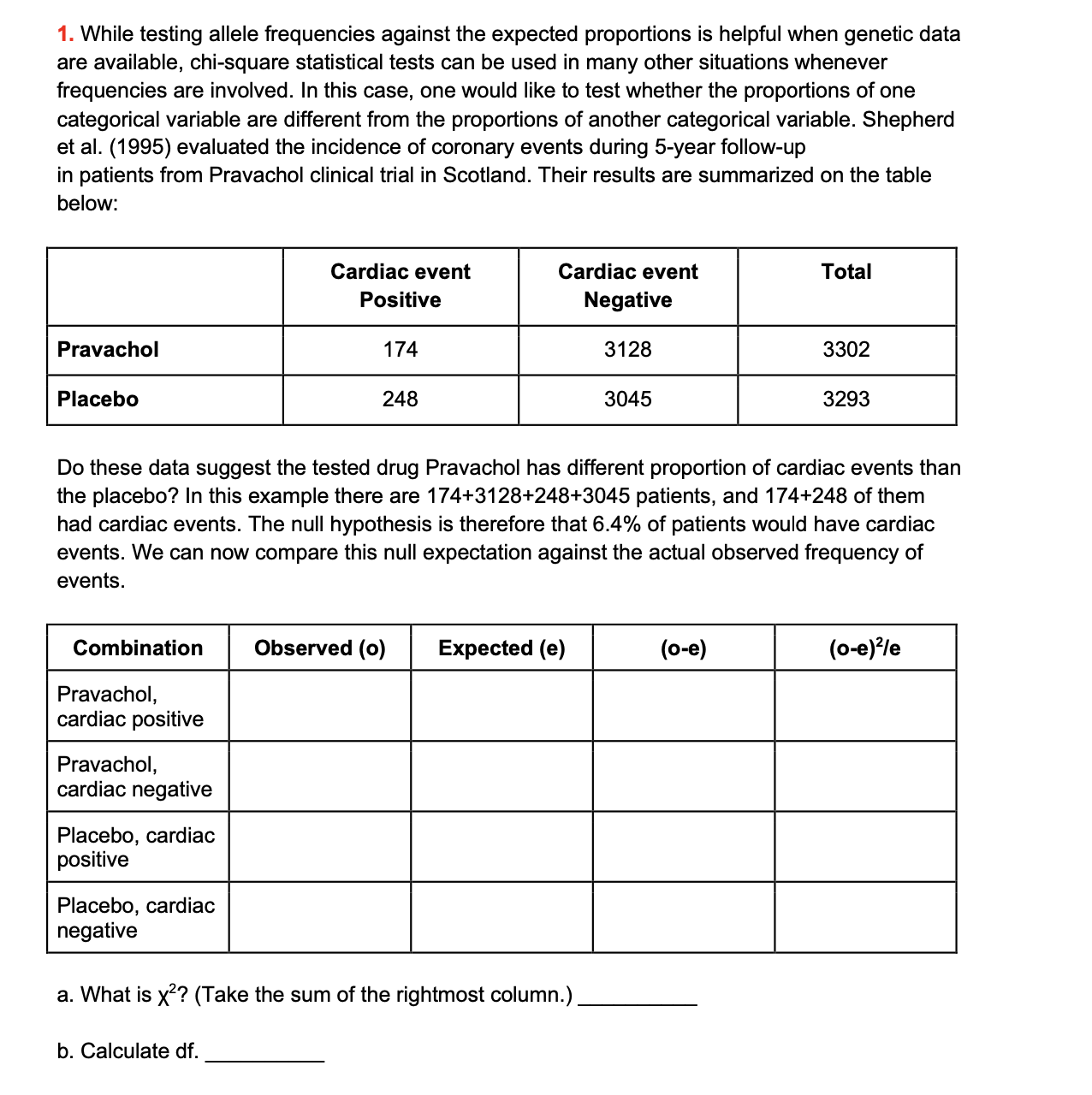
c. Using the critical values table, calculate the p-value for this test. d. Interpret the p-value as it relates to these data. Explain the meaning of this result. CRITICAL VALUES TABLE P 0.995 0.975 0.9 0.5 0.1 0.05 0.025 0.01 df 1 0.000 0.000 0.016 0.455 2.706 3.841 5.024 6.635 2 0.010 0.051 0.211 1.386 4.605 5.991 7.378 9.210 3 0.072 0.216 0.584 2.366 6.251 7.815 9.348 11.345 4 0.207 0.484 1.064 3.357 7.779 9.488 11.143 13.277 5 0.412 0.831 1.610 4.351 9.236 11.070 12.832 15.086 6 0.676 1.237 2.204 5.348 10.645 12.592 14.449 16.812 7 0.989 1.690 2.833 6.346 12.017 14.067 16.013 18.475 1. While testing allele frequencies against the expected proportions is helpful when genetic data are available, chi-square statistical tests can be used in many other situations whenever frequencies are involved. In this case, one would like to test whether the proportions of one categorical variable are different from the proportions of another categorical variable. Shepherd et al. (1995) evaluated the incidence of coronary events during 5-year follow-up in patients from Pravachol clinical trial in Scotland. Their results are summarized on the table below: Pravachol Placebo Cardiac event Positive Cardiac event Negative Total 174 248 3128 3045 3302 3293 Do these data suggest the tested drug Pravachol has different proportion of cardiac events than the placebo? In this example there are 174+3128+248+3045 patients, and 174+248 of them had cardiac events. The null hypothesis is therefore that 6.4% of patients would have cardiac events. We can now compare this null expectation against the actual observed frequency of events. Combination Observed (o) Expected (e) (o-e) (o-e)/e Pravachol, cardiac positive Pravachol, cardiac negative Placebo, cardiac positive Placebo, cardiac negative a. What is x2? (Take the sum of the rightmost column.) b. Calculate df.
Step by Step Solution
There are 3 Steps involved in it
I will guide you through the steps to calculate the pvalue and interpret the results using the data provided in the screenshots Heres how to go about it Part a Calculate the ChiSquare Statistic The fi... View full answer

Get step-by-step solutions from verified subject matter experts
 Study Help