







Question: c . What does your answer to part b tell you about this project's IRR? ( Select the best answer below. ) A . There
c What does your answer to part b tell you about this project's IRR? Select the best answer below.
A There are infinite IRRs for this project.
B There is no IRR for such cash flows.
C There are multiple IRRs for this project.
D There is only one IRR for this project.
d Should Froogle invest in this project if its cost of capital is @elect the best answer below.
A Yes
B No
Should Froogle invest in this project if its cost of capital is $elect the best answer below.
A No
B Yes
e Assume that the financing is and reinvestment rate is what is the MIRR?
If the WACC is nd the reinvestment rate is then the MIRR is Round to two decimal places.
f In general, when faced with a project like this, how should a firm decide whether to invest in the project or reject itSelect the best answer below.
A It is best to use the IRR method.
B It is best to use the NPV method.
C It is best to use the payback period method.
D None of the methods is suitable.
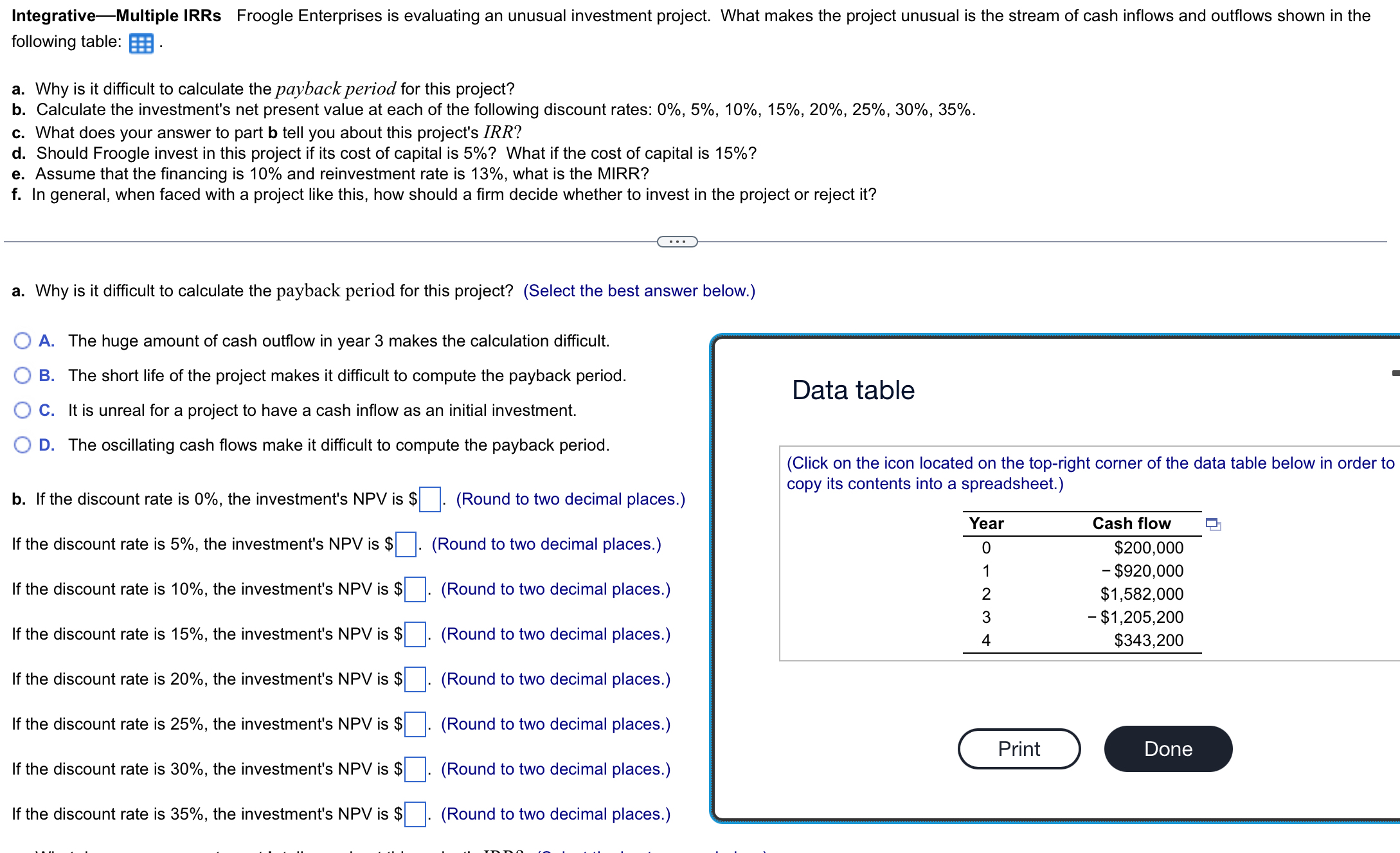
IntegrativeMultiple IRRs Froogle Enterprises is evaluating an unusual investment project. What makes the project unusual is the stream of cash inflows and outflows shown in the following table:
a Why is it difficult to calculate the payback period for this project?
b Calculate the investment's net present value at each of the following discount rates:
c What does your answer to part tell you about this project's IRR
d Should Froogle invest in this project if its cost of capital is What if the cost of capital is
e Assume that the financing is and reinvestment rate is what is the MIRR?
f In general, when faced with a project like this, how should a firm decide whether to invest in the project or reject it
a Why is it difficult to calculate the payback period for this project? Select the best answer below.
A The huge amount of cash outflow in year makes the calculation difficult.
B The short life of the project makes it difficult to compute the payback period.
C It is unreal for a project to have a cash inflow as an initial investment.
D The oscillating cash flows make it difficult to compute the payback period.
b If the discount rate is the investment's NPV is $ Round to two decimal places.
If the discount rate is the investment's NPV is $ Round to two decimal places.
If the discount rate is the investment's NPV is $
Round to two decimal places.
If the discount rate is the investment's NPV is $
Round to two decimal places.
If the discount rate is the investment's NPV is $
Round to two decimal places.
If the discount rate is the investment's NPV is $
Round to two decimal places.
If the discount rate is the investment's NPV is $Round to two decimal places.
If the discount rate is the investment's NPV is $Round to two decimal places.
Data table
Click on the icon located on the topright corner of the data table below in order to copy its contents into a spreadsheet.
tableYearCash flow$
Step by Step Solution
There are 3 Steps involved in it
1 Expert Approved Answer
Step: 1 Unlock

Question Has Been Solved by an Expert!
Get step-by-step solutions from verified subject matter experts
Step: 2 Unlock
Step: 3 Unlock
 Study Help