







Question: C++11 (h) In a static member function, you may use the this parameter TRUE-FALSE (i) Derived classes are able to directly access protected data members
C++11
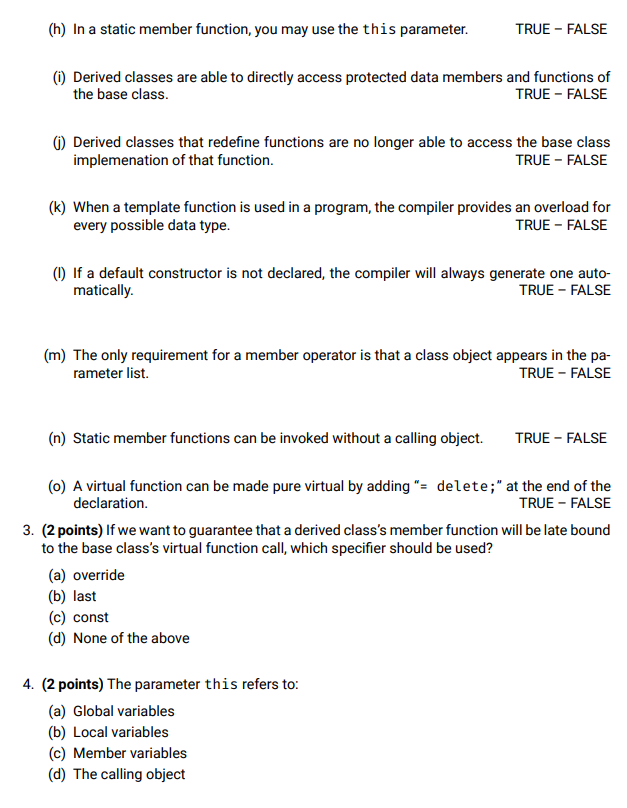
(h) In a static member function, you may use the this parameter TRUE-FALSE (i) Derived classes are able to directly access protected data members and functions of the base class TRUE -FALSE C) Derived classes that redefine functions are no longer able to access the base class TRUE -FALSE implemenation of that function. (k) When a template function is used in a program, the compiler provides an overload for TRUE -FALSE every possible data type (1) If a default constructor is not declared, the compiler will always generate one auto- TRUE- FALSE matically (m) The only requirement for a member operator is that a class object appears in the pa- TRUE-FALSE rameter list. (n) Static member functions can be invoked without a calling object. TRUE FALSE (o) A virtual function can be made pure virtual by addingdelete;" at the end of the TRUE- FALSE declaration. 3. (2 points) If we want to guarantee that a derived class's member function will be late bound to the base class's virtual function call, which specifier should be used? (a) override (b) last (c) const (d) None of the above 4. (2 points) The parameter this refers to (a) Global variables (b) Local variables (c) Member variables (d) The calling object
Step by Step Solution
There are 3 Steps involved in it

Get step-by-step solutions from verified subject matter experts
 Study Help