







Question: C8. (12 points) In this question, we will explore how the Linear Congruence Theorem has applications in other areas of mathematics. To do this, we
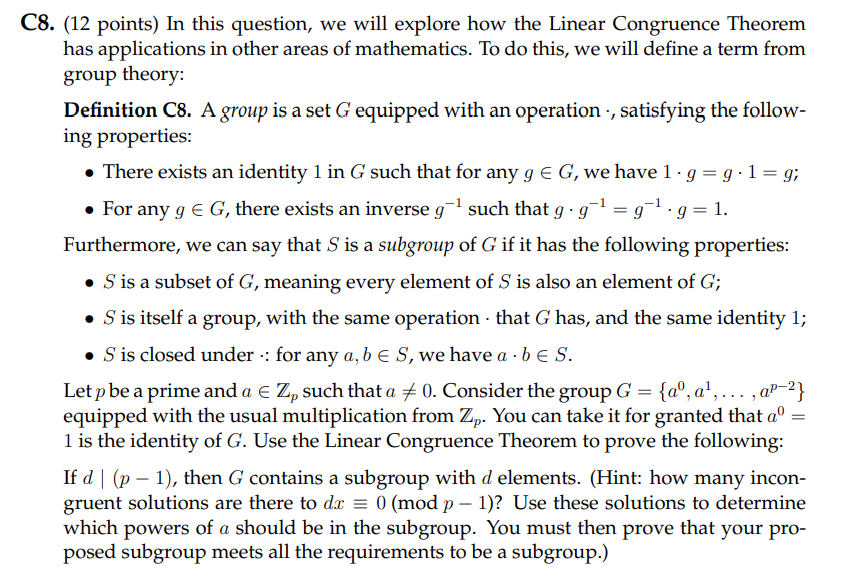
C8. (12 points) In this question, we will explore how the Linear Congruence Theorem has applications in other areas of mathematics. To do this, we will define a term from group theory: Definition C8. A group is a set G equipped with an operation ., satisfying the follow- ing properties: . There exists an identity 1 in G such that for any g E G, we have 1 . g = g . 1 = 9; . For any g E G, there exists an inverse go such that g . g ) = g ] . g = 1. Furthermore, we can say that S is a subgroup of G if it has the following properties: . S is a subset of G, meaning every element of S is also an element of G; . S is itself a group, with the same operation . that G has, and the same identity 1; . S is closed under .: for any a, be S, we have a . be S. Let p be a prime and a E Zp such that a # 0. Consider the group G = {a", al, ..., ap-?} equipped with the usual multiplication from Zp. You can take it for granted that a" = 1 is the identity of G. Use the Linear Congruence Theorem to prove the following: If d | (p - 1), then G contains a subgroup with d elements. (Hint: how many incon- gruent solutions are there to dr = 0 (mod p - 1)? Use these solutions to determine which powers of a should be in the subgroup. You must then prove that your pro- posed subgroup meets all the requirements to be a subgroup.)
Step by Step Solution
There are 3 Steps involved in it

Get step-by-step solutions from verified subject matter experts
 Study Help