







Question: CA-86 Chapter 4 . Multiplication SECTION 4.3 CLASS ACTIVITY 4-E X Why Is the Commutative Property of Multiplication Not Obvious and Why Is It True?
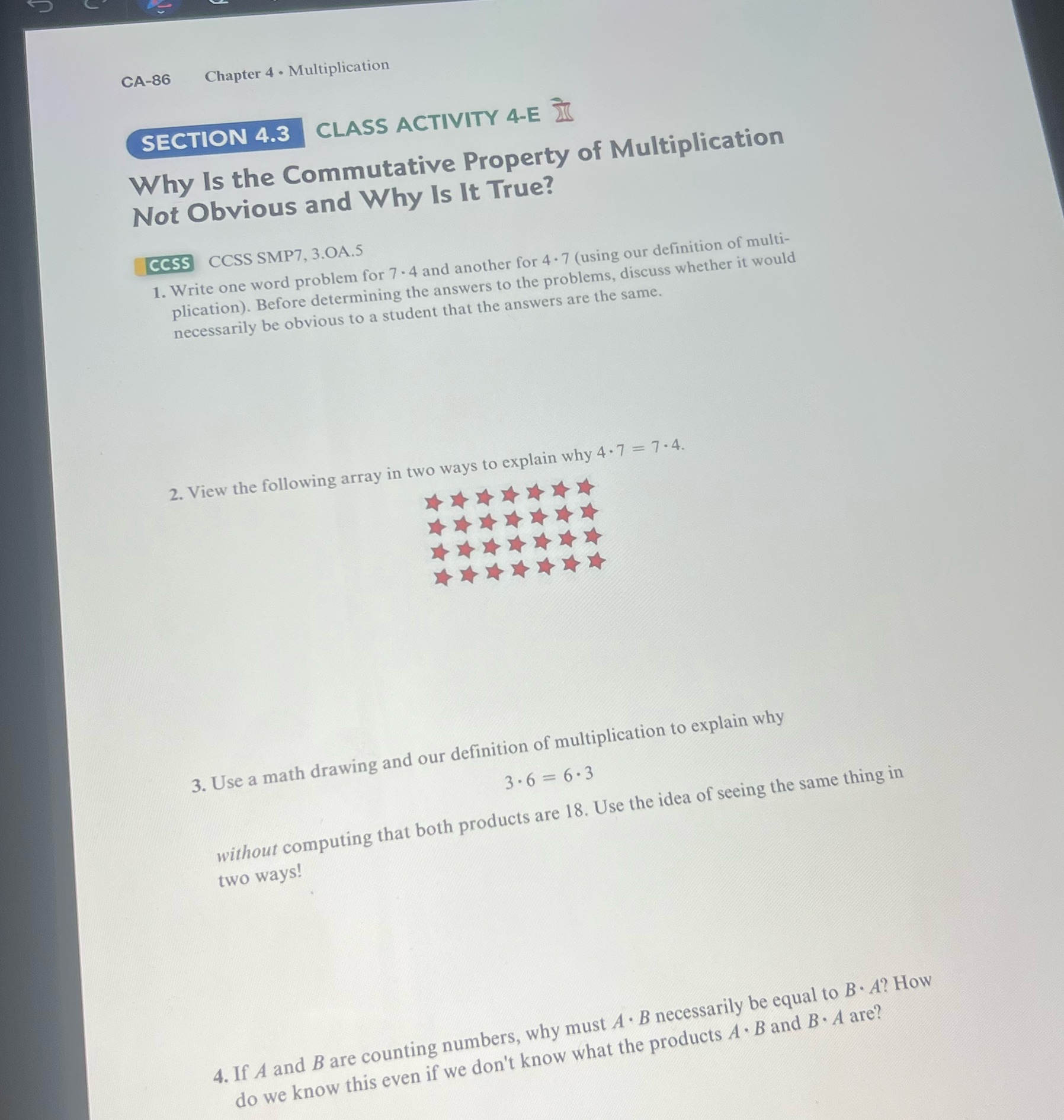
CA-86 Chapter 4 . Multiplication SECTION 4.3 CLASS ACTIVITY 4-E X Why Is the Commutative Property of Multiplication Not Obvious and Why Is It True? CCSS CCSS SMP7, 3.0A.5 1. Write one word problem for 7 . 4 and another for 4 . 7 (using our definition of multi- plication). Before determining the answers to the problems, discuss whether it would necessarily be obvious to a student that the answers are the same. 2. View the following array in two ways to explain why 4. 7 = 7 . 4. 3. Use a math drawing and our definition of multiplication to explain why 3. 6 = 6.3 without computing that both products are 18. Use the idea of seeing the same thing in two ways! 4. If A and B are counting numbers, why must A . B necessarily be equal to B . A? How do we know this even if we don't know what the products A . B and B . A are
Step by Step Solution
There are 3 Steps involved in it

Get step-by-step solutions from verified subject matter experts
 Study Help