



Question: Calculate CAPM, WACC, NPV Evaluation: Case Questions: (Read the case below and provide your answers to the 3 listed questions below by assuming a role
Calculate CAPM, WACC, NPV Evaluation:
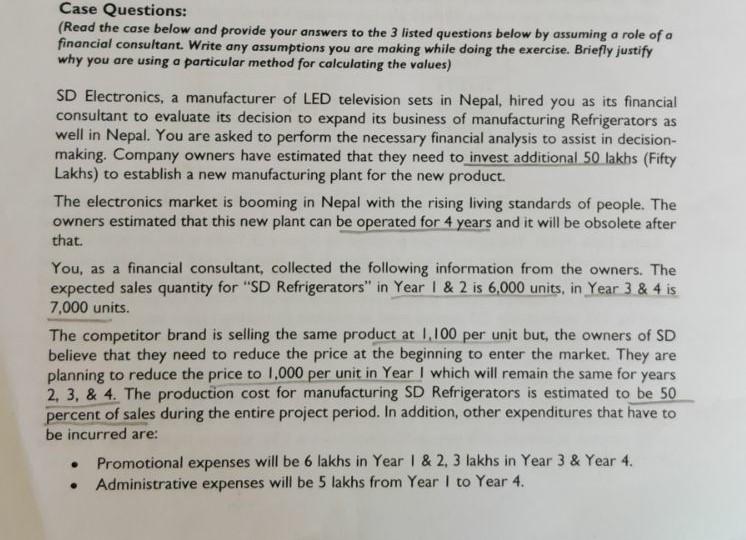
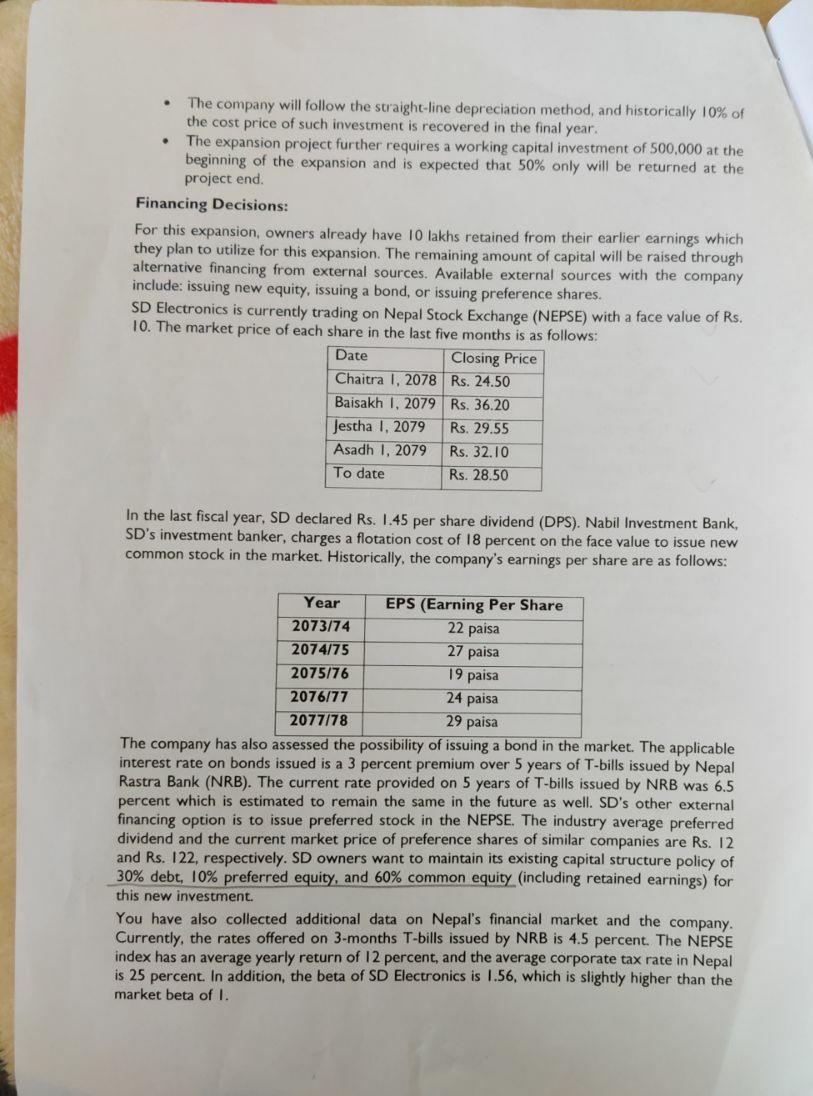
Case Questions: (Read the case below and provide your answers to the 3 listed questions below by assuming a role of a financial consultant. Write any assumptions you are making while doing the exercise. Briefly justify why you are using a particular method for calculating the values) SD Electronics, a manufacturer of LED television sets in Nepal, hired you as its financial consultant to evaluate its decision to expand its business of manufacturing Refrigerators as well in Nepal. You are asked to perform the necessary financial analysis to assist in decisionmaking. Company owners have estimated that they need to invest additional 50 lakhs (Fifty Lakhs) to establish a new manufacturing plant for the new product. The electronics market is booming in Nepal with the rising living standards of people. The owners estimated that this new plant can be operated for 4 years and it will be obsolete after that. You, as a financial consultant, collected the following information from the owners. The expected sales quantity for "SD Refrigerators" in Year I \& 2 is 6,000 units, in Year 3 \& 4 is 7,000 units. The competitor brand is selling the same product at 1.100 per unit but, the owners of SD believe that they need to reduce the price at the beginning to enter the market. They are planning to reduce the price to 1.000 per unit in Year I which will remain the same for years 2,3,8 4. The production cost for manufacturing SD Refrigerators is estimated to be 50 percent of sales during the entire project period. In addition, other expenditures that have to be incurred are: - Promotional expenses will be 6 lakhs in Year 1&2,3 lakhs in Year 3 \& Year 4. - Administrative expenses will be 5 lakhs from Year I to Year 4. - The company will follow the straight-line depreciation method, and historically 10% of the cost price of such investment is recovered in the final year. - The expansion project further requires a working capital investment of 500,000 at the beginning of the expansion and is expected that 50% only will be returned at the project end. Financing Decisions: For this expansion, owners already have 10 lakhs retained from their earlier earnings which they plan to utilize for this expansion. The remaining amount of capital will be raised through alternative financing from external sources. Available external sources with the company include: issuing new equity, issuing a bond, or issuing preference shares. SD Electronics is currently trading on Nepal Stock Exchange (NEPSE) with a face value of Rs. 10. The market price of each share in the last five months is as follows: In the last fiscal year, SD declared Rs. I.45 per share dividend (DPS). Nabil Investment Bank, SD's investment banker, charges a flotation cost of 18 percent on the face value to issue new common stock in the market. Historically, the company's earnings per share are as follows: The company has also assessed the possibility of issuing a bond in the market. The applicable interest rate on bonds issued is a 3 percent premium over 5 years of T-bills issued by Nepal Rastra Bank (NRB). The current rate provided on 5 years of T-bills issued by NRB was 6.5 percent which is estimated to remain the same in the future as well. SD's other external financing option is to issue preferred stock in the NEPSE. The industry average preferred dividend and the current market price of preference shares of similar companies are Rs. 12 and Rs. 122, respectively. SD owners want to maintain its existing capital structure policy of 30% debt, 10% preferred equity, and 60% common equity (including retained earnings) for this new investment. You have also collected additional data on Nepal's financial market and the company. Currently, the rates offered on 3-months T-bills issued by NRB is 4.5 percent. The NEPSE index has an average yearly return of 12 percent, and the average corporate tax rate in Nepal is 25 percent. In addition, the beta of SD Electronics is 1.56, which is slightly higher than the market beta of
Step by Step Solution
There are 3 Steps involved in it

Get step-by-step solutions from verified subject matter experts