







Question: Calculate the equivalent capacitance between points a and b in the combination of capacitors shown in the figure below, if C1 = 3.85uF, C2 =
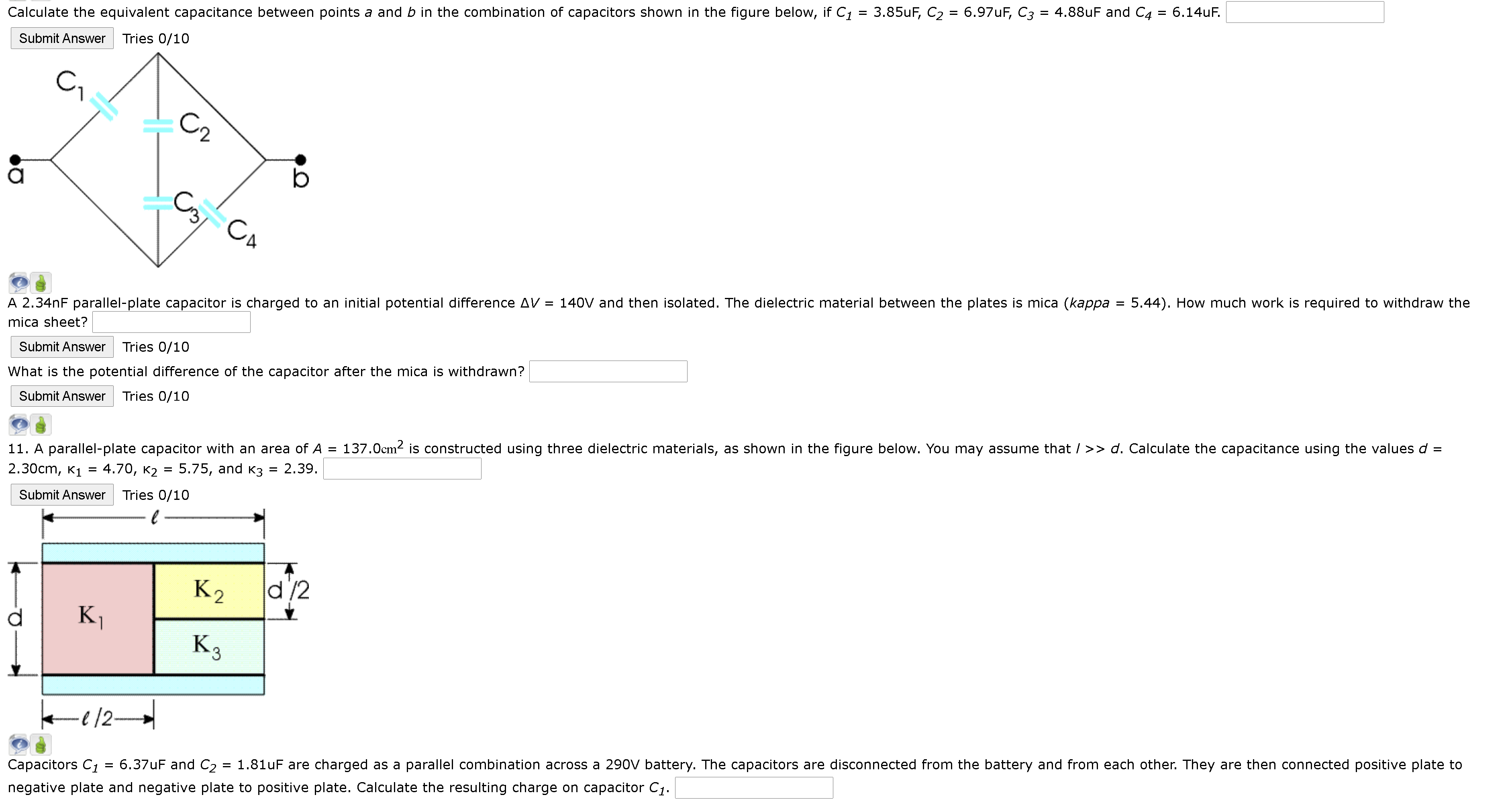
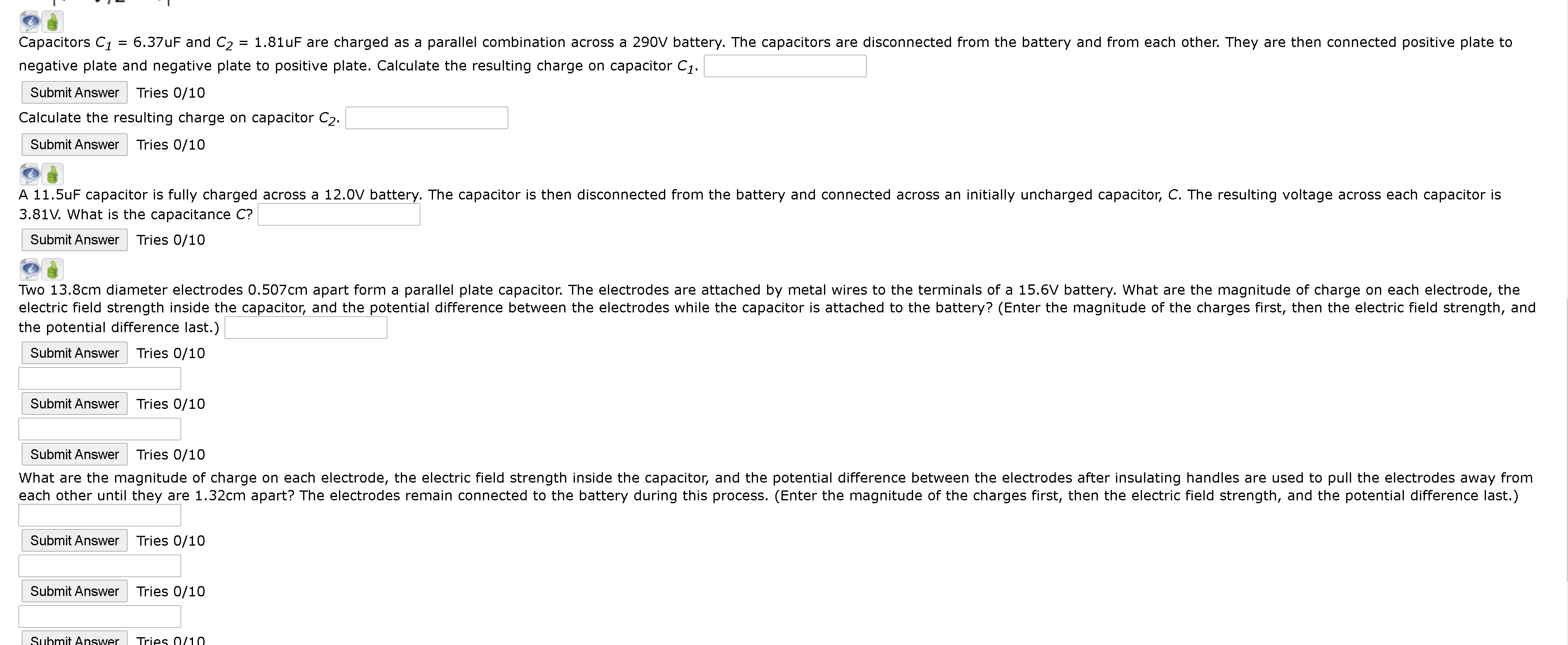

Calculate the equivalent capacitance between points a and b in the combination of capacitors shown in the figure below, if C1 = 3.85uF, C2 = 6.97uF, C3 = 4.88uF and C4 = 6.14uF. Submit/Answer Tries 0/10 C1 C2 57% b C3 Q. a a A. 2.34nF parallel-plate capacitor is charged to an initial potential difference AV = 140V and then isolated. The dielectric material between the plates is mica (kappa = 5.44). How much work is required to withdraw the mica sheet? Submit Answer Tries 0/10 What is the potential difference of the capacitor after the mica is withdrawn? ': Submit Answer Tries 0/10 '9' i 11. A parallel-plate capacitor with an area ofA = 137.com2 is constructed using three dielectric materials, as shown in the figure below. You may assume that I >> d. Calculate the capacitance using the values d = 2.30cm, K1 = 4.70, K2 = 5.75, and K3 = 2.39. Submit Answer Tries 0/10 iii- 3 Capacitors C1 = 6.37uF and C2 = 1.81uF are charged as a parallel combination across a 290V battery. The capacitors are disconnected from the battery and from each other. They are then connected positive plate to negative plate and negative plate to positive plate. Calculate the resulting charge on capacitor C1. \\:l Capacitors C1 = 6.37uF and C2 = 1.81uF are charged as a parallel combination across a 290V battery. The capacitors are disconnected from the battery and from each other. They are then connected positive plate to negative plate and negative plate to positive plate. Calculate the resulting charge on capacitor C1. Submit Answer Tries 0/10 Calculate the resulting charge on capacitor C2. Submit Answer Tries 0/10 A 11.5uF capacitor is fully charged across a 12.0V battery. The capacitor is then disconnected from the battery and connected across an initially uncharged capacitor, C. The resulting voltage across each capacitor is 3.81V. What is the capacitance C? Submit Answer Tries 0/10 Two 13.8cm diameter electrodes 0.507cm apart form a parallel plate capacitor. The electrodes are attached by metal wires to the terminals of a 15.6V battery. What are the magnitude of charge on each electrode, the electric field strength inside the capacitor, and the potential difference between the electrodes while the capacitor is attached to the battery? (Enter the magnitude of the charges first, then the electric field strength, and the potential difference last.) Submit Answer Tries 0/10 Submit Answer Tries 0/10 Submit Answer Tries 0/10 What are the magnitude of charge on each electrode, the electric field strength inside the capacitor, and the potential difference between the electrodes after insulating handles are used to pull the electrodes away from each other until they are 1.32cm apart? The electrodes remain connected to the battery during this process. (Enter the magnitude of the charges first, then the electric field strength, and the potential difference last.) Submit Answer Tries 0/10 Submit Answer Tries 0/10Submit Answer Tries 0/10 What are the magnitude of charge on each electrode, the electric field strength inside the capacitor, and the potential difference between the electrodes after the original electrodes (moved back to 0.507cm apart) are expanded until they are 26.5cm in diameter while remaining connected to the battery? (Enter the magnitude of the charges first, then the electric field strength, and the potential difference last.) Submit Answer Tries 0/10 Submit Answer Tries 0/10 Submit Answer Tries 0/10
Step by Step Solution
There are 3 Steps involved in it

Get step-by-step solutions from verified subject matter experts
 Study Help