







Question: Calculate the probability that the total cost in Example 2.5.3 will exceed 8,250,000 if the retention limit is a. 30,000 b. 50,000. Answers: a. 0.0041
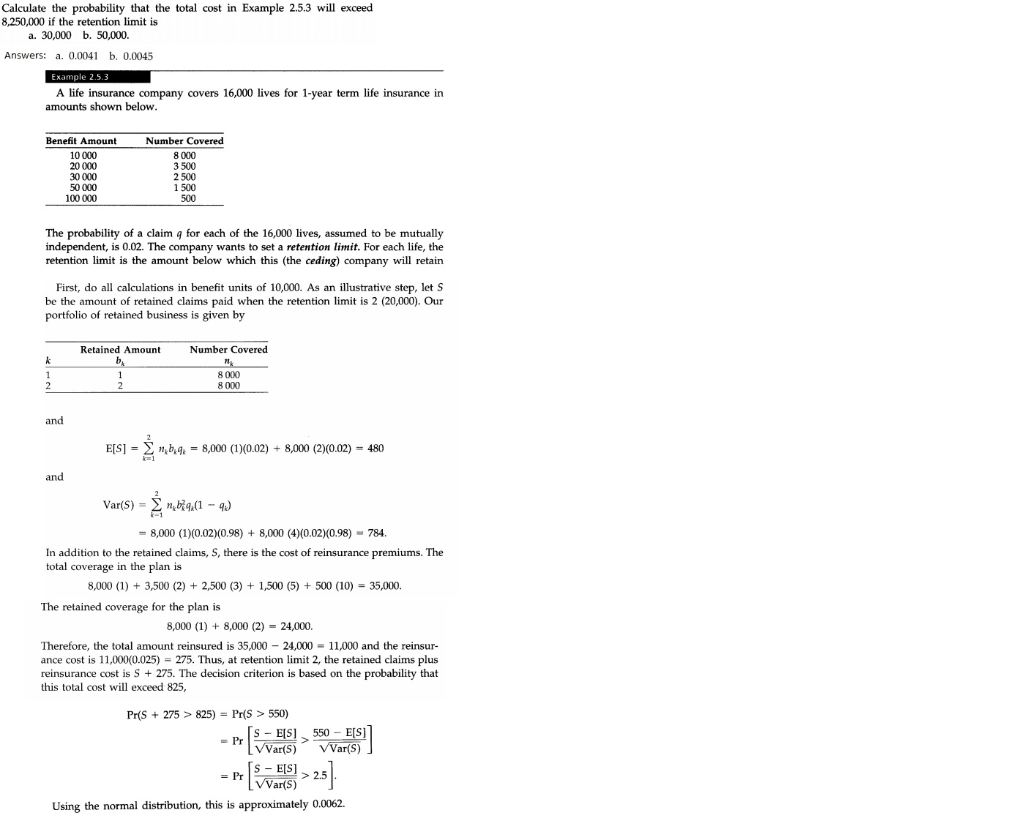
Calculate the probability that the total cost in Example 2.5.3 will exceed 8,250,000 if the retention limit is a. 30,000 b. 50,000. Answers: a. 0.0041 b. 0.0045 Example 2.5.3 A life insurance company covers 16,000 lives for 1-year term life insurance in amounts shown below. Benefit Amount Number Covered 10 000 20 000 8 000 3 500 30 000 2 500 50 000 1 500 100 00 500 The probability of a claim q for each of the 16,000 lives, assumed to be mutually independent, is 0.02. The company wants to set a retention limit. For each life, the retention limit is the amount below which this (the ceding) company will retain First, do all calculations in benefit units of 10,000. As an illustrative step, let S be the amount of retained claims paid when the retention limit is 2 (20,000). Our portfolio of retained business is given by Retained Amount Number Covered 1 8 000 8 000 and E[S] = > ",b,q. = 8,000 (1)(0.02) + 8,000 (2)(0.02) = 480 and Var(S) = > nbq(1 - q = 8,000 (1)(0.02)(0.98) + 8,000 (4)(0.02)(0.98) - 784. In addition to the retained claims, S, there is the cost of reinsurance premiums. The total coverage in the plan is 8,000 (1) + 3,500 (2) + 2,500 (3) + 1,500 (5) + 500 (10) = 35,000. The retained coverage for the plan is 8,000 (1) + 8,000 (2) = 24,000. Therefore, the total amount reinsured is 35,000 - 24,000 = 11,000 and the reinsur- ance cost is 11,000(0.025) = 275. Thus, at retention limit 2, the retained claims plus reinsurance cost is S + 275. The decision criterion is based on the probability that this total cost will exceed 825, Pr(S + 275 > 825) = Pr(5 > 550) - pr S - EIS] 550 - E[S] [ V Var(S) V Var(S) = Pr S - EIS] > 2.5 [ V Var(S) Using the normal distribution, this is approximately 0.0062
Step by Step Solution
There are 3 Steps involved in it

Get step-by-step solutions from verified subject matter experts
 Study Help