



Question: Calculating Prot Sharing Pay Awards In your new role as compensation analyst, you have been asked to estimate the dollar amount of the prot-sharing pool
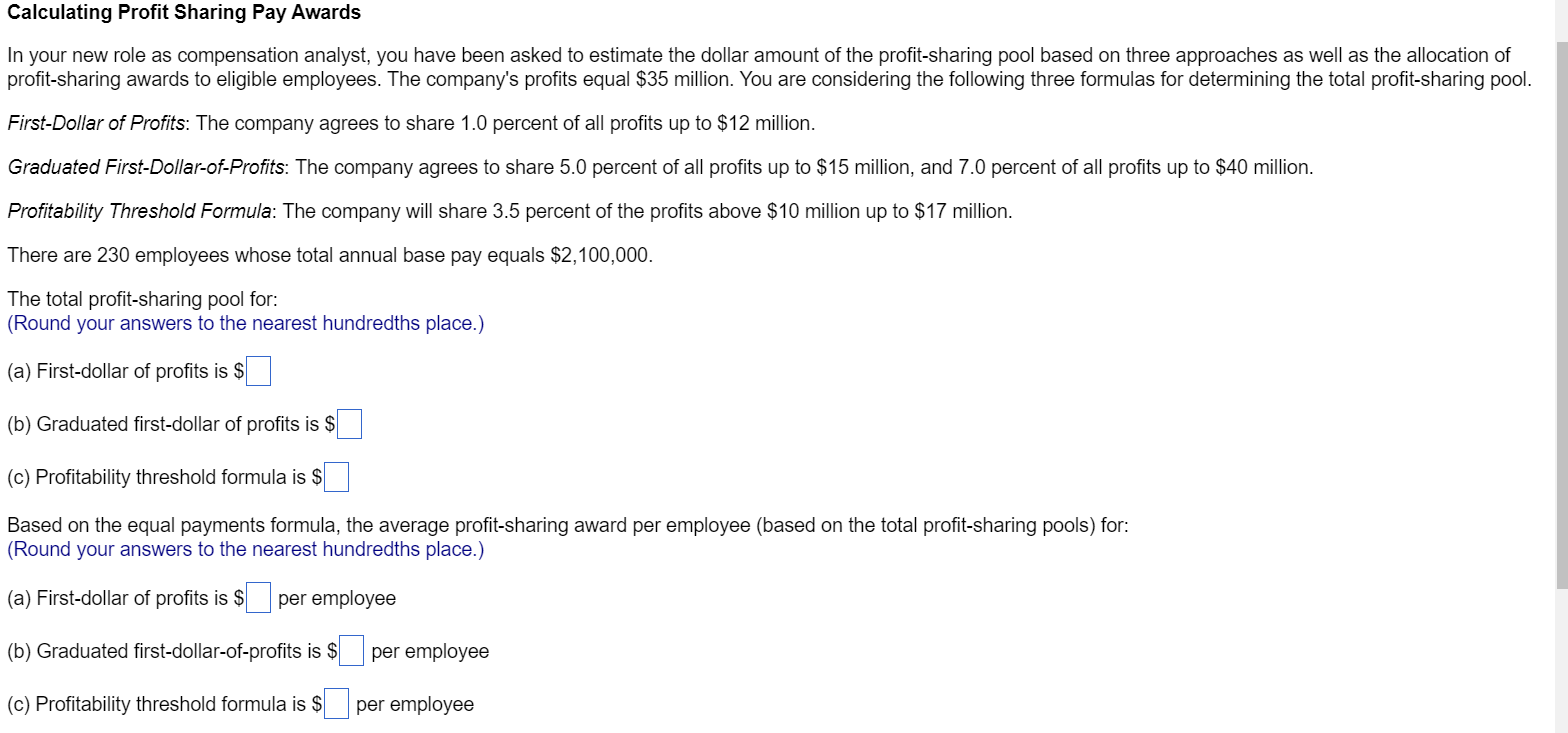
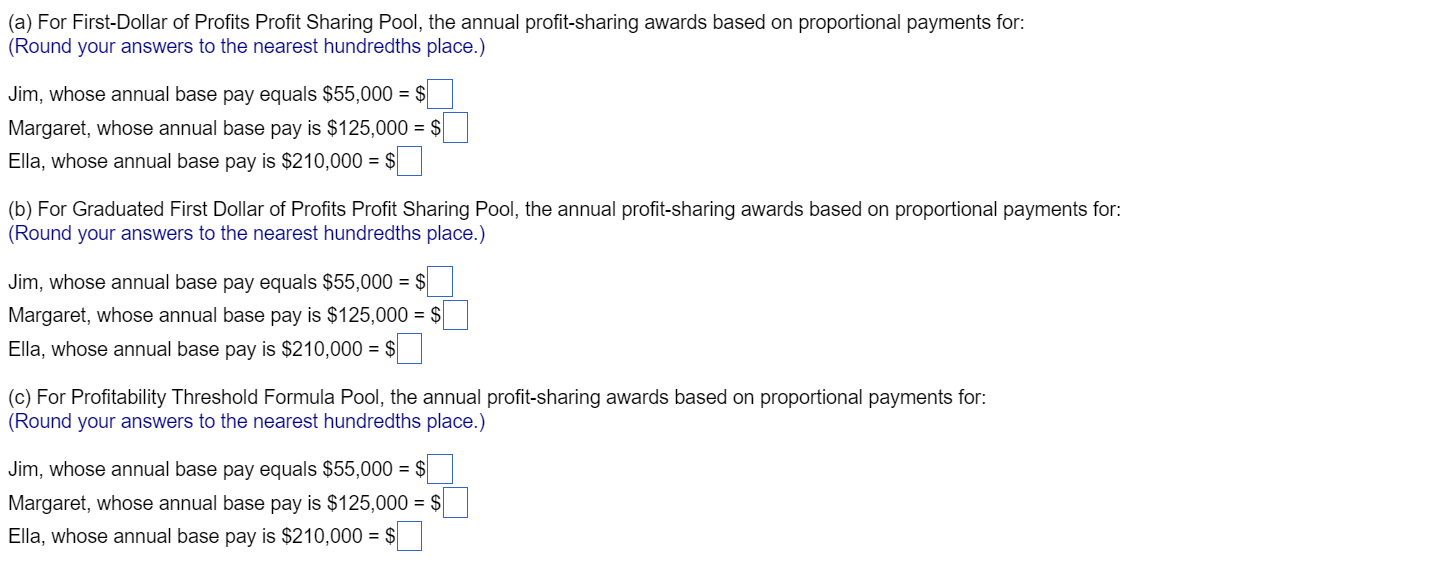
Calculating Prot Sharing Pay Awards In your new role as compensation analyst, you have been asked to estimate the dollar amount of the prot-sharing pool based on three approaches as well as the allocation of prot-sharing awards to eligible employees. The company's prots equal $35 million. You are considering the following three formulas for determining the total prot-sharing pool. First-Dollar of Prots: The company agrees to share 1.0 percent of all prots up to $12 million. Graduated FlrstDollarofProtits: The company agrees to share 5.0 percent of all prots up to $15 million, and 7.0 percent of all prots up to $40 million. Protability Threshold Formula: The company will share 3.5 percent of the prots above $10 million up to $17 million. There are 230 employees whose total annual base pay equals $2,100,000. The total prot-sharing pool for: (Round your answers to the nearest hundredths place.) (a) First-dollar of prots is $ (b) Graduated rst-dollar of prots is $ (c) Protability threshold formula is $ Based on the equal payments formula, the average prot-sharing award per employee (based on the total prot-sharing pools) for: (Round your answers to the nearest hundredths place.) (a) First-dollar of prots is $ per employee (b) Graduated rst-dollar-olprots is $ per employee (c) Protability threshold formula is $ per employee (a) For First-Dollar of Prots Prot Sharing Pool, the annual prot-sharing awards based on proportional payments for: (Round your answers to the nearest hundredths place.) Jim, whose annual base pay equals $55,000 = $ Margaret, whose annual base pay is $125,000 = $ Ella, whose annual base pay is $210,000 = $ (b) For Graduated First Dollar of Prots Prot Sharing Pool, the annual prot-sharing awards based on proportional payments for: (Round your answers to the nearest hundredths place.) Jim, whose annual base pay equals $55,000 = $ Margaret, whose annual base pay is $125,000 = $ Ella, whose annual base pay is $210,000 = $ (c) For Protability Threshold Formula Pool, the annual prot-sharing awards based on proportional payments for: (Round your answers to the nearest hundredths place.) Jim, whose annual base pay equals $55,000 = $ Margaret, whose annual base pay is $125,000 = $ Ella, whose annual base pay is $210,000 = $
Step by Step Solution
There are 3 Steps involved in it

Get step-by-step solutions from verified subject matter experts