







Question: Calculation 1a: Using the data in Table 1 in the experiment details, find the average value of the time taken for each of the balls
Calculation 1a:
Using the data in Table 1 in the experiment details, find the average value of the time taken for each of the balls (bocce and lead) to hit the water for each of the four heights. These values will be put in your Table 1 below.
Calculation 1b:
For each average time obtained in Calc. 1a, find the maximum speed of the balls as they hit the water. This value will be called the "average maximum speed" of a ball for a given height. These values will be put in Table 1 below.
Table 1:
Create a table that includes the type of ball, its mass, the initial height, the "average time" taken to hit the water, and the "average maximum speed" of the ball. You do not have to include uncertainties in this table. You must round the times and speeds to three decimal places.
Chart 1:
Using the data in Table 1, graph the square of "average maximum velocity" (?2) versus initial height (?) for each of the bullets. You should show both lines on the same graph. Use the linear regression tool on your data and
make sure to show your data table and the uncertainties for each line. Be sure to give your graph an appropriate title that describes the data shown.
Calculation 1c:
Using the slope of the linear regressions in Chart 1, calculate the experimental value of the gravitational acceleration ?exp (and its uncertainty) for each type of bullet.
Question 1a:
Compare the ?exp value obtained in Calc. 1c to the value ? = 9.8 m/s
2
. Which bullet gives a more more accurate value?
NB. You have already used in the previous labs different methods to compare experimental values to their accepted/theoretical to their accepted/theoretical values. A similar analysis is expected here
Calcul 1d: (2 pts) Calculez l'nergie cintique maximale moyenne (and son incertitude) pour la balle de plomb lorsqu'elle est lche d'une hauteur de 7,5 m. Vous devez utiliser la vitesse maximale moyenne que vous avez obtenue dans le Calc. 1b.
NB. Vous aurez besoin d'utiliser l'incertitude sur le temps moyen (trouve par la mthode statistique) et l'incertitude de la hauteur initiale pour trouver l'incertitude de la vitesse maximale moyenne. Ensuite, vous aurez besoin d'utiliser l'incertitude de la vitesse maximale moyenne et de la masse de la balle pour calculer l'incertitude de l'nergie cintique moyenne.
Calcul 1e: (2 pts) Calculez l'nergie potentielle initiale (et son incertitude) de la balle de plomb lche d'une hauteur de 7,5 m. Vous pouvez utiliser la valeur accepte de ? = 9.8 m/s 2 dans ce calcul. Vous devez utiliser l'incertitude de la hauteur initiale et de la masse de la balle dans ce calcul.
Question 1b: (1 pts) Comparez les valeurs d'nergies cintiques et potentielles obtenues dans les deux calculs prcdents. Est-ce que l'nergie est conserve? Si non, expliquez pourquoi il y aurait une contradiction.
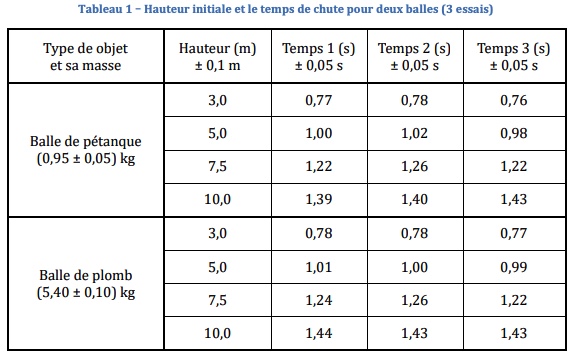
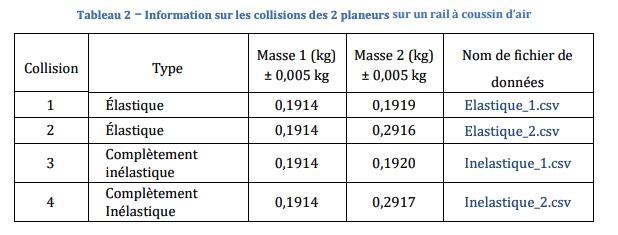
Tableau 1 - Hauteur initiale et le temps de chute pour deux balles (3 essais) Type de objet Hauteur (m) Temps 1 (s) Temps 2 (s) Temps 3 (s) et sa masse + 0,1 m + 0,05 s + 0,05 s + 0,05 s 3,0 0,77 0,78 0,76 Balle de petanque 5,0 1,00 1,02 0,98 (0,95 + 0,05) kg 7,5 1,22 1,26 1,22 10,0 1,39 1,40 1,43 3,0 0,78 0,78 0,77 Balle de plomb 5,0 1,01 1,00 0,99 (5,40 + 0,10) kg 7,5 1,24 1,26 1,22 10,0 1,44 1,43 1,43Tableau 2 - Information sur les collisions des 2 planeurs sur un rail a coussin d'air Masse 1 (kg) Masse 2 (kg) Nom de fichier de Collision Type + 0,005 kg + 0,005 kg donnees 1 Elastique 0,1914 0,1919 Elastique_1.csv 2 Elastique 0,1914 0,2916 Elastique_2.csv Completement 3 0,1914 0,1920 inelastique Inelastique_1.csv 4 Completement 0,1914 0,2917 Inelastique Inelastique_2.csv
Step by Step Solution
There are 3 Steps involved in it

Get step-by-step solutions from verified subject matter experts
 Study Help