





Question: CALCULATIONS 2. +/- R2 = Vterm,BSA +/- R2 = Vterm, lysozyme Vterm,BSA 3. = Vterm,lysozyme M = M 4. % diff = [ratioexp - ratioacc
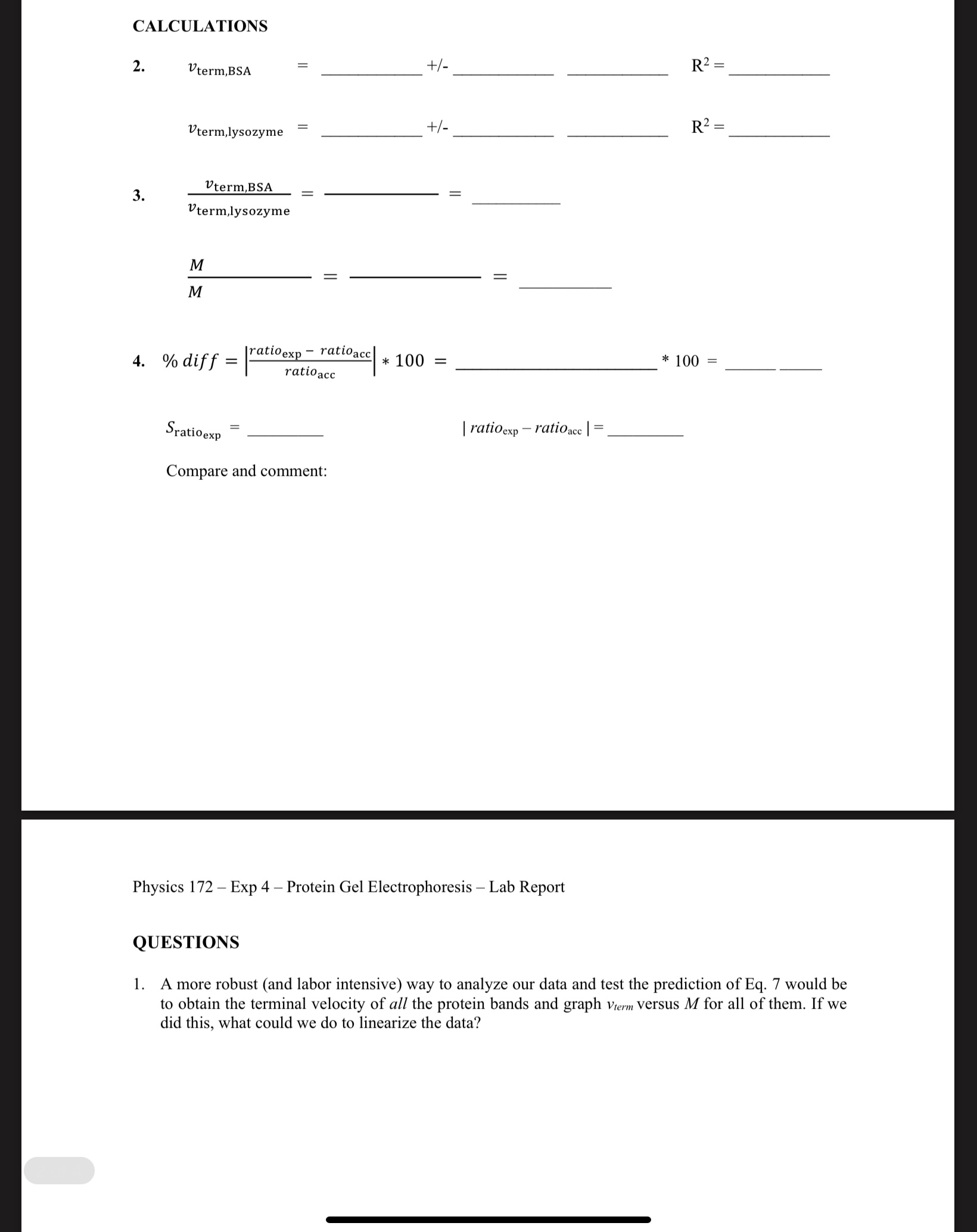
CALCULATIONS 2. +/- R2 = Vterm,BSA +/- R2 =CALCULATIONS 2. +/- R2 = Vterm,BSA +/- R2 =CALCULATIONS 2. +/- R2 = Vterm,BSA +/- R2 =
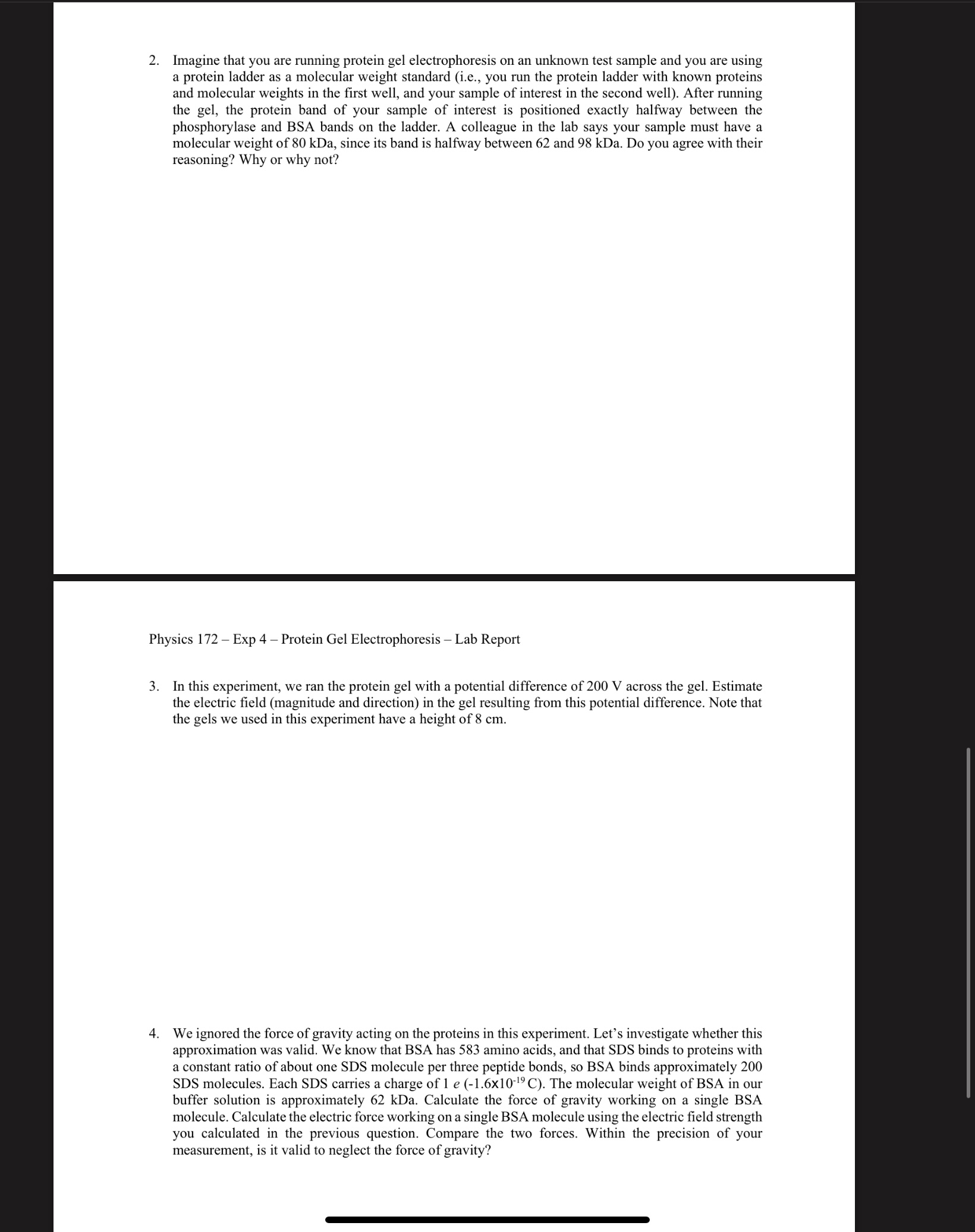
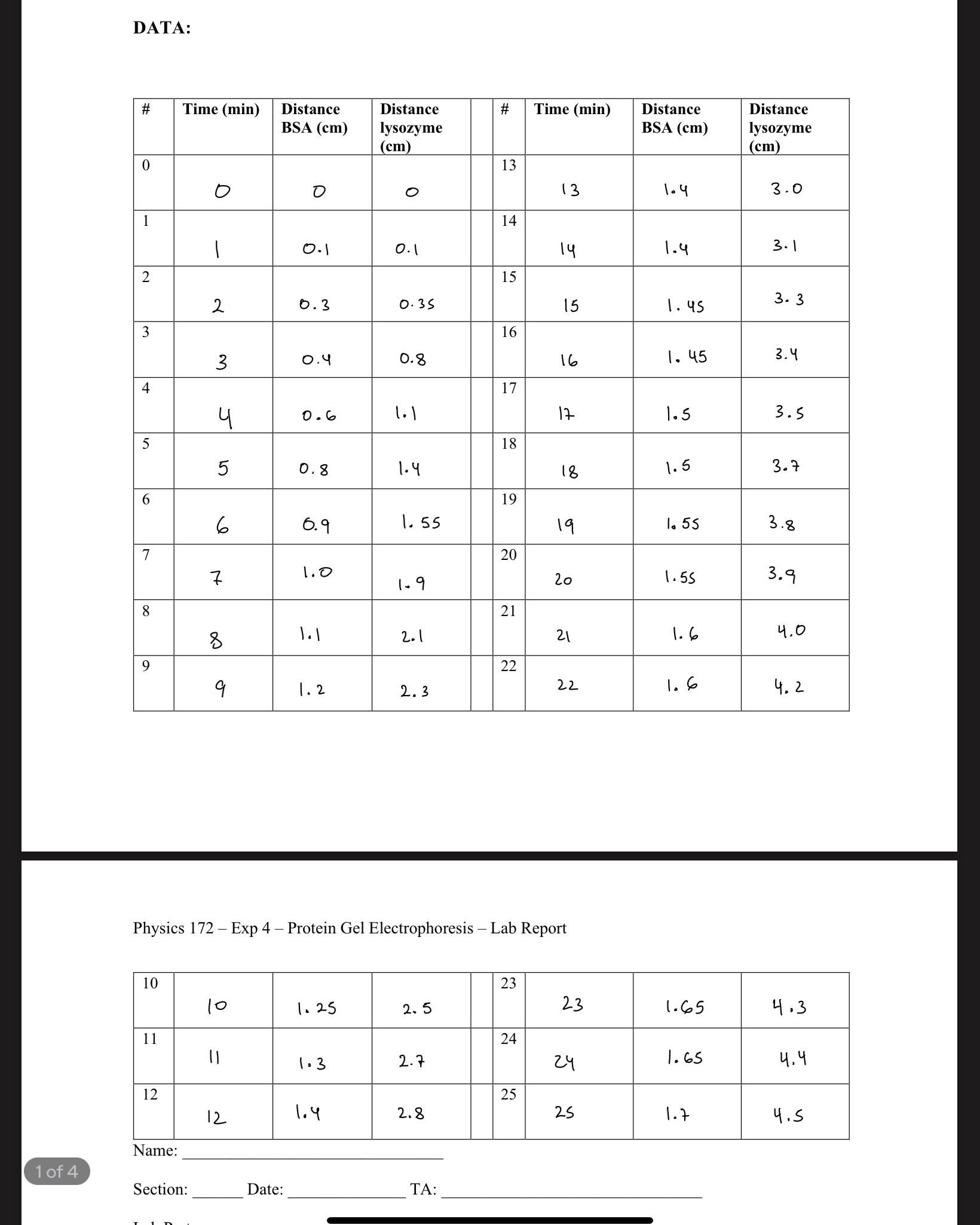
CALCULATIONS 2. +/- R2 = Vterm,BSA +/- R2 = Vterm, lysozyme Vterm,BSA 3. = Vterm,lysozyme M = M 4. % diff = [ratioexp - ratioacc * 100 = * 100 = ratioacc Sratioexp = | ratioexp - ratio acc |= Compare and comment: Physics 172 - Exp 4 - Protein Gel Electrophoresis - Lab Report QUESTIONS 1. A more robust (and labor intensive) way to analyze our data and test the prediction of Eq. 7 would be to obtain the terminal velocity of all the protein bands and graph Vterm versus M for all of them. If we did this, what could we do to linearize the data?Imagine that you are running protein gel electrophoresis on an unknown test sample and you are using a protein ladder as a molecular weight standard (i.e., you run the protein ladder with known proteins and molecular weights in the first well, and your sample of interest in the second well). After running the gel, the protein band of your sample of interest is positioned exactly halfway between the phosphorylase and BSA bands on the ladder. A colleague in the lab says your sample must have a molecular weight of 80 kDa, since its band is halfway between 62 and 98 kDa. Do you agree with their reasoning? Why or why not? Physics 172 Exp 4 Protein Gel Electrophoresis Lab Report 3 In this experiment, we ran the protein gel with a potential difference of 200 V across the gel. Estimate the electric field (magnitude and direction) in the gel resulting from this potential difference. Note that the gels we used in this experiment have a height of 8 cm. We ignored the force of gravity acting on the proteins in this experiment. Let's investigate whether this approximation was valid. We know that BSA has 583 amino acids, and that SDS binds to proteins with a constant ratio of about one SDS molecule per three peptide bonds, so BSA binds approximately 200 SDS molecules. Each SDS carries a charge of 1 e (-1.6x10"? C). The molecular weight of BSA in our buffer solution is approximately 62 kDa. Calculate the force of gravity working on a single BSA molecule. Calculate the electric force working on a single BSA molecule using the electric field strength you calculated in the previous question. Compare the two forces. Within the precision of your measurement, is it valid to neglect the force of gravity? DATA: # Time (min) Distance Distance # Time (min) Distance Distance BSA (cm) lysozyme BSA (cm) lysozyme (cm (cm 0 13 D 13 1. 4 3.0 1 14 O. 1 0 . 1 14 1.4 3. 1 2 15 2 0. 35 15 1. 45 3. 3 3 16 0.4 0. 8 16 1. 45 3.4 4 17 0 . 6 1 . 1 17 1.5 3.5 5 18 5 0 . 8 1.4 18 1.5 3.7 6 19 6.9 1. 55 1. 55 3.8 7 20 7 1.0 1- 9 20 1. 55 3.9 8 21 1 . 1 2.1 21 1. 6 4.0 9 22 1. 2 2. 3 22 1. 6 1. 2 Physics 172 - Exp 4 - Protein Gel Electrophoresis - Lab Report 10 23 10 1. 25 2. 5 23 1.65 4 . 3 11 24 1 . 3 2.7 24 1. 65 4.4 12 25 12 . 4 2. 8 25 1. 7 4. 5 Name: 1 of 4 Section: Date: TA
Step by Step Solution

There are 3 Steps involved in it

1 Expert Approved Answer
Step: 1 Unlock blur-text-image

Question Has Been Solved by an Expert!

Get step-by-step solutions from verified subject matter experts

Step: 2 Unlock
Step: 3 Unlock

Students Have Also Explored These Related Law Questions!