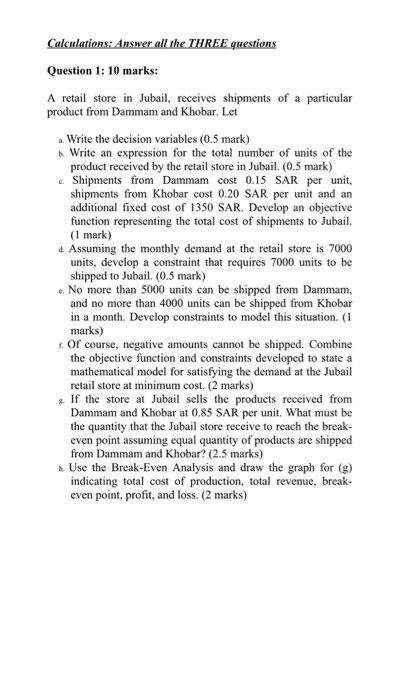
Question: Calculations: Answer all the THREE questions Question 1: 10 marks: A retail store in Jubail, receives shipments of a particular product from Dammam and Khobar.
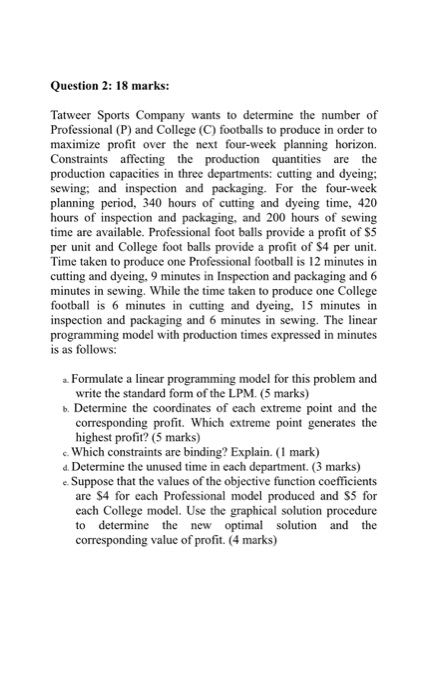
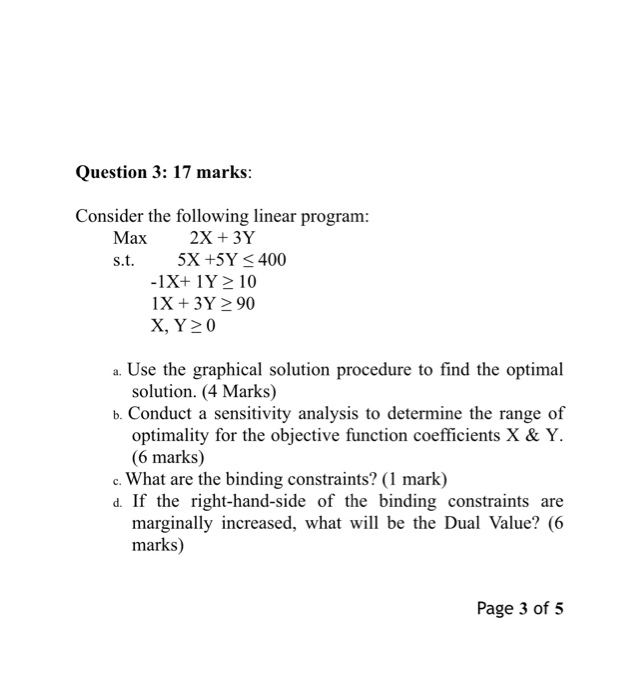
Calculations: Answer all the THREE questions Question 1: 10 marks: A retail store in Jubail, receives shipments of a particular product from Dammam and Khobar. Let a. Write the decision variables (0.5 mark) Write an expression for the total number of units of the product received by the retail store in Jubail. (0.5 mark) 6. Shipments from Dammam cost 0.15 SAR per unit, shipments from Khobar cost 0.20 SAR per unit and an additional fixed cost of 1350 SAR. Develop an objective function representing the total cost of shipments to Jubail. (1 mark) 4. Assuming the monthly demand at the retail store is 7000 units, develop a constraint that requires 7000 units to be shipped to Jubail. (0.5 mark) e. No more than 5000 units can be shipped from Dammam, and no more than 4000 units can be shipped from Khobar in a month. Develop constraints to model this situation. (1 marks) r. Of course, negative amounts cannot be shipped. Combine the objective function and constraints developed to state a mathematical model for satisfying the demand at the Jubail retail store at minimum cost. (2 marks) If the store at Jubail sells the products received from Dammam and Khobar at 0.85 SAR per unit. What must be the quantity that the Jubail store receive to reach the break- even point assuming equal quantity of products are shipped from Dammam and Khobar? (2.5 marks) 1. Use the Break-Even Analysis and draw the graph for (g) indicating total cost of production, total revenue, break- even point, profit, and loss. (2 marks) Question 2: 18 marks: Tatweer Sports Company wants to determine the number of Professional (P) and College (C) footballs to produce in order to maximize profit over the next four-week planning horizon. Constraints affecting the production quantities are the production capacities in three departments: cutting and dyeing, sewing; and inspection and packaging. For the four-week planning period, 340 hours of cutting and dyeing time, 420 hours of inspection and packaging, and 200 hours of sewing time are available. Professional foot balls provide a profit of $5 per unit and College foot balls provide a profit of $4 per unit. Time taken to produce one Professional football is 12 minutes in cutting and dyeing, 9 minutes in Inspection and packaging and 6 minutes in sewing. While the time taken to produce one College football is 6 minutes in cutting and dyeing, 15 minutes in inspection and packaging and 6 minutes in sewing. The linear programming model with production times expressed in minutes is as follows: a Formulate a linear programming model for this problem and write the standard form of the LPM. (5 marks) b. Determine the coordinates of each extreme point and the corresponding profit. Which extreme point generates the highest profit? (5 marks) Which constraints are binding? Explain. (1 mark) a. Determine the unused time in each department. (3 marks) e. Suppose that the values of the objective function coefficients are S4 for each Professional model produced and S5 for each College model. Use the graphical solution procedure to determine the new optimal solution and the corresponding value of profit. (4 marks) Question 3: 17 marks: Consider the following linear program: Max 2X + 3Y s.t. 5X +5Y 10 1X +3Y>90 X, Y>0 a. Use the graphical solution procedure to find the optimal solution. (4 Marks) b. Conduct a sensitivity analysis to determine the range of optimality for the objective function coefficients X & Y. (6 marks) c. What are the binding constraints? (1 mark) d. If the right-hand-side of the binding constraints are marginally increased, what will be the Dual Value? (6 marks) Page 3 of 5 Calculations: Answer all the THREE questions Question 1: 10 marks: A retail store in Jubail, receives shipments of a particular product from Dammam and Khobar. Let a. Write the decision variables (0.5 mark) Write an expression for the total number of units of the product received by the retail store in Jubail. (0.5 mark) 6. Shipments from Dammam cost 0.15 SAR per unit, shipments from Khobar cost 0.20 SAR per unit and an additional fixed cost of 1350 SAR. Develop an objective function representing the total cost of shipments to Jubail. (1 mark) 4. Assuming the monthly demand at the retail store is 7000 units, develop a constraint that requires 7000 units to be shipped to Jubail. (0.5 mark) e. No more than 5000 units can be shipped from Dammam, and no more than 4000 units can be shipped from Khobar in a month. Develop constraints to model this situation. (1 marks) r. Of course, negative amounts cannot be shipped. Combine the objective function and constraints developed to state a mathematical model for satisfying the demand at the Jubail retail store at minimum cost. (2 marks) If the store at Jubail sells the products received from Dammam and Khobar at 0.85 SAR per unit. What must be the quantity that the Jubail store receive to reach the break- even point assuming equal quantity of products are shipped from Dammam and Khobar? (2.5 marks) 1. Use the Break-Even Analysis and draw the graph for (g) indicating total cost of production, total revenue, break- even point, profit, and loss. (2 marks) Question 2: 18 marks: Tatweer Sports Company wants to determine the number of Professional (P) and College (C) footballs to produce in order to maximize profit over the next four-week planning horizon. Constraints affecting the production quantities are the production capacities in three departments: cutting and dyeing, sewing; and inspection and packaging. For the four-week planning period, 340 hours of cutting and dyeing time, 420 hours of inspection and packaging, and 200 hours of sewing time are available. Professional foot balls provide a profit of $5 per unit and College foot balls provide a profit of $4 per unit. Time taken to produce one Professional football is 12 minutes in cutting and dyeing, 9 minutes in Inspection and packaging and 6 minutes in sewing. While the time taken to produce one College football is 6 minutes in cutting and dyeing, 15 minutes in inspection and packaging and 6 minutes in sewing. The linear programming model with production times expressed in minutes is as follows: a Formulate a linear programming model for this problem and write the standard form of the LPM. (5 marks) b. Determine the coordinates of each extreme point and the corresponding profit. Which extreme point generates the highest profit? (5 marks) Which constraints are binding? Explain. (1 mark) a. Determine the unused time in each department. (3 marks) e. Suppose that the values of the objective function coefficients are S4 for each Professional model produced and S5 for each College model. Use the graphical solution procedure to determine the new optimal solution and the corresponding value of profit. (4 marks) Question 3: 17 marks: Consider the following linear program: Max 2X + 3Y s.t. 5X +5Y 10 1X +3Y>90 X, Y>0 a. Use the graphical solution procedure to find the optimal solution. (4 Marks) b. Conduct a sensitivity analysis to determine the range of optimality for the objective function coefficients X & Y. (6 marks) c. What are the binding constraints? (1 mark) d. If the right-hand-side of the binding constraints are marginally increased, what will be the Dual Value? (6 marks) Page 3 of 5









 Study Help