







Question: calculus 2. Consider the equation M(c, y) + N(c, y) =0. (a) Suppose this ODE is not exact. In some cases, we may multiply by
calculus
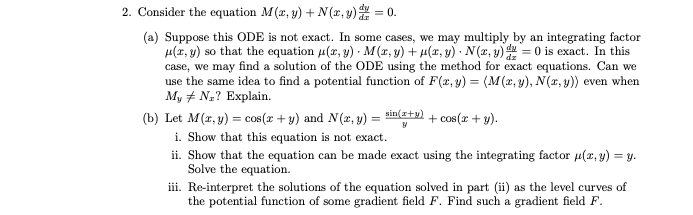
2. Consider the equation M(c, y) + N(c, y) =0. (a) Suppose this ODE is not exact. In some cases, we may multiply by an integrating factor u(r, y) so that the equation A(r, y) . M(r, y) + A(3,y) . N(@, y)2 jok = 0 is exact. In this case, we may find a solution of the ODE using the method for exact equations. Can we use the same idea to find a potential function of F(c, y) = (M(x, y), N(x, y)) even when My # N.? Explain. (b) Let M(x, y) = cos(x + y) and N(x, y) = =net" + cos(r + y). i. Show that this equation is not exact. ii. Show that the equation can be made exact using the integrating factor p(x, y) = y. Solve the equation. iii. Re-interpret the solutions of the equation solved in part (ii) as the level curves of the potential function of some gradient field F. Find such a gradient field F
Step by Step Solution
There are 3 Steps involved in it

Get step-by-step solutions from verified subject matter experts
 Study Help