







Question: Calculus 3 14.5 Reading Assignment: Directional Derivatives and Gradient Vectors I am suck with this question. Please help! Question 2. Read the boxed text Properties
Calculus 3 14.5 Reading Assignment: Directional Derivatives and Gradient Vectors
I am suck with this question. Please help!
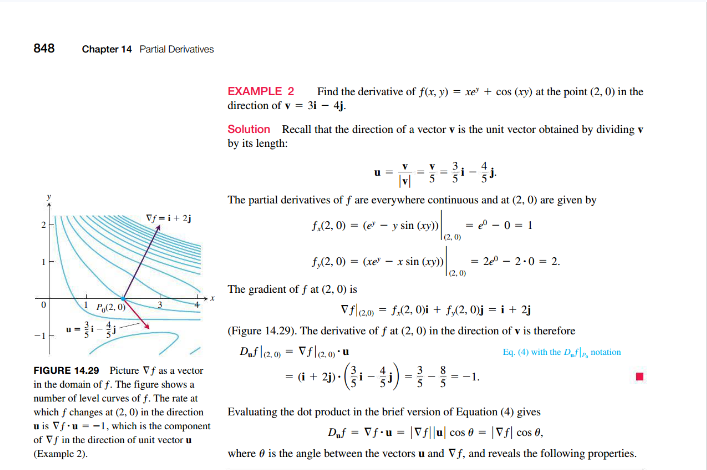
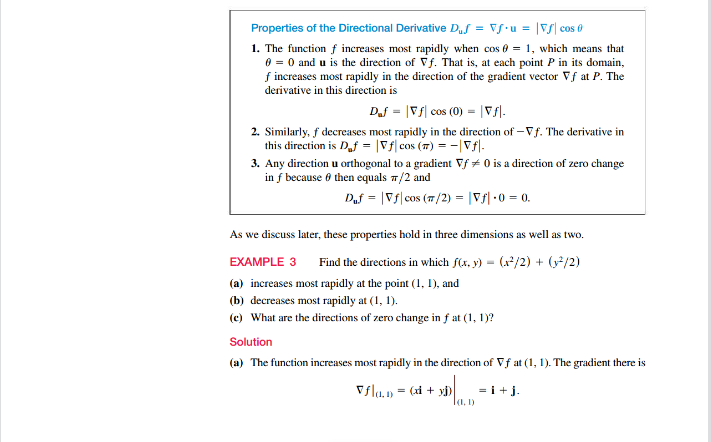
Question 2. Read the boxed text "Properties of the Directional Derivative" (p. 848). Thinking of ? = ?(?, ?) as a surface, describe the direction that the gradient points towards relative to the surface.
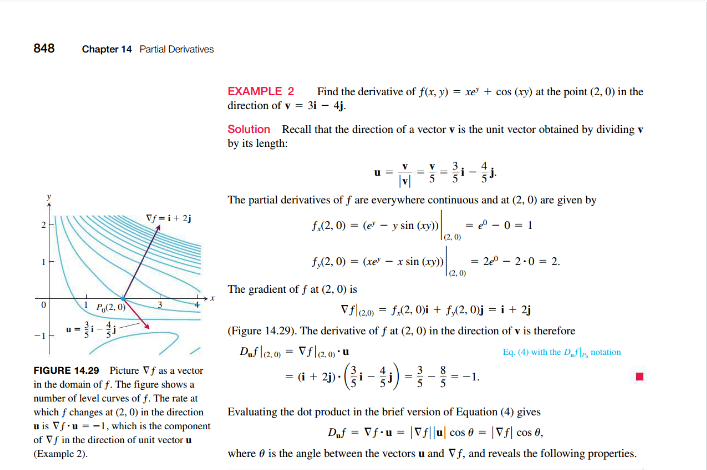
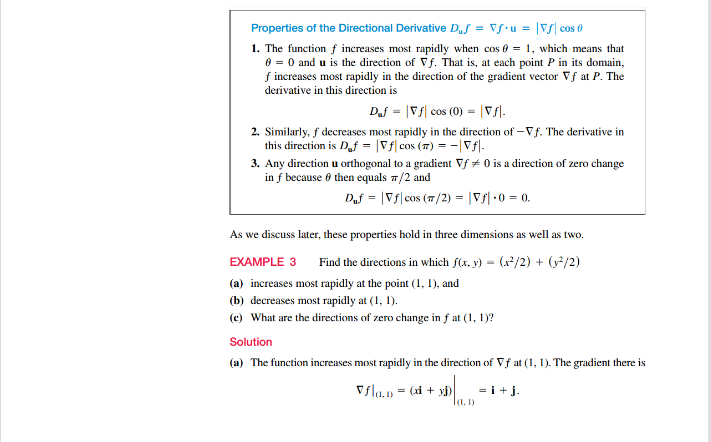
848 Chapter 14 Partial Derivatives EXAMPLE 2 Find the derivative of f(x, y) = xe + cos (xy) at the point (2, 0) in the direction of v = 3i - 4j- Solution Recall that the direction of a vector v is the unit vector obtained by dividing v by its length: n The partial derivatives of f are everywhere continuous and at (2, 0) are given by V-i+ 2j f.(2, 0) = (e' - y sin (xy)) =0-0 =1 f,(2, 0) = (xel - x sin (xy)) = 20" - 2.0 = 2. 12.0) The gradient of f at (2. 0) is P (2, 0) 3 flem = f42, 0ji + f (2, 0)j = i + 2j (Figure 14.29). The derivative of f at (2, 0) in the direction of v is therefore Eq. (4) with the D_fly, notation FIGURE 14.29 Picture Vf as a vector = (i + 2j). - 1 . in the domain of f. The figure shows a number of level curves of f. The rate at which f changes at (2, 0) in the direction Evaluating the dot product in the brief version of Equation (4) gives u is Vf . u = -1, which is the component Dif = Vf -u = \\Vf|lu| cos 0 = [Vf| cos 6. of V/ in the direction of unit vector u (Example 2). where o is the angle between the vectors u and Vf, and reveals the following properties.Properties of the Directional Derivative Dif = VS .u = [V/| cos d 1. The function f increases most rapidly when cos # = 1, which means that 0 = 0 and u is the direction of Vf. That is, at each point P in its domain, f increases most rapidly in the direction of the gradient vector Vf at P. The derivative in this direction is Dof = \\Vf| cos (0) = |Vfl- 2. Similarly, f decreases most rapidly in the direction of -Vf. The derivative in this direction is Def = [Vf| cos (#) = -|Vfl- 3. Any direction u orthogonal to a gradient Vf * 0 is a direction of zero change in f because o then equals w /2 and Duf = \\Vf| cos (w/2) = [Vf] . 0 = 0. As we discuss later, these properties hold in three dimensions as well as two. EXAMPLE 3 Find the directions in which f(x. )) = (x/2) + (13/2) (a) increases most rapidly at the point (1, 1), and (b) decreases most rapidly at (1, 1). (c) What are the directions of zero change in f at (1, 1)? Solution (a) The function increases most rapidly in the direction of Vf at (1, 1). The gradient there is Vflan = (i + x)) =i+j
Step by Step Solution
There are 3 Steps involved in it

Get step-by-step solutions from verified subject matter experts
 Study Help