Question: Calculus 3 Section 12.4 Reading Assignment: The Cross Product Answer Only Exercise 2 by using a screenshot provided Calculus Pearson textbook. Make sure you read
Calculus 3 Section 12.4 Reading Assignment: The Cross Product
Answer Only Exercise 2 by using a screenshot provided Calculus Pearson textbook. Make sure you read these three questions very carefully and see on what it is asking for and what is really about. Please be very serious careful with this assignment of exercise #2.
References: Thomas' Calculus: Early Transcendentals | Calculus | Calculus | Mathematics | Store | Pearson+
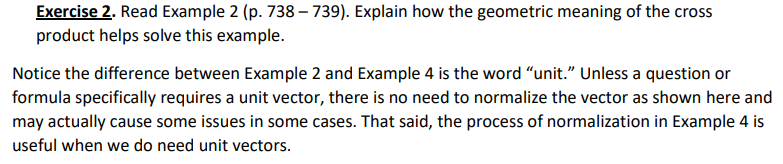
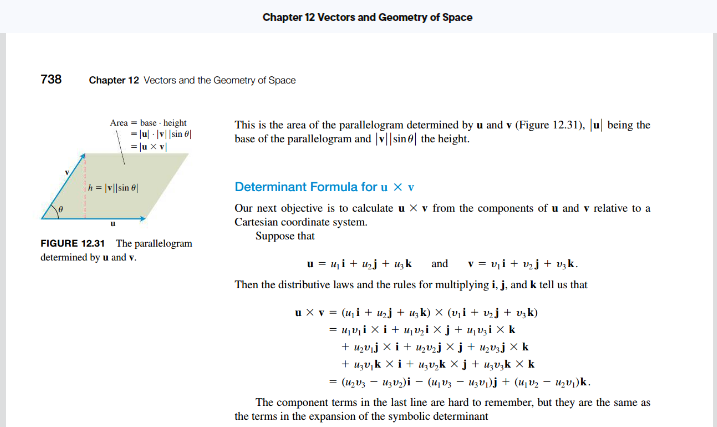
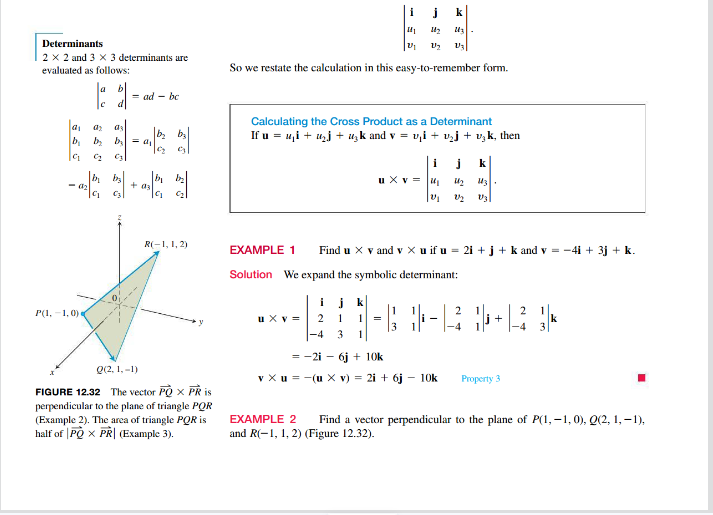
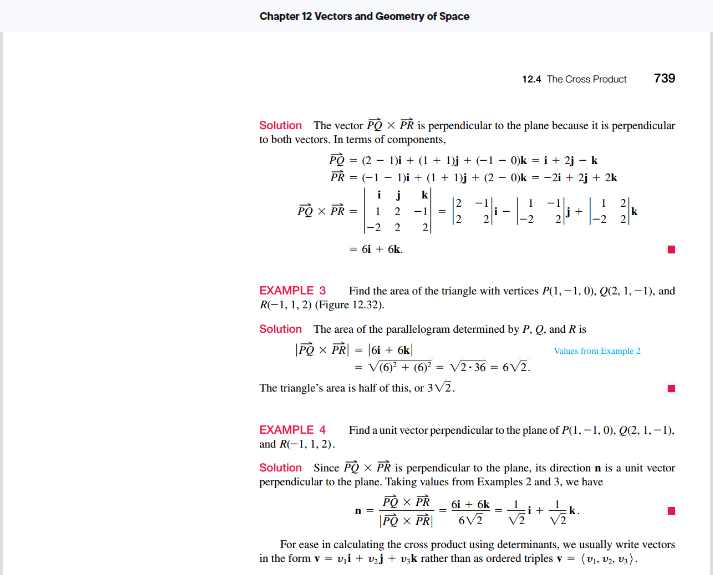
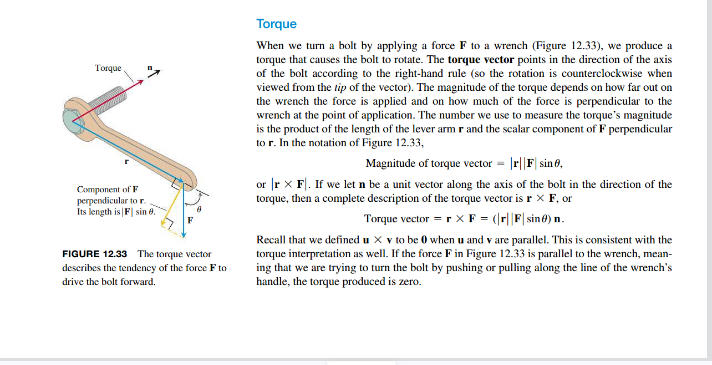
Exercise 2. Read Example 2 ip. F38 HQ}. Explain how the geometric meaning of the cross product helps solve this example. Notice the difference between Example 2 and Example 4 is the word \"unit.\" Unless a question or formula specifically requires a unit vector; there is no need to normalize the vector as shown here and may actually cause some issues in some cases. That said, the process of normalization in Example :1 is useful when we do need unit vectors. Chapter 12 Vectors and Geometry of Space 738 Chapter 12 Vectors and the Geometry of Space Area = base - height This is the area of the parallelogram determined by u and v (Figure 12.31), Ju| being the - lu| . |v| |sin el base of the parallelogram and | v| | sind| the height. =uxv ih = [visine] Determinant Formula for u X v Our next objective is to calculate u X v from the components of u and v relative to a Cartesian coordinate system. FIGURE 12.31 The parallelogram Suppose that determined by u and v. u =mitmituk and v=withjtuk. Then the distributive laws and the rules for multiplying i, j, and k tell us that oxv= (uitujtuk) X (uituj+uk) =mixi+mixj+mixk +mujxi+muj xj+ umj x k +ukxitnukxjtluk X k = (1213 - muz)i - (un; - uzu )j + (un - uzu)k. The component terms in the last line are hard to remember, but they are the same as the terms in the expansion of the symbolic determinant1 k Determinants 2 x 2 and 3 X 3 determinants ure evaluated as follows: So we restate the calculation in this easy-to-remember form. a b = ad - be Calculating the Cross Product as a Determinant If u = wit uj + uk and v = uji + uj + uk, then C2 i k I X V= - 02 C3 R( - 1, 1, 2) EXAMPLE 1 Find u X v and v X u if u = 21 + j + k and v = -41 + 3j + k. Solution We expand the symbolic determinant: P(1. - 1, 0) -4 3 = -21 - 6j + 10k 0(2. 1, -1) v Xu = -(u * v) = 21 + 6j - 10k Property 3 FIGURE 12.32 The vector PQ X PR is perpendicular to the plane of triangle POR (Example 2). The area of triangle POR is EXAMPLE 2 Find a vector perpendicular to the plane of P(1, -1, 0), 0(2, 1, -1). half of [ PQ x PR| (Example 3). and R(-1, 1, 2) (Figure 12.32).Chapter 12 Vectors and Geometry of Space 12.4 The Cross Product 739 Solution The vector PQ X PR is perpendicular to the plane because it is perpendicular to both vectors. In terms of components, PQ = (2 - Di + (1 + 1)j + (-1 - 0jk = i + 2j - k PR = (-1 - 1)i + (1 + 1)j + (2 - 0)k = -2i + 2j + 2k i j PQ X PR = 1 2 -2 2 ! - 13 21- 1-2 - 21 + 1-2 3 /k = 61 + 6k. EXAMPLE 3 Find the area of the triangle with vertices P(1, -1, 0), ((2, 1, -1), and R(-1, 1, 2) (Figure 12.32). Solution The area of the parallelogram determined by P. Q. and R is |PQ x PR) = 161 + 6k| Values from Example 2 = V(63+ (6) = V2.36 = 6V/2. The triangle's area is half of this, or 3V 2. EXAMPLE 4 Find a unit vector perpendicular to the plane of P(1. -1, 0). Q(2, 1, -1). and R(-1. 1. 2). Solution Since PQ X PR is perpendicular to the plane, its direction n is a unit vector perpendicular to the plane. Taking values from Examples 2 and 3, we have PQ X PR _ 61 + 6k |PQ X PRI 6V2 VI For ease in calculating the cross product using determinants, we usually write vectors in the form v = uji + wj + v;k rather than as ordered triples v = (v1, 12, 1).Torque When we turn a bolt by applying a force F to a wrench (Figure 12.33), we produce a torque that causes the bolt to rotate. The torque vector points in the direction of the axis Torque of the bolt according to the right-hand rule (so the rotation is counterclockwise when viewed from the rip of the vector). The magnitude of the torque depends on how far out on the wrench the force is applied and on how much of the force is perpendicular to the wrench at the point of application. The number we use to measure the torque's magnitude is the product of the length of the lever arm r and the scalar component of F perpendicular to r. In the notation of Figure 12.33, Magnitude of torque vector = r| |F| sine, Component of F or r X F . If we let n be a unit vector along the axis of the bolt in the direction of the Perpendicular to Is ... torque, then a complete description of the torque vector is r X F, or Its length is | F| sin A. F Torque vector = r X F = (r| |F| sing) n. Recall that we defined u X v to be 0 when u and v are parallel. This is consistent with the FIGURE 12.33 The torque vector torque interpretation as well. If the force F in Figure 12.33 is parallel to the wrench, mean- describes the tendency of the force F to ing that we are trying to turn the bolt by pushing or pulling along the line of the wrench's drive the bolt forward. handle, the torque produced is zero
Step by Step Solution
There are 3 Steps involved in it
1 Expert Approved Answer
Step: 1 Unlock
Question Has Been Solved by an Expert!
Get step-by-step solutions from verified subject matter experts
Step: 2 Unlock
Step: 3 Unlock
Students Have Also Explored These Related Mathematics Questions!









 Study Help