







Question: calculus 8. Given f(x) = sin (4x + ), find f' (). a) 0 b) 4 c) -4 d) 1 9. The derivative of
calculus
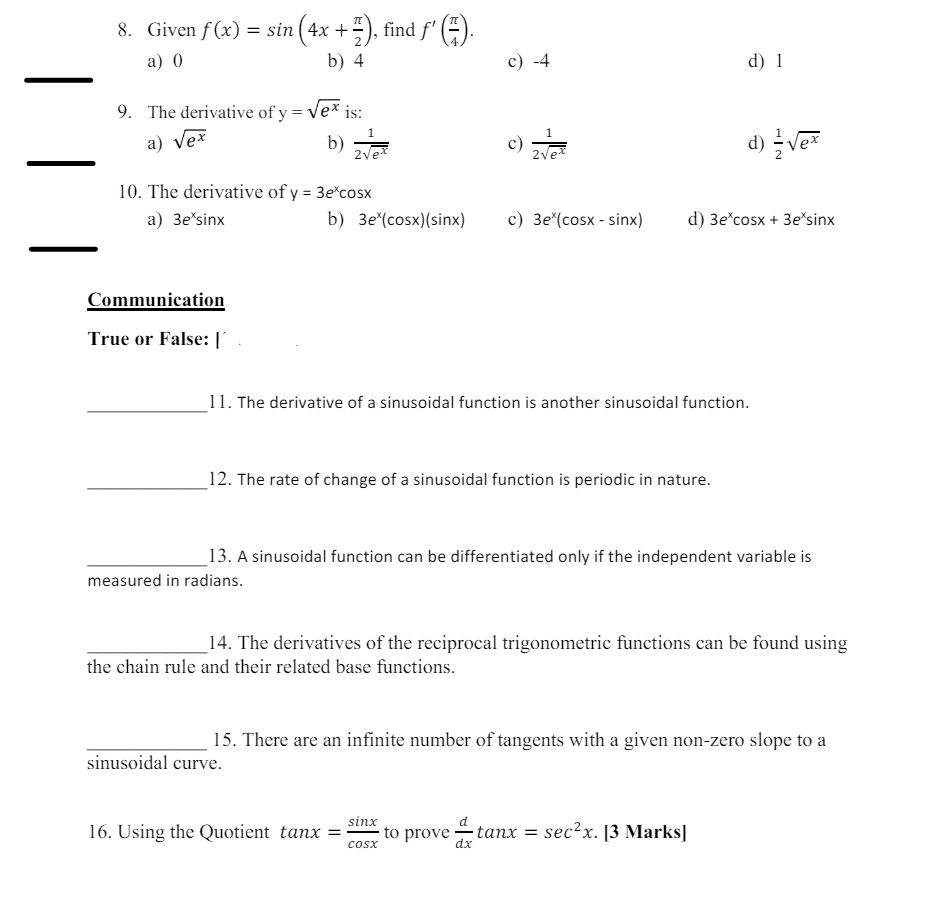
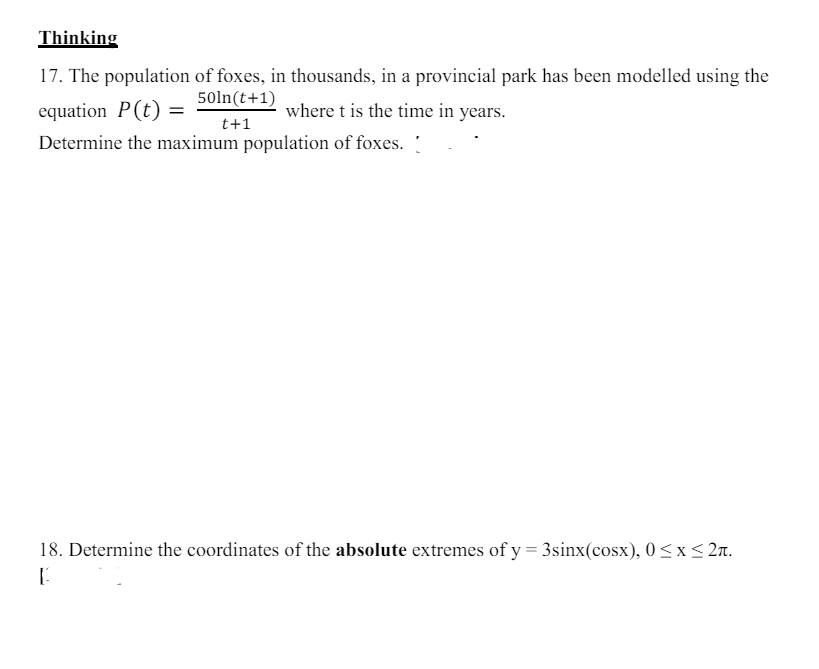
8. Given f(x) = sin (4x + " ), find f' ("). a) 0 b) 4 c) -4 d) 1 9. The derivative of y = vex is: a) vex b) zvet C) Net d) = Vex 10. The derivative of y = 3e*cosx a) 3e"sinx b) 3e*(cosx)(sinx) c) 3e*(cosx - sinx) d) 3e*cosx + 3e*sinx Communication True or False: [' 1 1. The derivative of a sinusoidal function is another sinusoidal function. 12. The rate of change of a sinusoidal function is periodic in nature. 13. A sinusoidal function can be differentiated only if the independent variable is measured in radians. 14. The derivatives of the reciprocal trigonometric functions can be found using the chain rule and their related base functions. 15. There are an infinite number of tangents with a given non-zero slope to a sinusoidal curve. 16. Using the Quotient tanx = = to prove - tanx = sec2x. [3 Marks]Thinkine el 17. The population of foxes, in thousands, in a provincial park has been modelled using the 50In(t+1) equation P(t) = where t is the time in years. Determine the maximum population of foxes. ' 18. Determine the coordinates of the absolute extremes of y = 3sinx(cosx), 0
Step by Step Solution
There are 3 Steps involved in it

Get step-by-step solutions from verified subject matter experts
 Study Help