







Question: Calculus problem 1. For each of the sequences determine whether it is bounded or unbouned, monotonic or not. Please explain your reasoning. 2. Let e
Calculus problem
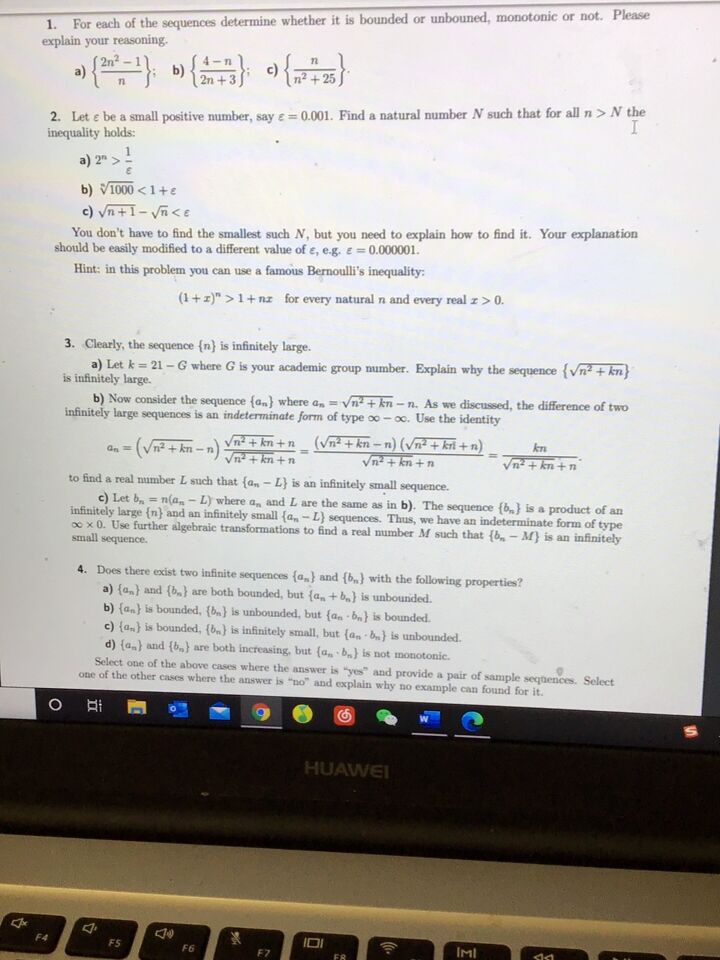
1. For each of the sequences determine whether it is bounded or unbouned, monotonic or not. Please explain your reasoning. 2. Let e be a small positive number, say = = 0.001. Find a natural number N such that for all n > > the inequality holds: a) 2" > = b) 1000 1 + nr for every natural n and every real z > 0. 3. Clearly, the sequence {n) is infinitely large. a) Let k = 21 - G where G is your academic group number. Explain why the sequence { vn? + kn} is infinitely large. b) Now consider the sequence {on} where an = vn + kn - n. As we discussed, the difference of two infinitely large sequences is an indeterminate form of type co - co. Use the identity an = ( Vn? +kn - n) Vnitknitn (vn + kn - m) (vn + kri+ n) kn vn- +kn+n Vn + kn + n Vn- + kn + n to find a real number L such that {an - L} is an infinitely small sequence. c) Let b. = n(a,, - L) where a, and [ are the same as in b). The sequence {6,} is a product of an infinitely large {n) and an infinitely small {am - L) sequences. Thus, we have an indeterminate form of type co x 0. Use further algebraic transformations to find a real munber M such that {6,, - M) is an infinitely small sequence. 4. Does there exist two infinite sequences {a, } and {b,} with the following properties? a) (an} and {b.} are both bounded, but {a, + b.} is unbounded. b) fan} is bounded, {ba } is unbounded, but fan - b,} is bounded. c) (an} is bounded, (6.} is infinitely small, but {an . b. } is unbounded. d) (on) and (6.} are both increasing, but {a, b. ) is not monotonic. Select one of the above cases where the answer is "yes" and provide a pair of sample sequences. Select one of the other cases where the answer is "no" and explain why no example can found for it. O 9 6 w S HUAWEI F4 F5 FG IMI
Step by Step Solution
There are 3 Steps involved in it

Get step-by-step solutions from verified subject matter experts
 Study Help