



Question: Can anyone from chegg please help me solve this I am stuck I did not know how to do it please save me Activity Outcomes
 Can anyone from chegg please help me solve this I am stuck I did not know how to do it please save me
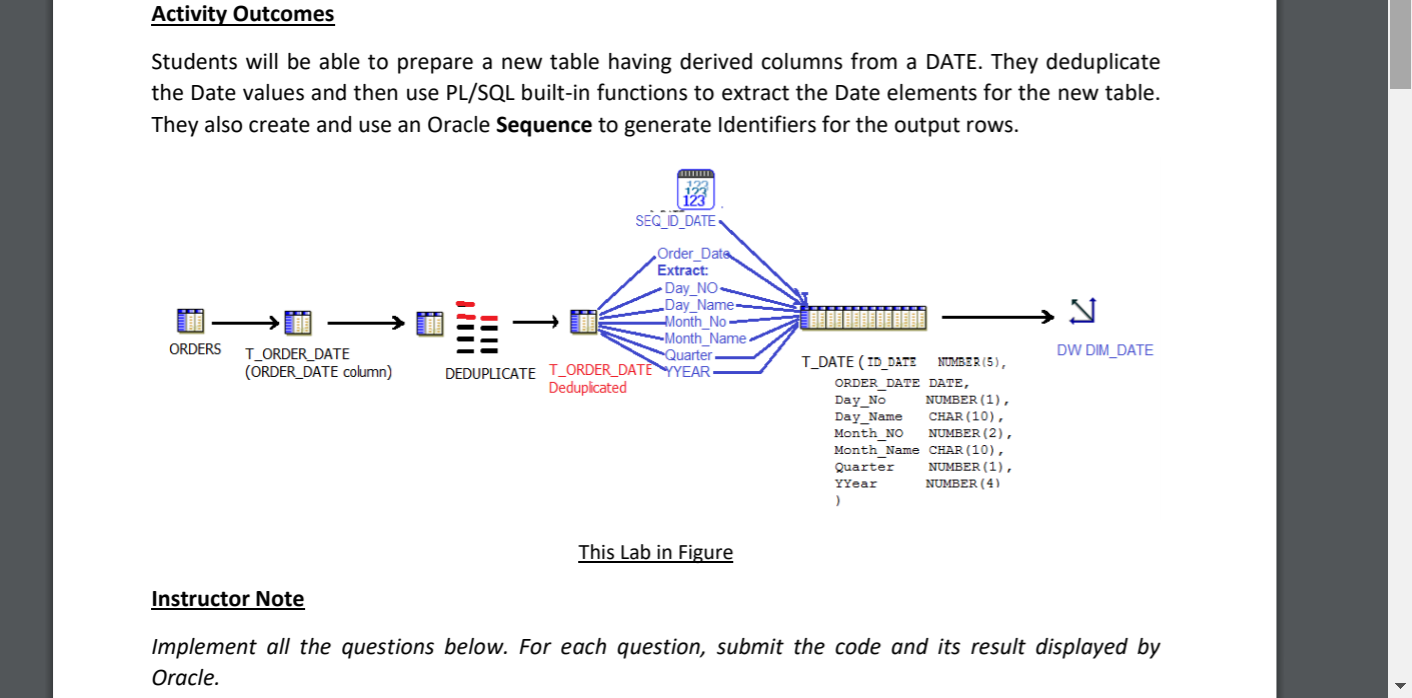
Activity Outcomes Students will be able to prepare a new table having derived columns from a DATE. They deduplicate the Date values and then use PL/SQL built-in functions to extract the Date elements for the new table. They also create and use an Oracle Sequence to generate Identifiers for the output rows. SEG D DATE Order_Dats Extract: Day_NO Day Name Month_No -Month Name Quarter DEDUPLICATE T_ORDER_DAT. YYEAR Deduplicated ORDERS DW DIM_DATE T_ORDER_DATE (ORDER_DATE column) T_DATE (ID_DATE NUMBER (5), ORDER DATE DATE, Day_No NUMBER (1) Day Name CHAR(10), Month_NO NUMBER (2) Month_Name CHAR(10), Quarter NUMBER (1) YYear NUMBER (4) This Lab in Figure Instructor Note Implement all the questions below. For each question, submit the code and its result displayed by Oracle. Activity Outcomes Students will be able to prepare a new table having derived columns from a DATE. They deduplicate the Date values and then use PL/SQL built-in functions to extract the Date elements for the new table. They also create and use an Oracle Sequence to generate Identifiers for the output rows. SEG D DATE Order_Dats Extract: Day_NO Day Name Month_No -Month Name Quarter DEDUPLICATE T_ORDER_DAT. YYEAR Deduplicated ORDERS DW DIM_DATE T_ORDER_DATE (ORDER_DATE column) T_DATE (ID_DATE NUMBER (5), ORDER DATE DATE, Day_No NUMBER (1) Day Name CHAR(10), Month_NO NUMBER (2) Month_Name CHAR(10), Quarter NUMBER (1) YYear NUMBER (4) This Lab in Figure Instructor Note Implement all the questions below. For each question, submit the code and its result displayed by Oracle
Step by Step Solution
There are 3 Steps involved in it

Get step-by-step solutions from verified subject matter experts