







Question: Can anyone help me with this problem 11. For the bonus question I decided to share with you something challenging and fascinating at the same
Can anyone help me with this problem
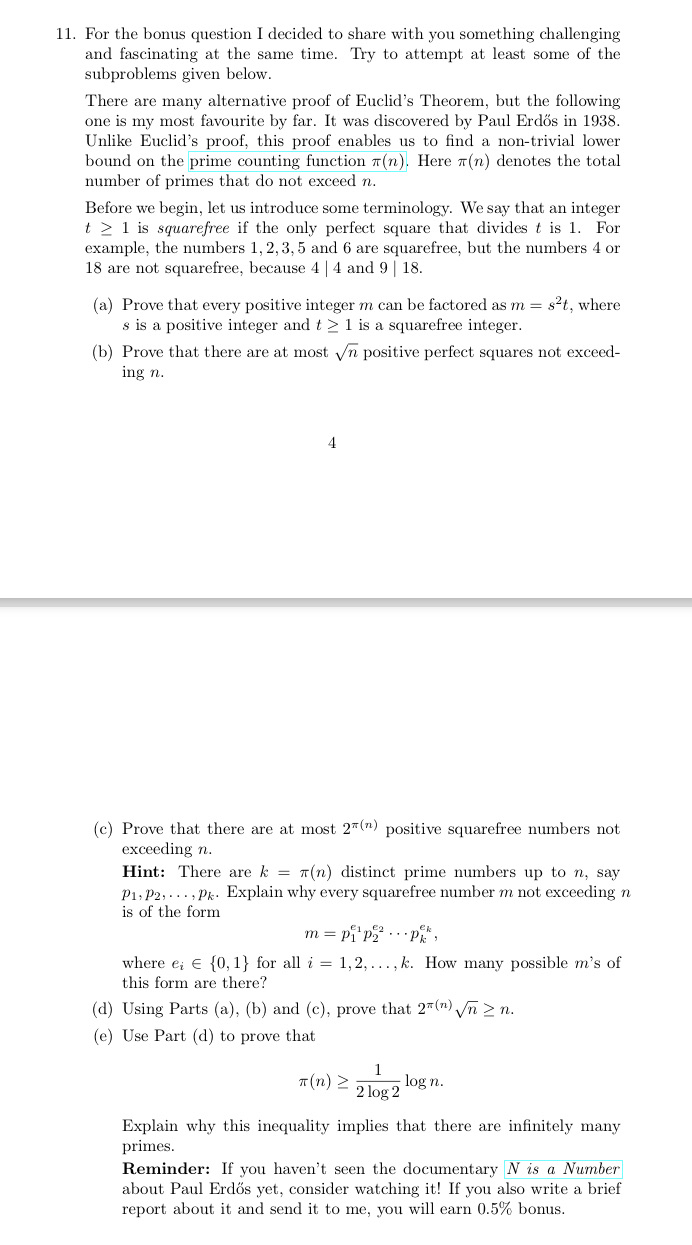
11. For the bonus question I decided to share with you something challenging and fascinating at the same time. Try to attempt at least some of the subproblems given below. There are many alternative proof of Euclid's Theorem, but the following one is my most favourite by far. It was discovered by Paul Erdiis in 1938. Unlike Euclid's proof, this proof enables us to nd a nontrivial lower bound on the prime counting function iii-(n). Here iii-(n) denotes the total number of primes that do not exceed 1:. Before we begin, let us introduce some terminology. We say that an integer t 2 1 is erg-carefree if the only perfect square that divides t is 1. For example, the numbers 1, 2, 3, 5 and 6 are squarefree, but the numbers 4 or 18 are not squarefree, because 4 | 4 and El I 18. (a) Prove that every positive integer in can be factored as m = sat, where s is a positive integer and t 2 1 is a squarefree integer. (b) Prove that there are at most positive perfect squares not exceed ing 1:. (c) Prove that there are at most 2"\":| positive squarefree numbers not exceeding 11. Hint: There are k = n) distinct prime numbers up to n, say :91, p2, . . . , pk. Explain why every squarefree number m not exceeding 11. is of the form _ 2122 E}: m-P1P2"'Psa where e,- E {9,1} for all i = 1,2,.. .,k.. How many possible m's of this form are there? (d) Using Parts (a), (b) and (c), prove that TWHXE 2 n. (e) Use Part (d) to prove that 1 21og2 11-01} :3 log n. Explain why this inequality implies that there are innitely many primes. Reminder: If you haven't seen the documentary N is a Number about Paul Erdos yet, consider watching it! If you also write a brief report about it and send it to me, you will earn 0.5% bonus
Step by Step Solution
There are 3 Steps involved in it

Get step-by-step solutions from verified subject matter experts
 Study Help