







Question: Can anyone help me with this question 7. For nonnegative integers a and 5, let max{oz, 5} and min{o, )3} denote the largest and the
Can anyone help me with this question
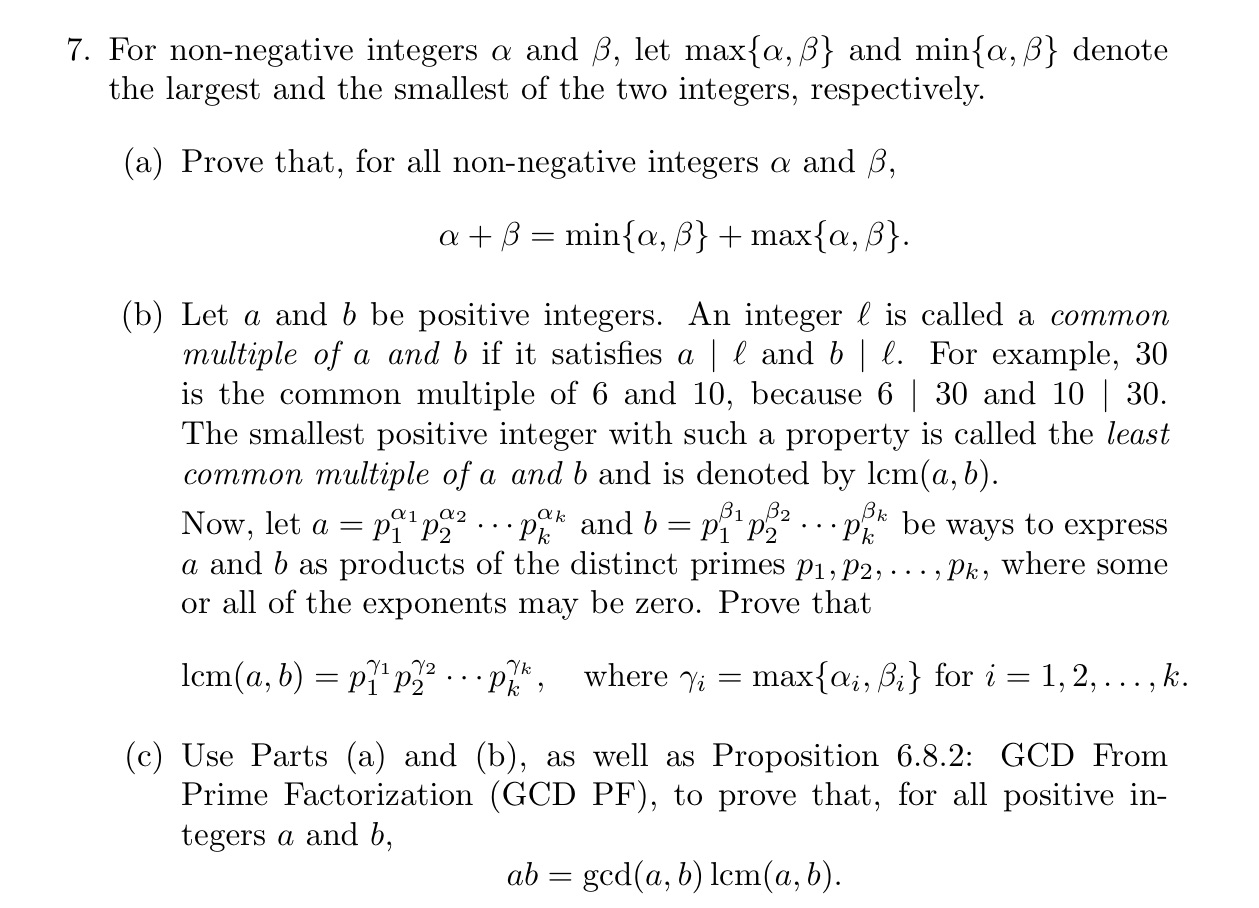
7. For nonnegative integers a and 5, let max{oz, 5} and min{o, )3} denote the largest and the smallest of the two integers, respectively. (a) (b) Prove that, for all non-negative integers a and 3: a + B : min{o:, )3} + max{os,}. Let 0: and b be positive integers. An integer E is called a common multiple of o; and b if it satises a | 3 and b | E. For example, 30 is the common multiple of 6 and 10, because 6 | 30 and 10 | 30. The smallest positive integer with such a property is called the least common multiple of a and b and is denoted by lcm(o, 6). Now, let a : ping)? up?\" and b : 13111352 - - 49?\" be ways to express a and b as products of the distinct primes pl, 102, . . . , Pk, where some or all of the exponents may be zero. Prove that lcm(o,b) : p1pg2---pgk, Where 7,; : max{a,-,;6',} for 72 : 1,2,. . . ,k. Use Parts (a) and (b), as well as Proposition 6.8.2: GCD From Prime Factorization (GCD PF), to prove that, for all positive in- tegers o and b, ob : gcd(o, b) lcm(o, b)
Step by Step Solution
There are 3 Steps involved in it

Get step-by-step solutions from verified subject matter experts
 Study Help